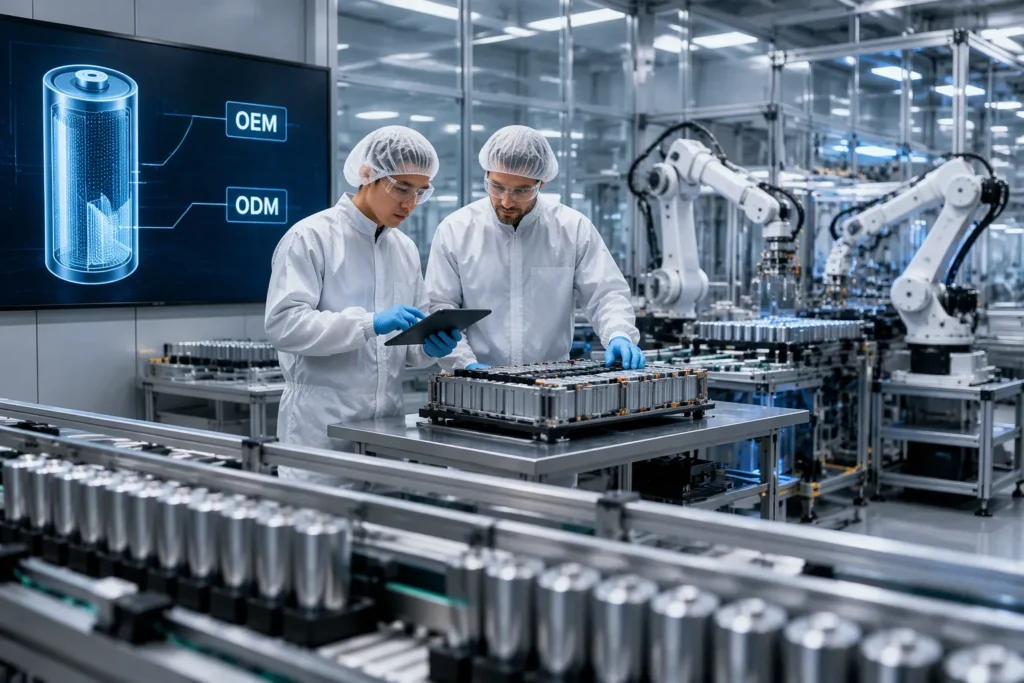
OEM and ODM are two distinct manufacturing models in sodium battery production. The choice affects design control, cost, speed to market, and branding. In OEM, the brand owner provides the design and specifications, and the manufacturer produces the battery. In ODM, the manufacturer designs the battery based on the customer’s requirements and parameters, then produces it. The customer provides only the idea brief and required framework. This article defines each model, compares them, and guides readers on selecting a reliable partner. It explains who owns the design, who produces the battery, and how each model suits different business needs. Readers will learn to evaluate partners for their OEM ODM sodium battery projects.
Key Takeaways
OEM means you own the battery design. The factory builds it for you.
ODM means the factory designs and builds the battery. You provide the idea.
Your choice affects design control, cost, and speed to market.
Check a partner’s experience, certifications, and quality systems.
OEM gives you more control. ODM gets you to market faster.
OEM in Sodium Battery Manufacturing
What OEM Means
In the OEM model, the brand owner supplies the complete battery design and detailed specifications. The manufacturer then produces the cells and packs exactly to that blueprint. This arrangement places full design ownership and intellectual property rights with the brand owner. The factory acts as a production partner rather than a design authority.
This structure gives the brand owner tight control over chemistry, form factor, voltage platform and safety features. The manufacturer contributes process capability, equipment and quality systems. Sodium-ion production can reuse much of the existing lithium-ion equipment and process flow, so an OEM partner with proven cell-making experience can often adapt lines with targeted chemistry changes.
OEM teams seek sodium-ion packs to differentiate their e-bike and e-scooter products rather than copying lithium stacks. Packs are engineered for “OEM-ready integration” as one system covering pack, cells and chemistry. Compliance planning for UN38.3 transport and CE/UKCA pack compliance is built in to support OEM customers who need credible transport and market-entry readiness.
Major Indian OEMs and cell manufacturers, some of whom are part of the PLI (Production Linked Incentive) scheme, are actively monitoring their supply chains. By strategically partnering with mining and refining companies, they aim to secure the necessary raw materials for cell production, similar to how Tesla collaborated with Panasonic to control the sourcing of graphite, cobalt, and nickel for their batteries.
When to Choose OEM
OEM suits companies that already hold a validated battery design and want to focus on branding, distribution and customer relationships. These firms treat the battery as a core asset and prefer to keep engineering in-house. They gain consistent output from a specialist factory without building their own plant.
This path also fits businesses that need custom packs matched to specific voltage, mount and controller compatibility. A capable partner can design custom packs or integrate cells into existing architectures. OEMs appear alongside fleet operators and distributors as target customers, and warranty and end-of-life support structures depend on whether the project serves riders directly, a fleet, or an OEM channel.
The wider industry must scale production and ensure accessibility for OEMs to integrate sodium-ion batteries into their products. That remains a key challenge for replacing lithium-ion. A brand owner with a strong design team and clear market entry plan will find OEM the more natural route.
ODM in Sodium Battery Manufacturing
What ODM Means
In the ODM model, the manufacturer designs and produces the sodium battery based on the customer’s requirements. The customer supplies a brief, performance targets and a required framework. The factory’s engineering team then handles cell chemistry, pack layout, battery management system logic and safety design. This arrangement differs from OEM, where the brand owner brings a finished blueprint to the production line.
The manufacturer typically retains design ownership unless both parties agree otherwise. A customer who wants exclusive rights to the design must negotiate that transfer in the contract. Otherwise, the factory may reuse the same platform for other clients. Buyers should clarify this point early, because it shapes long-term product differentiation.
Research and development in ODM centres on performance tuning and safety. Engineers adjust electrode formulations, electrolyte composition and thermal behaviour to meet the customer’s targets. They also pursue certifications such as UL for the finished pack. These credentials open doors to regulated markets and give the customer confidence in the product.
When to Choose ODM
ODM suits companies that lack in-house battery engineering or want to move quickly. A startup with a strong brand concept but no cell expertise can hand the technical work to a capable factory. The manufacturer absorbs the design risk and delivers a production-ready pack. This path shortens development cycles and reduces the need for specialist staff.
This model also fits buyers who need a proven platform with modest adjustments. They may request a different voltage, capacity or enclosure to match their application. The factory applies its existing knowledge rather than starting from scratch. Costs stay lower and lead times shrink, because the core design already exists.
A buyer with limited resources and a tight launch schedule will often find ODM the practical route. The trade-off is less control over the underlying design and possible limits on exclusivity. Companies that treat the battery as a differentiator should weigh that loss carefully before committing.
Comparing OEM ODM Sodium Battery Models
Design Ownership and IP
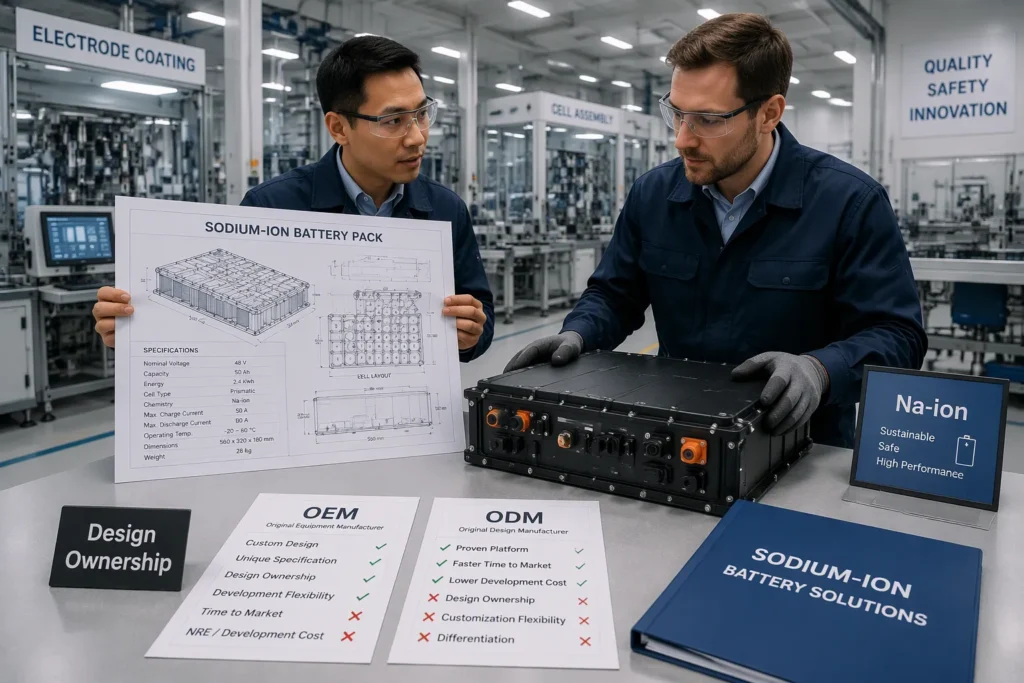
Design responsibility sits at the heart of the difference between these two models. In OEM, the brand owner creates the battery design and holds the intellectual property. The factory builds to that blueprint and cannot sell the same design to another client. In ODM, the manufacturer develops the design and usually keeps ownership. The customer buys a product built on the factory’s platform. Exclusive rights require a separate agreement and often a higher price.
This split shapes long-term strategy. A brand owner with patented cell chemistry or a unique pack architecture will guard that asset through OEM. A company that treats the battery as a commodity input can accept shared ownership under ODM. The choice affects product differentiation, because a rival can buy the same ODM platform. Buyers who need a unique selling point should secure exclusivity in writing.
Sodium-ion production reuses much of the same equipment and process flow as lithium-ion. Manufacturers adapt electrode formulations, electrolyte composition and formation protocols to suit sodium chemistry. This shared base means a factory with proven lithium experience can often shift to sodium with targeted changes. The design ownership question remains separate from this technical overlap.
Customisation and Production Scope
Customisation needs differ sharply between the two models. An OEM buyer specifies voltage, capacity, cell format, enclosure dimensions and battery management system logic. The factory delivers to that specification. An ODM buyer provides performance targets and a required framework, then accepts the manufacturer’s engineering choices. The factory may offer a standard platform with minor adjustments for voltage or capacity.
Cost and time-to-market follow from these differences. OEM projects carry higher engineering costs for the brand owner, because that firm funds the design work. Lead times can stretch when the design is new and untested. ODM projects move faster and cost less, because the core design already exists and the factory absorbs development risk. A startup with a tight launch schedule often finds ODM the practical route.
The table below summarises the main contrasts for an OEM ODM sodium battery project.
Factor | OEM | ODM |
|---|---|---|
Design owner | Brand owner | Manufacturer |
IP ownership | Brand owner | Manufacturer, unless transferred |
Customisation level | Full, to buyer’s blueprint | Moderate, to buyer’s brief |
Engineering cost | Borne by brand owner | Absorbed by manufacturer |
Time to market | Longer for new designs | Shorter, proven platform |
Exclusivity | Inherent | Requires negotiation |
A buyer with strong in-house engineering and a differentiated product will lean toward OEM. A buyer with limited resources and a fast launch goal will lean toward ODM. Both paths can deliver a compliant sodium battery pack. The right choice depends on where the buyer wants to invest control and capital.
Selecting a Reliable OEM or ODM Partner
Experience and Technical Expertise
Proven experience in sodium battery production separates capable partners from hopeful ones. Sodium-ion chemistry behaves differently from lithium-ion, so a factory must understand electrode formulations, electrolyte composition and formation protocols. A partner with a track record in cell manufacturing can adapt existing lines with targeted changes. Buyers should ask for evidence of past sodium projects, not just lithium work.
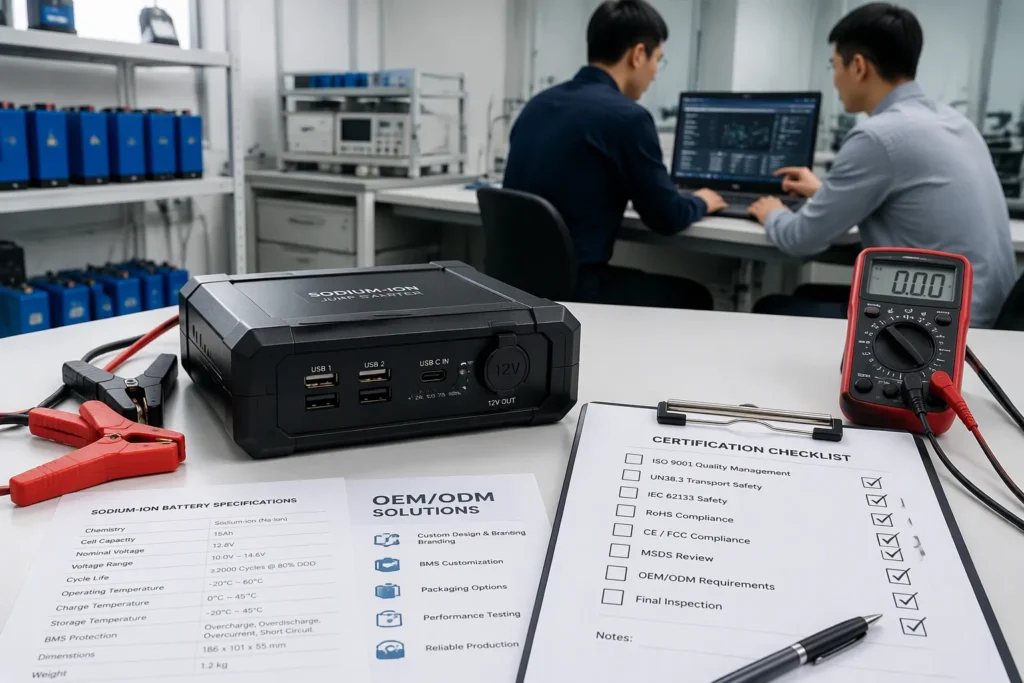
Technical expertise shows up in the details. CARKU, a Shenzhen-based manufacturer, demonstrates this through its own battery management and control systems. Its sodium-ion jump starter (JS-617N) features ten layers of protection against short circuits, overcurrent, overheating and reversed clamp connections. The unit weighs 3 kg, measures 277 x 126 x 156 mm, and houses a 38,400 mAh battery with USB and 12V outputs plus a 65W USB-C input. The company holds 852 global patents and runs R&D centres in Huizhou and Indonesia, with two plants covering over 110,000 m² and more than 1,000 employees.
That transparency gap matters. CARKU has not disclosed its cell supplier, detailed cathode or anode chemistry, cycle-life data, pricing, or a European commercial availability date. Buyers should probe these points when evaluating any partner. A factory that offers both OEM and ODM services as a one-stop power solution can handle either model, but the buyer must still verify the depth of its sodium-specific knowledge.
Certifications and Quality Assurance
Certifications prove that a manufacturer meets recognised safety and quality benchmarks. Sodium-ion batteries face new regulatory scrutiny and evolving safety standards. Safety certifications and third-party testing are crucial for meeting European regulatory standards. Extended Producer Responsibility regulations shift responsibility onto battery producers for safe collection, recycling and disposal. European rules also require proper battery labelling and traceability throughout the lifecycle.
Purpose / Scope | |
|---|---|
UL | Product safety testing and certification for batteries |
IEC | International product safety certification for batteries |
UN38.3 | Testing and certification for safe transport/shipping of batteries |
IATF 16949 | Automotive-grade quality management system certification |
ISO 14001 | Environmental management system certification |
OSHA compliance | Minimum worker safety requirements for battery production facilities |
Key global regulations include UNECE R100 and UL 2580. Testing methods cover thermal, mechanical and electrical tests. Collaboration with third-party testing bodies and certification agencies is required for compliance.
Quality assurance goes beyond certificates. A reliable partner implements rigorous process controls for batch-to-batch consistency. It maintains ultra-low moisture environments to prevent degradation. It invests in automation to reduce human error and variability. It establishes comprehensive quality management systems with full traceability. It develops rapid problem identification and correction systems. It conducts independent third-party testing to validate performance and build customer confidence.
A buyer evaluating an OEM ODM sodium battery partner should check these processes directly. Site audits, sample testing and reference checks reveal more than a certificate alone. The right partner combines documented credentials with a working quality culture.
Practical Considerations for Buyers
Cost, Lead Time, and Scalability
Cost structures differ between the two models. An OEM buyer funds the design work, tooling and testing. That upfront investment raises the total project cost. An ODM buyer pays for a finished platform and avoids most engineering expenses. The manufacturer spreads development costs across multiple clients, so the unit price stays lower.
Lead time follows a similar pattern. OEM projects with new designs take longer to validate and certify. ODM projects move faster because the core platform already exists. A buyer who needs a product on shelves within a tight window will find ODM more practical.
Scalability depends on the partner’s production capacity. A factory with proven cell-making lines can ramp output for either model. Buyers should confirm the partner can grow with demand without sacrificing batch consistency.
Balancing Control and Convenience
The final decision rests on one question. Does the customer supply a complete design, or does the manufacturer develop it? An OEM buyer brings a blueprint and keeps tight control over chemistry, form factor and safety features. An ODM buyer brings a brief and accepts the factory’s engineering choices.
Control carries a price. OEM buyers gain exclusivity and product differentiation, but they carry design risk and higher costs. ODM buyers gain speed and lower costs, but they may share the same platform with competitors. Exclusive rights require a separate agreement and often a higher price.
A buyer with strong in-house engineering and a differentiated product will lean toward OEM. A buyer with limited resources and a fast launch goal will lean toward ODM. Both paths can deliver a compliant sodium battery pack. The right choice depends on where the buyer wants to invest control and capital.
The core distinction is simple. In OEM, the brand owner owns the design and the manufacturer builds it. In ODM, the manufacturer designs and builds the battery from the customer’s brief. The right choice depends on design capabilities, resources, and time-to-market goals. A buyer with strong engineering and a differentiated product leans toward OEM. A buyer with limited resources and a fast launch leans toward ODM. Readers should evaluate potential partners against the criteria discussed: experience, certifications, quality assurance, cost, lead time, and scalability. Request quotes from several OEM ODM sodium battery suppliers and schedule consultations to compare their capabilities before committing.
FAQ
Who owns the battery design in each model?
In OEM, the brand owner creates the design and holds the intellectual property. In ODM, the manufacturer develops the design and usually keeps ownership. A buyer who wants exclusive rights under ODM must negotiate that transfer in the contract.
Can a factory reuse lithium-ion lines for sodium cells?
Yes. Sodium-ion production reuses much of the same equipment and process flow as lithium-ion. Manufacturers adapt electrode formulations, electrolyte composition and formation protocols to suit sodium chemistry. A partner with proven cell-making experience can often shift lines with targeted changes.
Which certifications should a buyer verify?
Buyers should check UL and IEC for product safety, UN38.3 for transport, IATF 16949 for automotive quality, and ISO 14001 for environmental management. UNECE R100 and UL 2580 also apply to key global markets. Site audits and sample testing reveal more than a certificate alone.
How does CARKU demonstrate sodium battery expertise?
CARKU builds its own battery management and control systems. Its sodium-ion jump starter (JS-617N) carries ten layers of protection and a 38,400 mAh battery. The company holds 852 global patents and runs two plants covering over 110,000 m².
Which model suits a fast product launch?
ODM suits a fast launch. The manufacturer absorbs design risk and delivers a production-ready pack from an existing platform. Costs stay lower and lead times shrink. OEM takes longer for new designs, because the brand owner funds engineering, tooling and testing.