
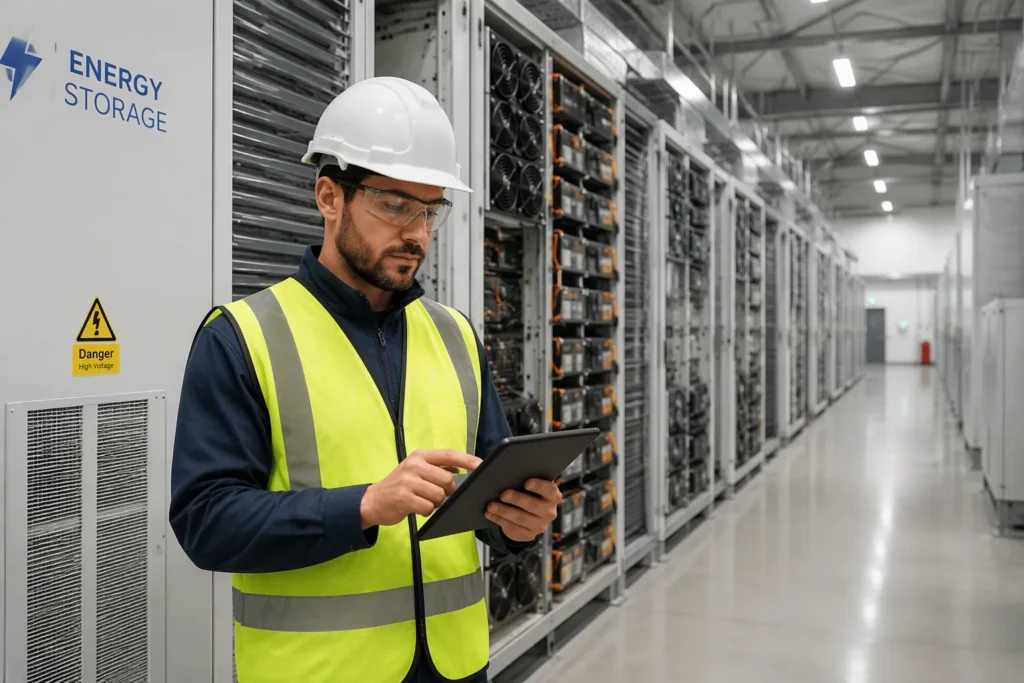
Two flagship projects answer the question directly. The Datang Hubei sodium-ion station, a 100,000 kWh deployment, counts as a success story because it moved sodium-ion battery for grid scale energy storage from demonstration into utility-scale operation. The Taiyuan, Shanxi Province system earns the same label: it proved sodium-ion batteries can shift renewable power and hold voltage on a live network.
These installations matter. They show sodium-ion has left the laboratory and now serves real grids. The case studies ahead reveal how scale, performance, and cost determine viability for commercial energy storage buyers.
Key Takeaways
Sodium-ion batteries now power real grids in China, proving they work at large scale.
These batteries perform well in extreme cold, keeping 85% efficiency at -20°C.
Sodium-ion batteries are safer and cheaper, with costs expected to match lithium by 2027.
They work best where space is not tight, like solar farms and cold regions.
Sodium-ion batteries complement lithium, not replace it, for energy storage.
Real-World Sodium-Ion Success Stories
From Pilot to Grid Scale
Documented projects carry more weight than laboratory data for grid storage decisions. A lab cell proves a chemistry works once. A deployed system proves it works across seasons, tariffs, and maintenance crews. Buyers of sodium-ion battery for grid scale energy storage need the second kind of proof.
The record now spans both stages. Early trials moved small modules through real charge and discharge cycles. Utility-scale stations followed, and they now deliver power to live networks. This progression from pilot to grid scale gives investors a track record to examine.
What Counts as a Success
Success rests on verifiable criteria, not press releases. Scale achieved, performance demonstrated, application fit, cost trajectory, and regulatory compliance form the test. The LiNa Energy and ion Ventures trial illustrates the pattern. That platform reached roughly 50 kWh, charged and discharged as expected, and an independent E4Tech scoping study rated it superior to existing lithium-ion storage in distribution, generation-level, and behind-the-meter applications.
Performance claims need context. Sodium-ion cells have lower energy density than LFP, so space requirements can rise. Sodium-ion technology offsets that trade-off where fire risk tolerance is very low. Solid-state designs face their own hurdle: efficient energy transfer depends on high ionic conductivity in the electrolyte.
“Whilst there isn’t any one battery technology to rule them all, sodium-ion batteries have so much potential to be cheaper and more sustainable […]” — Dr James Steele
That framing keeps expectations honest. Sodium-ion batteries will not win every site. They win where safety, cost, and temperature range matter more than footprint. The case studies that follow apply these criteria to real deployments.
China’s Flagship Projects
Location, Scale, and Application
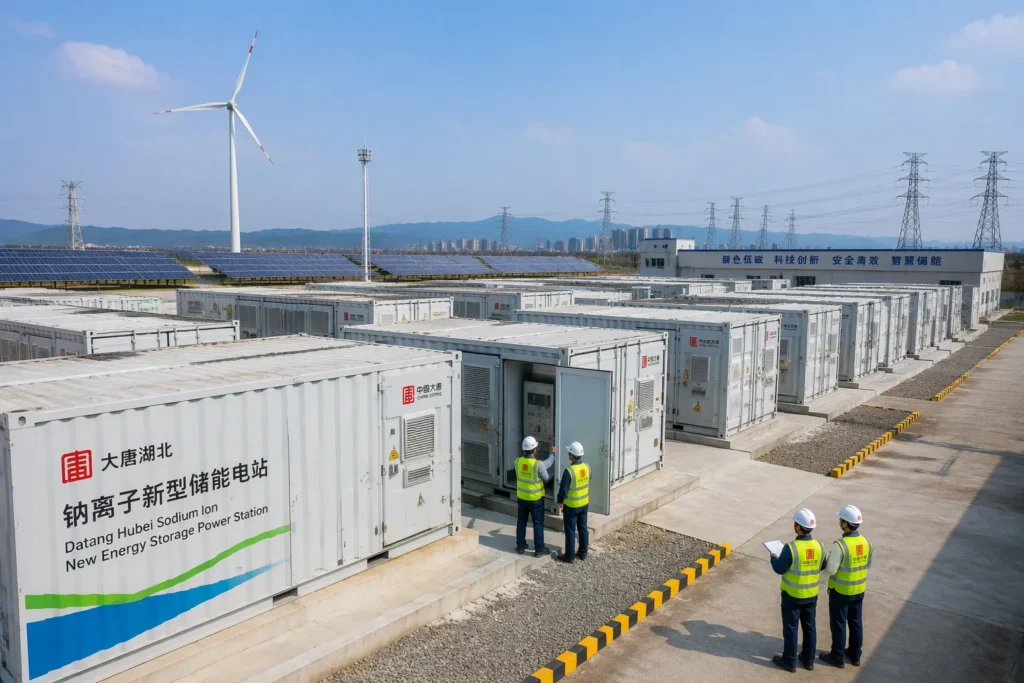
China hosts the deepest record of deployed sodium-ion capacity. The world’s first grid-scale sodium-ion energy storage system entered operation in Taiyuan, Shanxi Province. The Institute of Physics, Chinese Academy of Sciences, developed the technology across ten years and integrated the system with municipal power, solar, and charging facilities to form a micro-grid. That institute had already demonstrated a 100 kWh unit in 2019, so Taiyuan marks a visible step from small demonstration to full deployment.
The Datang Hubei Sodium Ion New Energy Storage Power Station (Phase 1) shows the commercial scale now reached:
Metric | Reported Value |
|---|---|
Location | Hubei Province, China |
Capacity | 100,000 kWh (enough to power 12,000 homes on a single charge) |
Site area | 30 acres (~15 football pitches) |
Charge/discharge efficiency at −20 °C | 85% |
Cycle life at 60 °C | 1,500 charge/discharge cycles |
These sites serve three duties. They shift renewable electricity from sunny or windy hours to peak demand. They shave peaks for industrial loads. They hold voltage and frequency steady on local networks. Each duty rewards long duration and steady output more than a small footprint.
Performance and Lessons Learned
Cold-weather data stands out. The Hubei station reports 85% charge/discharge efficiency at −20 °C, a figure lithium systems rarely match without heating. Reporters also note strong safety, puncture resistance, and impact resistance. Cycle life at 60 °C reaches 1,500 cycles, which suits hot climates where cooling costs erode returns.
Scale-up has not run smoothly. Kingshine cancelled a planned 6 GWh sodium-ion battery plant in Jiangxi in February 2024, an early sign that demand uncertainty and financing challenges can stall ambitions. Cost remains the sharpest hurdle. Chinese sodium-ion cells cost about $125/kWh against roughly $49/kWh for LFP, and analysts project parity near 2026–2027 at cell level.
Manufacturing consistency follows from container density. BYD’s MC Cube-SIB ESS, launched in November 2024, delivers 2.3 MWh per 20ft container versus about 5 MWh for lithium equivalents. Stationary projects absorb that trade-off through site layout, yet it raises balance-of-system cost per megawatt-hour.
China treats sodium-ion batteries as one hedge among several. The national portfolio pairs them with flow batteries for longer duration, aiming to reduce exposure to lithium prices. Industry observers call sodium-ion a complement to lithium rather than a replacement. CATL’s Robin Zeng expects sodium-ion battery cells to take a large share of the LFP market eventually, while other analysts stay cautious on adoption speed. The lesson for buyers is plain: sodium-ion batteries work at utility scale today, and manufacturing maturity, not chemistry, sets the pace.
Western Pilots and Sodium-Ion Battery Deployments
Project Profiles and Outcomes
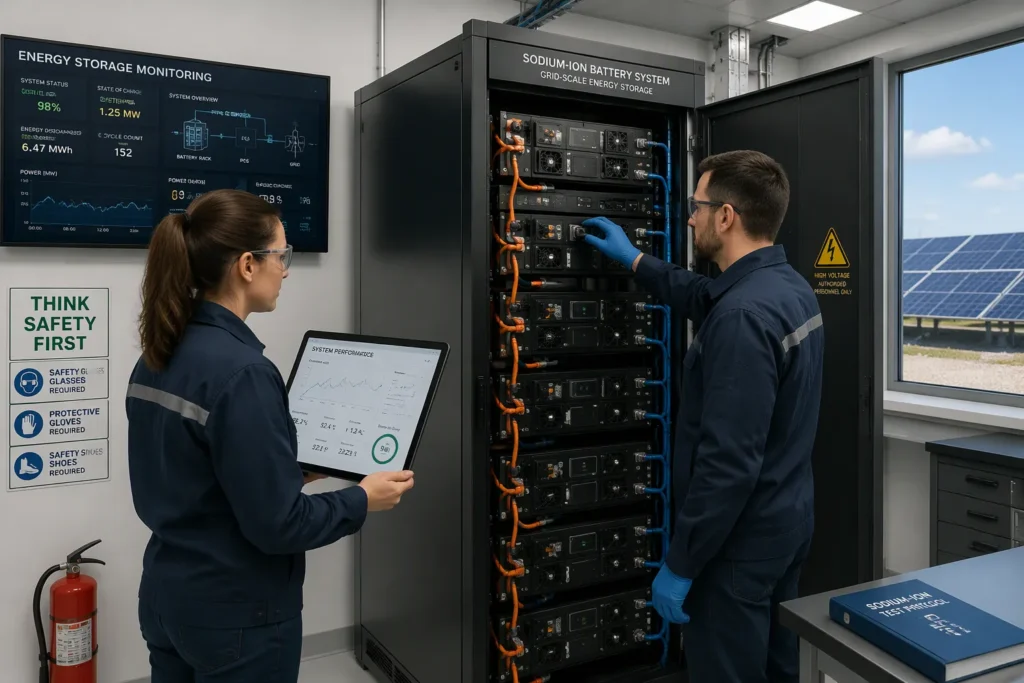
Europe and the United States run a thinner but instructive record. The LiNa Energy and ion Ventures trial stands as the clearest documented European pilot. That platform reached roughly 50 kWh, cycled as designed, and an independent E4Tech scoping study rated it stronger than existing lithium-ion options in distribution, generation-level, and behind-the-meter duties. The outcome matters less for its size than for its verification. An outside assessor, not the developer, signed off on the result.
American activity follows a different pattern. Developers pair sodium-ion batteries with demonstration grants and utility research programs rather than ordering utility-scale blocks outright. These pilots test the same duties Chinese stations already serve: renewable shifting, peak shaving, and voltage support. They also test procurement. A utility must certify a new chemistry against fire codes and interconnection rules before it energizes a single rack.
The outcomes so far share one theme. Western pilots validate fitness for purpose, not raw scale. They answer whether sodium-ion cells meet local safety and grid codes. They answer whether a site can absorb the larger footprint. They do not yet answer whether supply chains can deliver thousands of racks on schedule.
Cost and Regulatory Fit
Cost shapes the Western case differently than the Chinese one. Chinese sodium-ion cells cost about $125/kWh against roughly $49/kWh for LFP, and analysts project parity near 2026–2027 at cell level. European and American developers face higher input costs and smaller order volumes, so their early projects carry a premium. Policy support offsets part of that gap. Grant programs and storage mandates create a floor for demand, and that floor lets manufacturers plan capacity.
Regulatory compliance drives adoption more than price in these markets. Fire codes in the EU and US treat lithium thermal runaway as a design hazard. They demand suppression systems, spacing, and separation. Sodium-ion chemistry removes that hazard at the cell level. A project can therefore simplify its fire protection design and cut balance-of-system cost. Certification bodies still require test evidence, and that evidence now exists for commercial sodium-ion battery products.
The fit is clearest in urban and indoor sites. A commercial energy storage project inside a building faces strict fire separation rules. Sodium-ion batteries ease that burden. They also widen the range of acceptable locations. Western buyers weigh this compliance advantage alongside the cost curve, and the two trends now point the same direction.
Cold-Climate Demonstrations and VEKEN Solutions
Technical Performance in Harsh Conditions
Cold weather exposes the weak point of most storage chemistries. Standard lithium packs lose a large share of usable capacity below freezing, and operators often add heaters to keep them working. Sodium-ion cells behave differently. Documented demonstrations show sodium-ion batteries discharging normally at -20°C and, in dedicated designs, at -40°C without auxiliary heating. That removes a parasitic load and a failure point at the same time.
Cycle life holds up under the same stress. Sodium-ion cells in commercial designs now exceed 8000 charge and discharge cycles, a figure that stretches replacement intervals across a multi-decade project life. Emergency lighting in Nordic buildings and solar-powered airport lighting in cold regions provide the field evidence. Both applications demand steady output after long idle periods in sub-zero conditions, and both now rely on sodium-ion chemistry to deliver it.
Application Fit and Results
VEKEN‘s Sodium Battery (sodium battery) line applies this chemistry to real installations. The cells are intrinsically safe, operate from -40°C to 60°C, and exceed 8000 cycles. VEKEN supports the line with 100GWh of annual capacity, more than 300 cooperative patents, and manufacturing bases in Ningbo, Nanchang, and Dongguan. Details sit at https://power.vekenindustry.com/.
The portfolio maps onto distinct duties. Commercial and industrial storage (commercial and industrial storage) serves factories and buildings that need peak shaving and backup. Backup power (backup power) covers remote and off-grid sites where maintenance visits are costly. Residential storage (residential storage) gives homeowners a stackable, indoor-safe option. Extreme-cold solutions (extreme cold) keep emergency lighting and airport infrastructure running through arctic winters. Each case leans on the same traits: stable output in deep cold, long service life, and chemistry that will not catch fire.
Success Factors for Sodium-Ion Battery for Grid Scale Energy Storage
What the Projects Share
Five traits recur across every documented deployment. Raw material abundance tops the list. Sodium costs roughly $0.05/kg against about $15/kg for lithium, and seawater holds an effectively unlimited supply. Cost stability follows. Sodium-ion cells substitute abundant sodium compounds for volatile lithium carbonate, and cell-level manufacturing expenses fall by up to forty percent. Intrinsic safety ranks third. Sodium-ion chemistries avoid the thermal runaway hazard that shapes fire protection design. Wide temperature range comes fourth, with commercial packs operating from -40°C to 60°C. Long cycle life completes the set, and designs now exceed 8000 cycles.
One material detail reinforces the cost case. Sodium does not alloy with aluminum, so manufacturers use cheap aluminum foil on both current collectors instead of copper. That choice saves capital and reduces exposure to copper pricing. NFPP chemistry builds on these traits as a safer, lower-cost option for grid-scale and commercial energy storage.
Sodium-Ion Batteries Versus Other Technologies
Each technology fits a different duty. The comparison below covers technical performance, application fit, regulatory compliance, and cost.
Criterion | Sodium-ion | Lithium-ion (LFP) | Lead-acid |
|---|---|---|---|
Energy density | Lower; larger footprint | Higher; compact | Lowest |
Cold performance | Stable to -40°C | Needs heating below freezing | Large capacity loss |
Cycle life | 8000+ cycles | Strong, chemistry-dependent | Short |
Regulatory fit | Simplified fire design | Suppression systems required | Mature codes |
Best fit | Space-unconstrained grid sites, cold and indoor sites | Footprint-limited sites | Cost-sensitive backup |
Sodium-ion batteries suit large co-located solar or wind projects where land is plentiful. Lithium-ion remains the choice where space is tight. Lead-acid still serves low-cost backup roles. No single option wins everywhere.
Challenges remain. Sodium-ion battery technology carries lower energy density, so stationary enclosures grow larger. Manufacturing scale is still maturing, and battery-grade sodium salts and hard carbon anode supply chains must expand in tandem. Bankability depends on real-product validation, and 2025–2027 pilots must prove cycle life and calendar life beyond lab specs. VEKEN’s Sodium Battery line shows commercial application fit in C&I and residential storage today.
The case studies show real progress. Taiyuan opened the first grid-scale sodium-ion installation, and the Datang Hubei station reached 100,000 kWh capacity. Field data confirms 85% charge/discharge efficiency at −20°C and cycle life beyond 8000 cycles in commercial designs. These sites shift renewable power, shave peaks, and back up critical loads.
Sodium-ion battery for grid scale energy storage fits best next at co-located renewable sites, cold regions, and indoor installations. Cell-cost parity near 2026–2027 would confirm broader viability, and 2025–2027 pilots must validate calendar life. Lower energy density and supply-chain scale-up remain open challenges. Sodium-ion batteries complement lithium-ion and lead-acid options rather than replace them.
FAQ
How do sodium-ion batteries compare on cost?
Chinese sodium-ion cells cost about $125/kWh versus roughly $49/kWh for LFP. Analysts project cell-level parity near 2026–2027. Western sodium-ion batteries carry a premium from smaller order volumes. The energy density trade-off raises footprint.
Do sodium-ion batteries work in cold climates?
Yes. The Datang Hubei station reports 85% charge/discharge efficiency at −20°C. Commercial sodium-ion batteries operate from −40°C to 60°C without auxiliary heating. These packs hold stable output where lithium fades.
How safe is sodium-ion chemistry?
Sodium-ion cells avoid the thermal runaway hazard of lithium. They pass nail penetration tests without fire. This chemistry simplifies fire protection design under EU and US codes.
What cycle life do sodium-ion batteries offer?
Commercial sodium-ion batteries exceed 8000 charge and discharge cycles. The Datang Hubei station reports 1,500 cycles at 60°C. Long service life stretches replacement intervals across a multi-decade project.
Where do sodium-ion batteries fit best?
They suit co-located renewable sites, cold regions, and indoor installations. This chemistry eases fire-code compliance in urban buildings. Energy density stays lower, so land availability matters. Lithium-ion remains the choice where space is tight.