
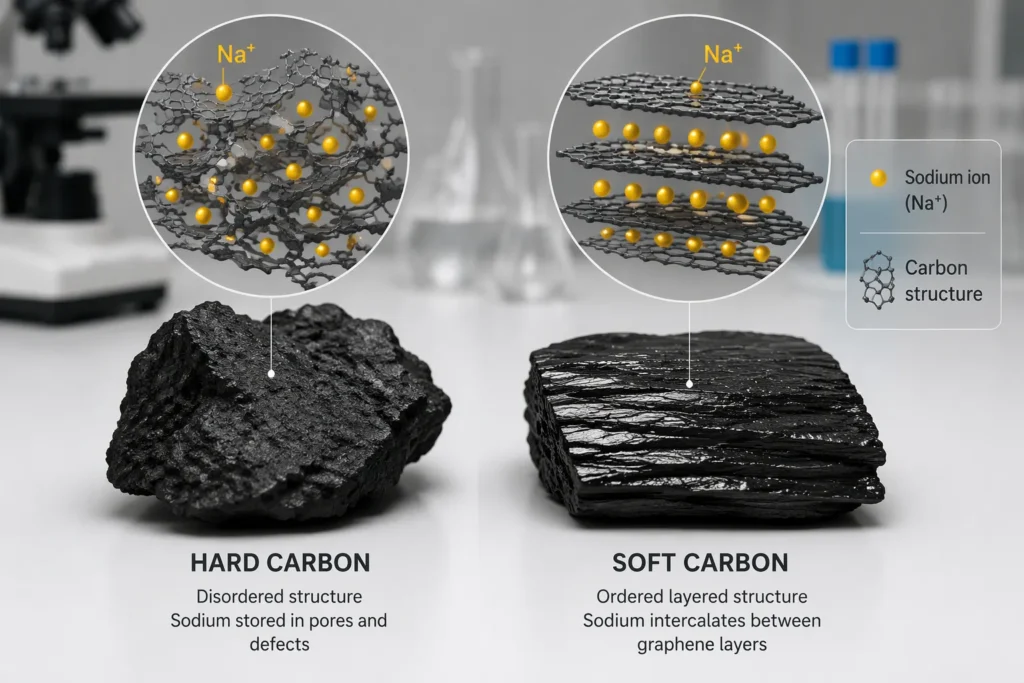
Hard carbon and soft carbon anodes act very differently when storing sodium. Hard carbon gives a higher reversible capacity by storing sodium in many disordered sites. Soft carbon gives better rate capability and cycling stability through ordered conductive pathways. Hard carbon is a non-graphitisable carbon. Its cross-linked structure resists turning into graphite even at high temperatures. Soft carbon is a graphitisable carbon. Its precursors rearrange into ordered graphitic domains when heated. These structural contrasts directly shape how sodium-ion batteries perform. Hard carbon and soft carbon each suit different duty cycles. 🔋
Key Takeaways
Hard carbon holds more sodium and works well for high-energy uses.
Soft carbon moves sodium more quickly and lasts longer for high-power needs.
Always compare anodes under the same test conditions to get fair results.
Look at four main measures: capacity, first-cycle efficiency, rate capability, and cycle stability.
Pick the anode that fits how often the application is used, so it works at its best.
Hard Carbon and Soft Carbon Anodes: Structural Differences
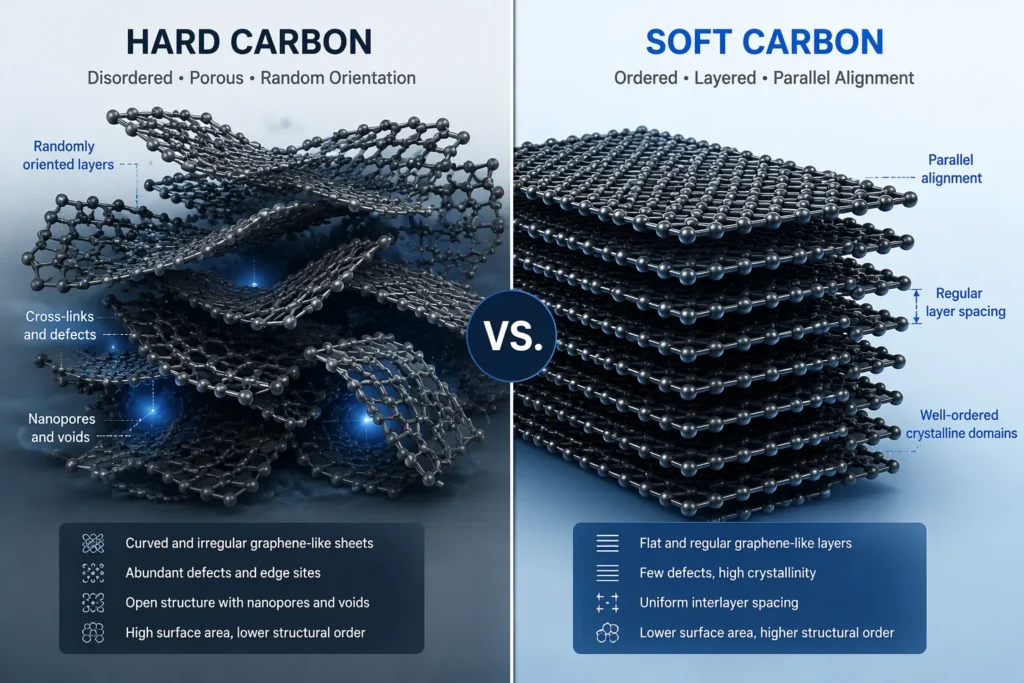
A graphitisable carbon rearranges into ordered graphite layers when makers heat it to a high temperature. A non-graphitisable carbon keeps its cross-linked, random structure even under the same heat treatment. This one difference separates the two families of carbon anodes used in sodium-ion cells. 🔬
Hard Carbon’s Disordered Architecture
Hard carbon gets its name from a stubborn structure. Its precursor resists graphitisation, so the final material holds randomly oriented graphene layers. These layers sit at irregular angles and leave open space between them. The result is a porous framework full of nanopores and voids.
Researchers often call this arrangement graphite-like, but disordered, carbon sheets. The sheets never stack into the neat, parallel planes of graphite. That randomness gives hard carbon its structural strength. The rigid cross-links stop the framework from collapsing during repeated charge and discharge. Hard carbons therefore cope well with volume change. The open voids also create many entry points for sodium ions. Hard carbon electrodes gain from this sponge-like texture. Each void and each layer edge can hold sodium, so the material stores charge in several ways at once. Hard carbon anodes suit uses that value capacity over raw power.
Soft Carbon’s Ordered Framework
Soft carbon acts very differently under heat. Its precursors melt and rearrange into ordered graphitic domains. The layers line up into tidy stacks with regular spacing. Makers can tune this order through graphitisation. A higher treatment temperature grows the crystalline domains and closes the gaps between layers. A lower temperature leaves smaller domains and more defects.
This ordered framework gives soft carbon an edge in electronic conduction. Electrons move easily along the lined-up planes. Soft carbon anodes therefore deliver strong rate capability and stable cycling. The trade-off lies in storage space. Tightly stacked layers offer fewer open sites than the porous hard carbon network. Soft carbon still stores sodium at layer edges and defect sites, but the total capacity stays modest. Soft carbon fits power-focused duty cycles, such as fast charging and high-current discharge.
Both structures have clear strengths. Hard carbons excel at holding charge. Soft carbon excels at moving it quickly. Neither material wins on every metric. The right choice depends on the target use and its energy-versus-power balance. Designers who compare hard and soft carbon anodes should read the structural data first. Layer spacing, pore volume and domain size predict how each carbon electrode will behave in a real cell.
Sodium Storage Mechanisms in Hard Carbon and Soft Carbon
The two carbon families store sodium in different ways. The structure decides which way is the main one. 🔍
Adsorption, Intercalation and Nanopore Filling in Hard Carbon
Hard carbon anodes use three ways to store sodium at once. Sodium ions first stick to the outer surface and to defect sites. This step happens at a higher voltage and adds fast charge at the surface. Sodium then slips in between the disordered graphene layers at a lower voltage. A third step fills the tiny pores inside with clustered sodium.
The plateau region is the flat, low-voltage part of the charge curve. It holds the pore-filling step and lifts the sodium-storage capacity. A long, well-formed plateau points to strong pore storage. The initial Coulombic efficiency is the share of inserted sodium that comes back out on the first cycle. Surface defects and trapped sodium pull this value down. Hard carbons with fewer defects and cleaner pores usually show better first-cycle efficiency. These sodium storage regimes explain why hard carbon electrodes reach high capacity. The sodium-carbon interaction in pores and at layer edges drives the gain.
Interlayer and Defect-Site Storage in Soft Carbon Anodes
Soft carbon anodes depend on interlayer and defect-site storage. Sodium ions slide between the ordered graphitic layers during sodium insertion. Defect sites at domain edges also catch sodium. The lined-up planes carry electrons quickly to the reaction front. This bulk electronic conductivity supports fast charging and steady output.
Soft carbon gives a lower sodium storage capacity than hard carbon. Its strength lies in speed and durability. The ordered lattice puts up with repeated cycling and barely strains. Soft carbon anodes therefore suit high-power duty cycles in sodium-ion batteries. Both carbon anodes play real roles. Hard carbon favours capacity, and soft carbon favours power. ⚡
Performance Metrics in Sodium-Ion Batteries
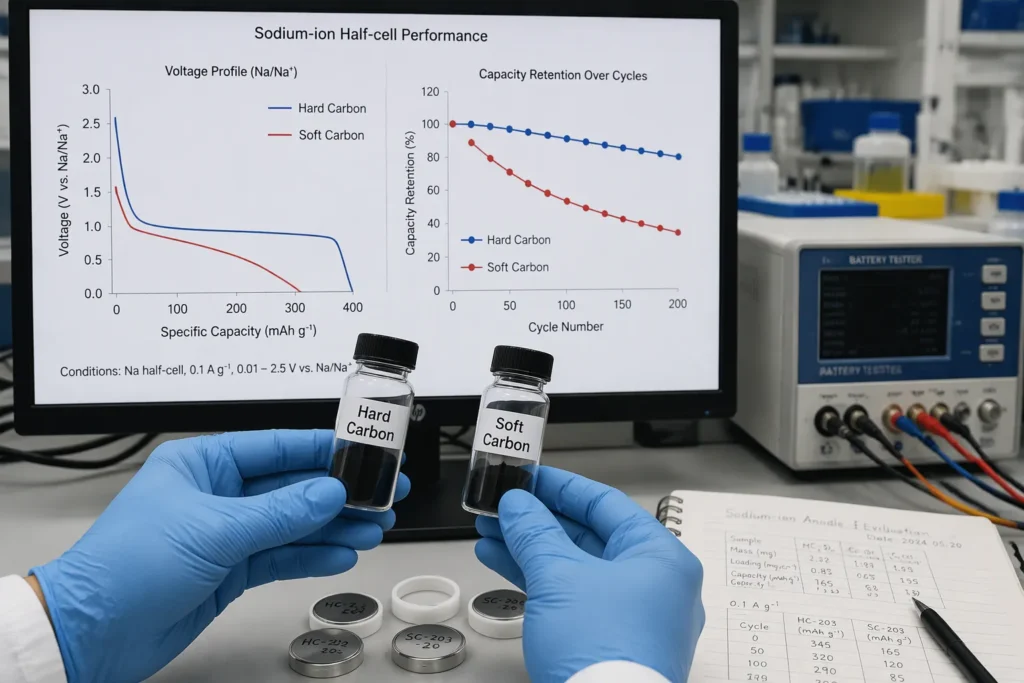
Test data shows what really happens with any anode material. Four metrics matter most for hard carbon and soft carbon anodes: reversible capacity, initial Coulombic efficiency, rate capability and cycle stability. Each metric shows a different part of the electrochemical performance picture. 📊
Reversible Capacity and Initial Coulombic Efficiency
Reversible capacity measures how much sodium an electrode stores and releases on each cycle. A high value means more usable sodium-storage capacity. Hard carbons usually show higher reversible capacity than soft carbon. The disordered structure gives more storage sites for sodium ions. Soft carbon gives a lower but steady reversible capacity.
The reversible capacity and voltage profile together describe the full storage behaviour. A long plateau at low voltage signals pore filling in hard carbon. A sloping curve points to interlayer and defect storage in soft carbon. Readers should plot both curves side by side before judging either material.
Initial Coulombic efficiency is the share of inserted sodium that comes back on the first cycle. A low value means sodium stays trapped in defects or on surfaces. Hard carbon often loses more sodium to surface reactions. Soft carbon usually shows better first-cycle efficiency. Both values depend on the electrolyte and the voltage window used in the test.
Rate Capability, Cycle Stability and Expansion
Rate capability shows how well an electrode works at high current. Soft carbon does best here. Its ordered planes carry electrons quickly to the reaction front. Hard carbon falls behind at high rates. Its twisting pores slow sodium transport. Test data should report capacity at several current densities, not just one.
Cycle stability tracks capacity retention over many charge and discharge cycles. Soft carbon keeps its capacity well under repeated cycling. The ordered lattice barely strains during sodium insertion. Hard carbons also cycle stably, though their porous framework can shift over time. A good dataset shows capacity against cycle number for at least several hundred cycles.
Expansion describes how much the electrode swells during sodium storage. Hard carbon takes up volume change through its open voids. Soft carbon expands less because its layers stay aligned. Researchers measure expansion with in-situ techniques or stack-level pressure tests. These electrochemical properties link directly to pack design and safety margins.
The summary comparison table in the selection section will place these metrics side by side for quick reference. Readers should treat any single headline number with care. A fair benchmark reports all four metrics under matched conditions. That approach gives a true picture of sodium storage behaviour in sodium-ion batteries. 🔋
Processing Effects and Fair Comparisons
Processing choices change how each carbon behaves. Synthesis temperature and precursor selection shift the structure, and the structure sets the performance. ⚙️
Synthesis Temperature and Precursor Influence
Heat treatment temperature guides hard carbon structure in clear ways. A higher temperature grows the ordered domains and closes some pores. This step can raise the plateau capacity, but it may also cut the number of open storage sites. A lower temperature leaves more defects and voids. Those defects trap sodium ions and lower first-cycle efficiency. Precursor choice matters just as much. Resins, biomass and pitches each leave a different pore network after carbonisation. Biomass often brings natural voids. Resins give a more even texture.
Soft carbon reacts to temperature through graphitisation. A higher temperature enlarges the graphitic domains and boosts electronic conduction. The trade-off is fewer defect sites for sodium storage. A lower temperature keeps more defects and stores more sodium, but conduction drops. Precursor selection sets the starting point. Aromatic pitches graphitise easily. Other precursors need more heat to order. Makers tune both variables together to reach a target balance of capacity and rate.
Matching Test Conditions for Valid Benchmarks
A fair benchmark keeps every test condition the same. Current density, voltage window and electrolyte all shift the measured values. A fast current hides the plateau of hard carbons. A narrow voltage window cuts the low-voltage storage step. Different salts or solvents change the first-cycle efficiency by a wide margin.
Compare hard carbon and soft carbon only under identical current density, voltage window and electrolyte, or the numbers mean little.
Readers should check the test protocol before trusting any comparison. The same rule applies to electrochemical properties reported across studies. Matched conditions turn scattered data into a reliable guide for sodium-ion batteries. 🔬
Hard Carbon and Soft Carbon: Trade-Offs and Selection
Capacity Versus Practical Energy Density
A high reversible capacity does not always raise the energy of a full sodium-ion cell. The first-cycle loss matters just as much. A material with strong sodium-storage capacity can still waste part of it on surface reactions. That loss cuts the usable energy in the finished pack. Designers weigh capacity against initial coulombic efficiency before they choose a chemistry. ⚖️
Hard carbon leads on raw capacity. Its porous network stores sodium in several ways at once. Soft carbon trails on capacity but gives back more of its stored charge on the first cycle. Soft carbon also keeps its voltage profile steady under load. So each material fits a different target. Capacity-driven designs lean towards hard carbon. Power-driven designs lean towards soft carbon.
Application Fit and VEKEN Sodium Battery Solutions
Application duty cycles decide the fit. Telecom backup and home or industrial energy storage reward long, deep cycling. Emergency power systems need reliable output after long idle periods. E-mobility and engine start demand strong high-rate discharge. 🔌
VEKEN builds sodium-ion anodes and cells for these duties. Its sodium batteries hold stable output in cold conditions, down to -40℃ in the published cell range. The cells pass nail penetration tests without fire or explosion. Deep discharge tolerance gives over five times the cycle life of lead-acid batteries. Prismatic cells exceed 4000 cycles. VEKEN serves telecom, e-mobility, emergency power, and home and industrial energy storage from its Ningbo, Nanchang and Dongguan bases. Readers can explore the range at https://power.vekenindustry.com/.
Metric | Hard Carbon | Soft Carbon |
|---|---|---|
Reversible capacity | Higher | Lower, steady |
Initial coulombic efficiency | Often lower | Often higher |
Rate capability | Moderate | Strong |
Cycle stability | Good | Strong |
Expansion | Absorbed by voids | Low |
Best fit | Energy density | Power and durability |
The table sums up the trade-offs for carbon anodes. Hard carbon and soft carbon anodes each serve real duties. Structure remains the deciding variable for sodium-ion anodes.
Structure decides the result. Hard carbon and soft carbon anodes differ in one key way: disordered carbon holds more sodium, while ordered carbon moves it faster. Hard carbon is best for energy density that depends on capacity. Soft carbon is best for power and long life. 🔋
Readers should check test data against reversible capacity, first-cycle efficiency, rate capability and cycle stability. Match the anode to what the application needs, not to one headline number. Sodium storage performance only makes sense when test conditions are the same.
Composite and hybrid carbon strategies look promising. Blends may bring together open pores and conductive pathways. Researchers are still exploring these designs, and future data will show where they fit.
FAQ
Which anode suits a high-energy or a high-power design?
A high-energy design leans towards hard carbon. Its disordered network stores more sodium and lifts reversible capacity. A high-power design leans towards soft carbon. Its ordered planes carry electrons quickly and hold up under fast charging. 🔋
Why does soft carbon often show better first-cycle efficiency?
Soft carbon has fewer surface defects and cleaner layer edges. Fewer sodium ions get trapped on the first cycle. Hard carbon offers more voids and defect sites, so it loses a larger share of its first charge. Electrolyte choice still shifts both values.
Do test conditions change the comparison between the two carbons?
Yes. Current density, voltage window and electrolyte all move the measured numbers. A fast current hides the hard carbon plateau. A narrow window cuts low-voltage storage. Readers should compare sodium storage data only under matched conditions.
How does anode choice connect to finished sodium battery cells?
Cell design follows the duty cycle. VEKEN sodium cells hold stable output down to -40℃ and pass nail penetration tests without fire. Prismatic cells exceed 4000 cycles. Deep discharge tolerance gives over five times the cycle life of lead-acid batteries. ⚡
Can makers combine hard and soft carbon in one electrode?
Blends are an active research direction. A mix may pair the open pores of hard carbon with the conductive pathways of soft carbon. Published data on these hybrid designs is still growing, so readers should check matched test results before drawing conclusions.