
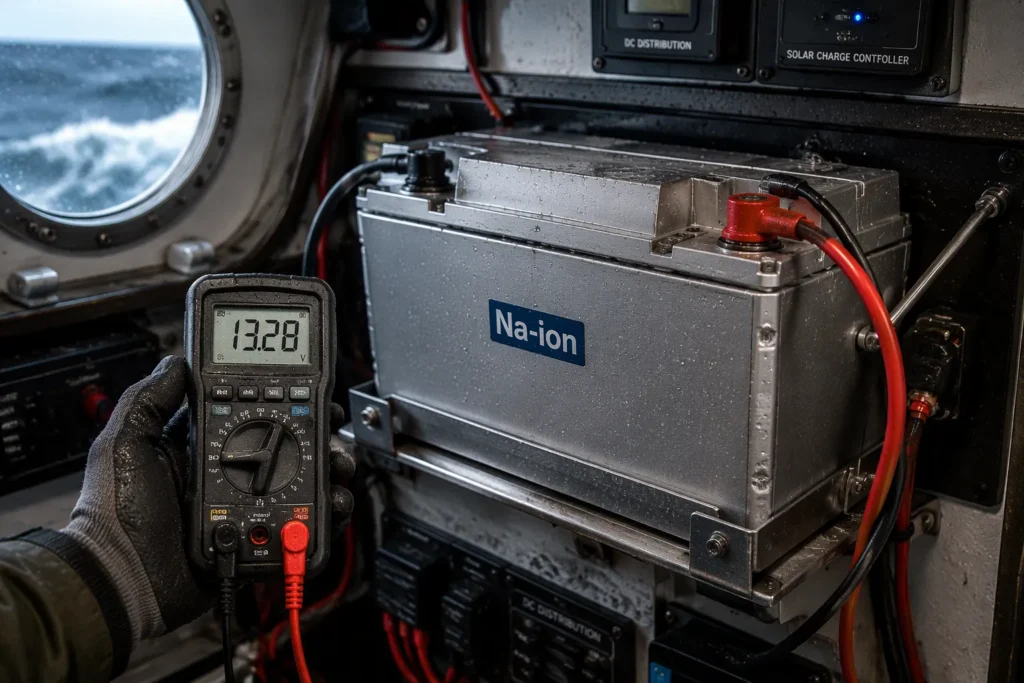
Yes, sodium-ion batteries suit harsh environments well. They shine in cold weather, stay safe under abuse, and cost less than many alternatives. The catch? They store less energy per kilogram.
Three settings test them hardest. Marine duty throws salt, humidity and vibration at a pack. Off-grid sites demand cold-weather grit and years of cycling. UPS systems need instant high-rate response and rock-solid reliability.
This article sets sodium-ion performance in harsh environments against lithium-ion, especially LiFePO4, using measurable criteria. Sodium-ion earns its place in cold, cost-sensitive and safety-critical roles. LiFePO4 keeps the energy-density crown. Each chemistry fits somewhere.
Key Takeaways
Sodium-ion batteries work well in freezing cold and keep about 90% power at -40°C.
They last longer than lithium batteries, offering 6,000 to 10,000 cycles for off-grid use.
Sodium-ion batteries are safer to ship and store because they resist overheating.
They store less energy per kilogram than lithium, so they may need more space.
Choose sodium-ion for cold, safety-critical, or cost-sensitive roles; choose lithium for tight space.
Sodium-Ion Performance in Harsh Environments
Operating principles and voltage behaviour
Think of a sodium-ion battery as a shuttle service. Sodium ions travel between two electrodes through an electrolyte. They leave the positive electrode during charge and park themselves in the negative one. Discharge reverses the trip. The materials are abundant and the cell is safe, which is why sodium-ion batteries attract so much attention for tough duty.
The shuttle has a quirk. Sodium ions are larger than lithium ions, so the host materials must offer roomier parking spaces. Hard carbon often serves as the negative electrode for this reason. The electrolyte is usually a sodium salt dissolved in a solvent. This setup shapes the voltage behavior from the very first cycle.
Voltage characteristics and usable capacity
Here’s the part that surprises people. A sodium-ion battery doesn’t hold a flat voltage line for most of its discharge. The voltage behavior slopes downward as the cell empties. LiFePO4 behaves quite differently, sitting on a long plateau before it drops.
Why does this matter? A sloping curve means the inverter or charger sees a moving target. The system must track battery voltage behavior carefully to estimate state of charge. A simple voltage cut-off won’t tell the whole story. Good battery management electronics handle this well.
Usable capacity depends on where the designer sets the cut-offs. A conservative low-voltage limit protects cycle life but leaves some capacity unused. A generous limit squeezes out more runtime at the cost of stress. The voltage behavior of sodium-ion therefore ties directly to how much energy a pack actually delivers in the field. Designers who understand the curve get more from every cell. Those who treat it like a lithium plateau will misjudge both runtime and state of charge.
Sodium-Ion Batteries Versus Lithium-Ion
Efficiency, temperature resilience, and cycle life
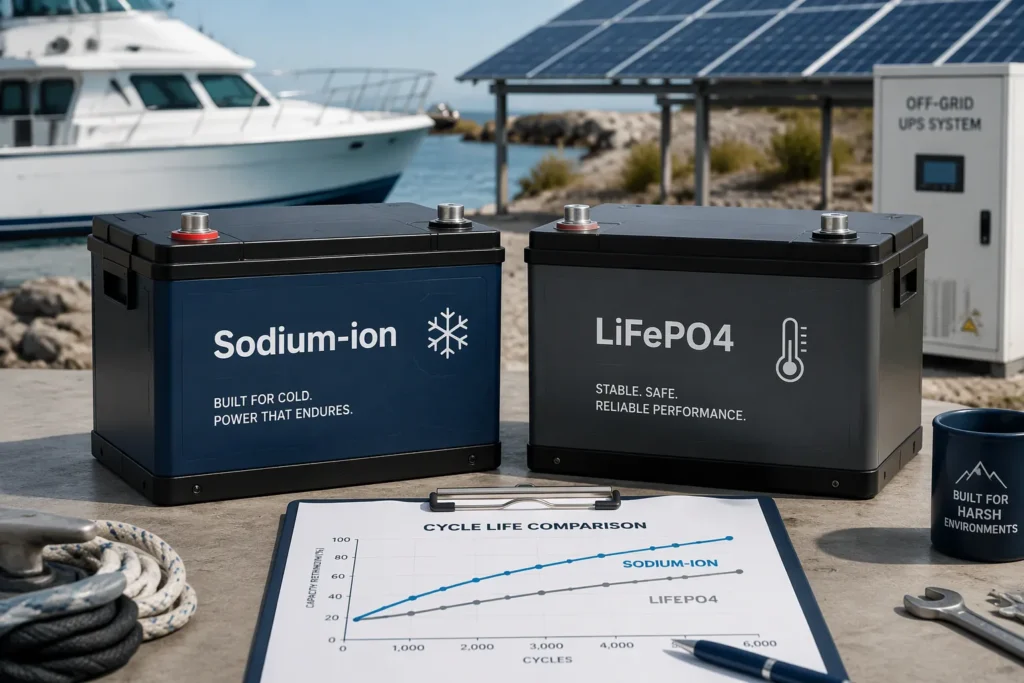
Round-trip efficiency favours lithium today. Sodium-ion cells sit a little lower, though the gap is small enough that most off-grid designs simply absorb it. Temperature is where sodium-ion pulls ahead. It keeps working in deep cold, and the off-grid section below covers that in detail.
Cycle life tells a bigger story. Quality LiFePO4 packs routinely deliver 3,000–5,000+ cycles. Sodium-ion batteries reach 6,000–10,000 cycles, or 10–15 years, in off-grid storage. That margin matters for anyone modelling cycle life and degradation across a decade of daily charging. Fewer replacements mean lower lifetime cost, and that saving compounds quietly in the background.
Weight, safety, and cost
Here’s the honest trade-off. A sodium-ion battery may store roughly 30–40% less energy than a lithium battery of the same size. Weight-sensitive projects feel that difference. A marine hull with a tight mass budget, for instance, will notice it straight away.
Safety runs the other way. Sodium-ion batteries are generally safer to ship and store. They tolerate abuse well and arrive with fewer transport restrictions. That’s a genuine advantage for remote sites and cramped equipment rooms.
Cost favours sodium on raw materials. Abundant sodium salts keep cell prices stable, while lithium prices swing more. For stationary storage, the cheaper chemistry often wins the business case.
So which one leads? Neither, across the board. Sodium-ion performance in harsh environments looks strong on cold, safety and longevity. Lithium keeps the energy-density crown. 🔋
A quick side-by-side helps:
Criterion | Sodium-ion | LiFePO4 |
|---|---|---|
Cycle life | 6,000–10,000 cycles | 3,000–5,000+ cycles |
Energy per size | 30–40% lower | Higher |
Cold weather | Strong | Weaker |
Shipping and storage | Generally safer | More regulated |
Designers weighing sodium-ion vs lithium-ion energy density should start with the load profile, not the datasheet headline. A sodium-ion pack that runs cold and lasts fifteen years often beats a lighter pack that needs replacing sooner. Sodium-ion chemistry also avoids the thermal runaway worries that push up enclosure costs elsewhere.
For independent background on cycle life and safety, the Clean Energy Institute offers a neutral primer, and Nature Reviews Materials publishes peer-reviewed sodium-ion comparisons.
Marine Applications: Salt, Humidity, and Vibration
Environmental stressors and enclosure design
A boat lives in a punishing world. Salt air coats every surface. Humidity never really leaves. Engines and hulls shake constantly. That mix of salt, moisture and vibration is what makes harsh marine environments so tough on any battery pack.
Exposure to saltwater is the first enemy. Salt crystals creep into connectors and start corrosion. Saltwater ingress into a cell compartment can short a pack in minutes. Designers fight back with sealed enclosures, marine-grade connectors and pressure-tested cable glands. A robust enclosure also needs vibration mounts. Constant hull movement loosens weak joints over time.
Humidity adds a slower threat. In humid marine environments, condensation forms inside cold enclosures. Desiccant breathers and conformal coatings help. So does smart placement away from bilge areas.
Sodium ion batteries in hybrid marine propulsion systems
Safety and thermal stability drive most marine design choices. Sodium ion batteries in hybrid marine propulsion systems handle this well. They tolerate abuse, resist thermal runaway and ship with fewer restrictions. That matters on a vessel where a fire has nowhere to go.
Sodium-ion batteries also keep their cool under load. Hybrid marine propulsion systems pair them with diesel or electric drives for a reason. The pack absorbs peak demand while the engine runs steady. Sodium ion batteries in hybrid marine propulsion systems suit this buffer role nicely.
Weight still counts, though. Sodium-ion packs store less energy per kilogram than lithium. Hybrid marine propulsion systems on weight-sensitive hulls may favour LiFePO4. Sodium ion batteries in hybrid marine propulsion systems win on safety and cost instead.
The same logic reaches boats, rvs, and off-grid living. Marine applications reward chemistry that shrugs off salt and shock. Sodium-ion fits that brief. Hybrid marine propulsion systems simply need the right sizing from day one.
Off-Grid Applications: Cold Temperature Performance
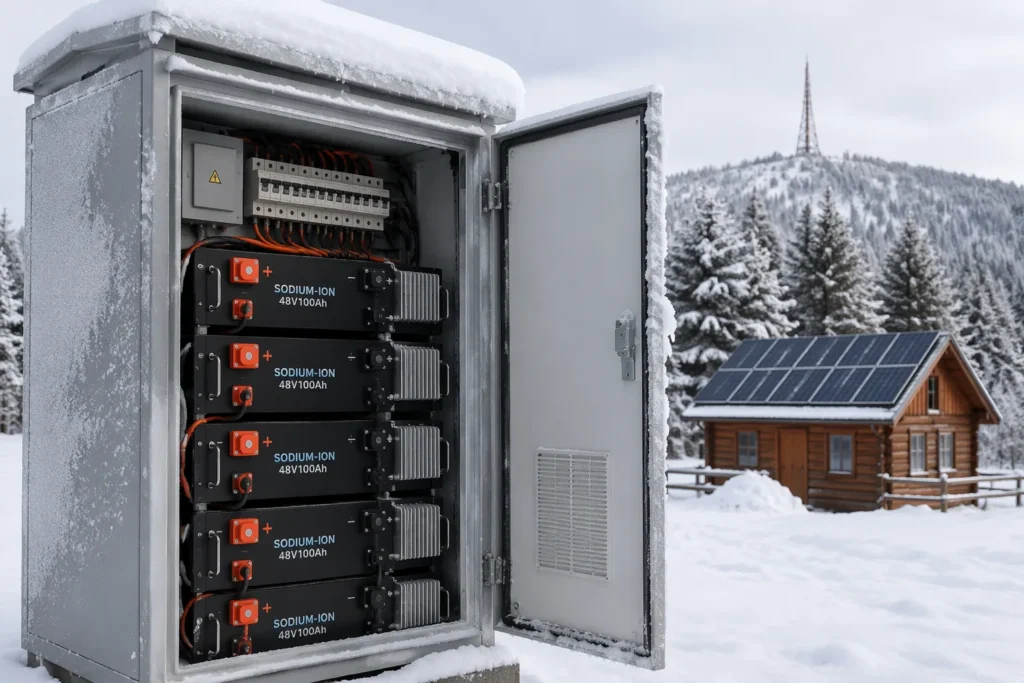
Remote power sites punish weak chemistry. A cabin in the Yukon or a telecom mast on a Scottish hill sees weeks below freezing. Standard lithium packs throttle charging there. Sodium-ion batteries simply carry on. That gap is the heart of the cold temperature performance story. ❄️
Wide temperature range operation
Cold temperature performance is where sodium-ion earns its reputation. Sodium-ion batteries hold around 90% of power output at temperatures as low as −40 °C. That figure comes from lab testing, and independent bodies such as the National Renewable Energy Laboratory track similar storage data. A lithium pack at that temperature delivers a fraction of its rating.
Better still, sodium-ion runs without active cooling. No fans, no glycol loop, no heater blanket drawing standby power at 3 a.m. The pack maintains stable performance on its own. In off-grid battery energy storage systems for remote power, sodium-ion delivers 85–90% of rated capacity. That’s a real number a designer can size against.
What does this mean in practice? Take a 12v or a 48v off-grid solar setup in a cold climate. The sodium-ion bank keeps charging on a bright January morning. A lithium bank may refuse charge until it warms up. That low-temperature charging capability changes how the whole system behaves. The cold-weather advantage isn’t marketing talk. It’s the difference between a working site and a dead one.
Maintenance and system sizing
Sizing an off-grid solar setup starts with honest numbers. Use the 85–90% capacity figure, not the datasheet peak. Add headroom for cloudy spells. Then check the voltage curve against the inverter’s window.
Maintenance looks different too. Sodium-ion batteries need no thermal management hardware. Fewer parts mean fewer failures at a site that’s four hours from the nearest road. That simplicity suits mobile and off-grid applications especially well.
Cycle life seals the case. Sodium-ion delivers 6,000–10,000 cycles, or 10–15 years, in off-grid storage. Track cycle life and degradation across that span and the maths gets friendly. One pack, one install, one decade of service. Compare that with a shorter-lived bank that needs swapping mid-life.
The 12-volt, 24-volt, and 48-volt ecosystem covers most remote builds. Boats, rvs, and off-grid living all draw from the same pool of gear. A 48 V rack suits a larger homestead. A 12 V bank fits a camper van. Sodium-ion slots into both without special charging profiles.
One caution for designers. Size the array for the coldest week, not the average. Sodium-ion handles the cold, but the panels still need sunlight. Pair realistic weather data with the capacity figures above and the system will hold up. Skip that step and even great chemistry looks bad.
For anyone weighing rv and off-grid systems, the message is simple. Cold sites reward chemistry that doesn’t flinch. Sodium-ion fits that brief neatly.
UPS Applications: Reliability and High-Rate Demands
A UPS has one job. It sits quietly for months, then delivers a big burst of power the moment the mains fails. That standby-then-surge pattern stresses a battery differently from daily cycling. Sodium-ion handles the brief well, though designers must plan around its quirks. ⚡
Standby and float behaviour
Sodium-ion batteries spend most of their life at a high state of charge in a UPS. Float charging holds the pack near full, ready for the next outage. Sodium-ion tolerates this holding pattern comfortably. It doesn’t demand the careful voltage ceiling that some lithium packs need.
The battery management system earns its keep here. It tracks cell balance, temperature and state of charge across long idle stretches. A good unit also flags drift before it becomes a problem. That vigilance underpins the reliability a data centre or hospital expects.
Self-discharge stays modest, so a healthy pack holds its charge between tests. Scheduled discharge tests remain essential, though. They prove the pack can still deliver when called upon.
Safety and footprint in confined spaces
UPS rooms are tight. Racks stack close together and airflow is limited. Sodium-ion batteries help here because they resist thermal runaway and need no complex cooling loop. Fewer hot spots mean calmer operation in a crowded cabinet.
Footprint is the trade-off. Sodium-ion stores roughly 30–40% less energy than lithium in the same space. A designer may need a larger cabinet or more racks to hit the same runtime target. That extra volume costs money and floor space.
Weigh both sides before committing. Where safety and long service life top the list, sodium-ion fits neatly. Where every rack unit counts, LiFePO4 still wins. Either way, the reliability of the whole system rests on honest sizing and regular testing.
Regulatory Compliance and Safety
Transport, installation, and standards
Shipping rules matter before a pack ever reaches a site. Sodium-ion batteries travel under the UN Manual of Tests and Criteria, specifically UN 38.3. That test series covers altitude, thermal cycling, vibration, shock, external short circuit and overcharge. A pack that passes ships by air, sea or road with fewer headaches. Sodium-ion cells often clear this bar more easily than lithium, which is a real bonus for remote projects.
Installation standards vary by market. Stationary storage draws on IEC 62619 for safety requirements and UL 1973 in North America. Marine work adds class society rules. Designers working on vessels should check international maritime safety standards from bodies such as DNV or ABS early in the project. Catching a gap at the drawing stage beats rebuilding an enclosure later.
Safety under abuse and fault conditions
What happens when things go wrong? Sodium-ion chemistry handles abuse calmly. Nail penetration, overcharge and external short tests rarely trigger thermal runaway. The electrolyte and electrode materials are simply less eager to burn. That calm behaviour lowers enclosure costs and simplifies fire suppression design.
Fault tolerance still needs engineering. A robust battery management system watches cell voltage, current and temperature. It isolates a faulty string before damage spreads. Sodium-ion batteries tolerate stress well, yet no chemistry forgives a badly designed pack. Test to IEC 62619 and UL 9540A where the market demands it. 🔒
Sodium-ion batteries fit cold climates, cost-sensitive stationary storage, and off-grid or UPS roles where safety and cycle life matter. Lithium-ion, especially LiFePO4, still leads on energy density and ecosystem maturity.
No single chemistry wins everywhere. Priorities decide.
For marine designers, weigh pack mass against safety in hybrid marine propulsion systems. Hybrid marine propulsion systems on weight-tight hulls may favour lithium. Hybrid marine propulsion systems that prize thermal stability suit sodium-ion. Off-grid builds should size for the coldest week. UPS rooms need honest runtime maths.
Sodium-ion performance in harsh environments rewards careful planning. So does every rival. Match the chemistry to the duty, then test it. 🔋
FAQ
Do sodium-ion batteries work in freezing conditions?
Yes. They hold around 90% of power output at −40 °C. Off-grid battery energy storage systems for remote power get 85–90% of rated capacity. No heater blanket needed. ❄️
How long do sodium-ion batteries last in off-grid storage?
Expect 6,000–10,000 cycles, or 10–15 years. That beats the 3,000–5,000+ cycles of quality LiFePO4 packs. One install can serve a decade.
Are sodium-ion batteries safe to ship?
Generally, yes. They pass UN 38.3 testing and travel with fewer restrictions than lithium. That helps remote sites and tight equipment rooms.
Which chemistry suits hybrid marine propulsion best?
It depends on the hull. Propulsion systems on weight-tight vessels may favour LiFePO4. Propulsion setups that prize thermal stability suit sodium-ion. Propulsion design starts with honest sizing either way. ⚓
Do sodium-ion batteries need cooling in a UPS room?
No active cooling loop is required. The chemistry resists thermal runaway, so cabinets run calmer. Footprint is the catch. A pack stores roughly 30–40% less energy than lithium in the same space.