
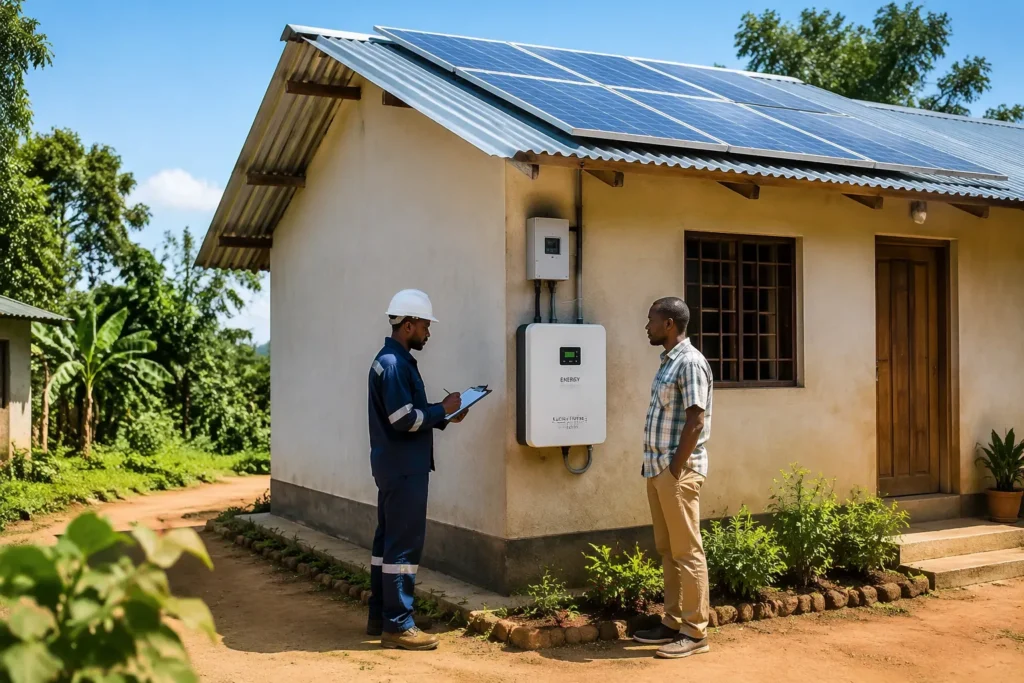
Is sodium-ion the right chemistry for your next solar home system? In 2026, the honest answer is: it’s technically promising and increasingly credible, yet it still costs more upfront than LFP. Most analysts expect price parity around 2028.
Sodium-Ion Batteries have moved from lab curiosity to real procurement option. That doesn’t make them a universal replacement for LFP today. They win in specific conditions: extreme heat, safety-critical installations and supply-constrained procurement.
Weigh technical performance, application fit, regulatory compliance and lifetime cost before you commit. Your temperature band, safety requirements and budget horizon will decide more than any headline specification.
Key Takeaways
Sodium-ion batteries work well in very hot or very cold places. They need less cooling and fewer repairs.
Sodium-ion cells cost more than LFP cells in 2026. Most experts expect prices to match around 2028.
Always use a good battery management system with sodium-ion batteries. They are not fireproof without it.
Compare total lifetime costs, not just the first price. Fuel savings and fewer replacements can make sodium-ion cheaper over time.
Keep your options open for future projects. A flexible agreement lets you switch chemistry when prices drop.
Why Sodium-Ion Batteries Are Gaining Attention
Abundant Materials and Supply Security
Sodium is everywhere. It makes up a large share of the salt in seawater, so raw material availability rarely limits production. That abundance matters for cost and for availability. Buyers of Sodium-Ion Batteries face fewer supply bottlenecks than buyers of lithium cells, because sodium feedstock comes from many regions and many suppliers.
Supply security follows from that spread. A rural electrification programme needs cells it can reorder in two years at a predictable price. Sodium-ion supply chains are still young, yet they don’t depend on a handful of concentrated extraction sites. Procurement teams value that resilience, especially on multi-year tenders where a single supplier failure can stall a whole rollout.
Chemistry Compared with Lithium
Sodium-ion shares a lot of ground with lithium-ion. Both chemistries move ions between electrodes through an organic electrolyte. That shared design brings a practical warning: sodium-ion is not inherently non-flammable. It still needs a proper battery management system (BMS) to manage voltage limits, temperature and cell balancing. Treat safety claims with care, and specify a BMS either way.
Where does the chemistry fit best? Sodium-ion suits small electronics, mid-sized battery packs, uninterruptible power supplies and small electric vehicles such as bikes. These applications tolerate a larger, heavier cell in exchange for stable material costs. A bike pack or a backup power unit doesn’t need the lightest cell on the market. It needs a cell that’s affordable, available and easy to service.
That’s the appeal in a nutshell. Sodium-ion offers a credible alternative built on common materials, and it slots neatly into applications where weight matters less than cost and continuity of supply.
The Cost Picture Against LFP
The 2026 Price Gap
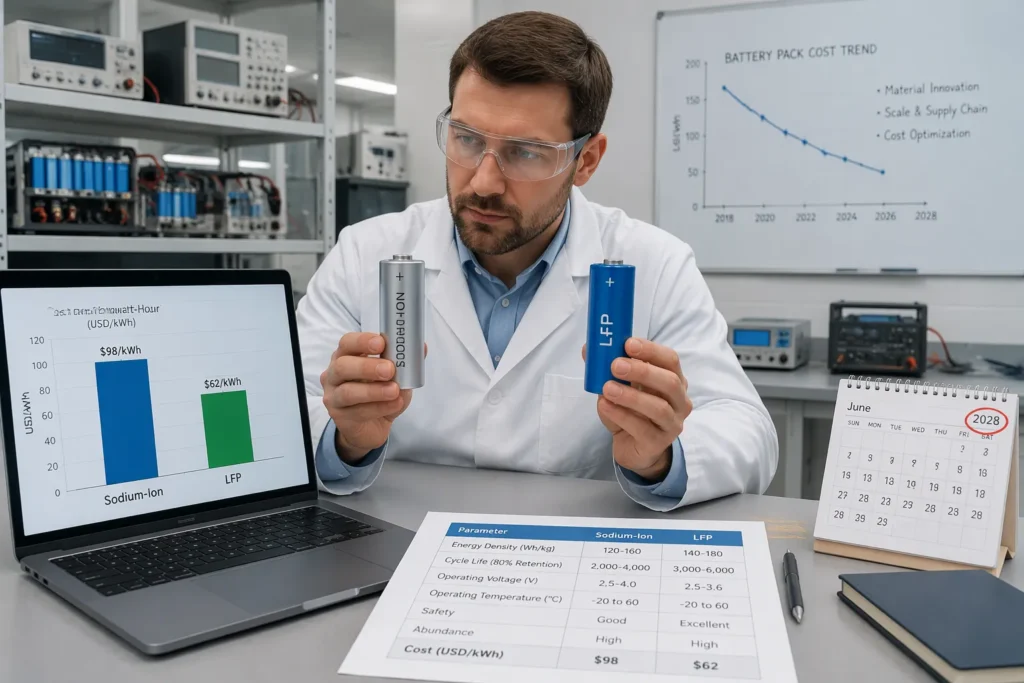
Here’s the awkward part. Sodium-ion cells still cost more per kilowatt-hour than LFP cells in 2026. Buyers comparing sodium-ion vs LFP cost per kWh will see a premium at the quotation stage, and that premium shapes tender decisions.
Why the gap? Scale explains most of it. LFP factories have run for years, supply chains are mature, and cell prices have fallen through sheer volume. Sodium-ion lines are newer and smaller. Manufacturers are still learning, yields are still improving, and output is still climbing. Every one of those factors adds cost per cell today.
The gap also varies by order size. A pilot order of a few hundred cells carries a bigger premium than a multi-container order for a rural electrification rollout. Procurement teams should price both chemistries side by side for their actual volume, not rely on headline figures from trade press.
Factor | Sodium-Ion (2026) | LFP (2026) |
|---|---|---|
Upfront cell cost | Higher | Lower |
Supply chain maturity | Young, expanding | Mature |
Price trend | Falling | Broadly stable |
Does that premium rule sodium-ion out? Not at all. It simply means the business case rests on lifetime value, not sticker price. Projects in extreme heat or remote sites often recover the difference through fewer replacements and lower cooling loads.
The Road to Parity by 2028
Most analysts expect price parity around 2028. That’s the milestone worth diarising. As sodium-ion production scales, unit costs should fall toward LFP levels, and the upfront premium should shrink with them.
Price parity is widely expected around 2028 — treat it as the trigger for revisiting chemistry choice in future project pipelines.
What drives the decline? Three things, mainly. Factory utilisation rises as more sodium-ion capacity comes online. Cell designs mature, which lifts yields. And demand grows, which spreads fixed costs across more units. None of these is speculative; they’re standard patterns in cell manufacturing.
So how should a project manager plan? For tenders closing in 2026 and 2027, budget for the premium and justify it on total cost of ownership. For pipelines stretching into 2028 and beyond, keep the chemistry decision open. A framework agreement that allows either chemistry gives you room to switch when prices converge.
One caution: parity is a forecast, not a guarantee. Treat published dates as planning assumptions and confirm them against live quotations before you commit a multi-year budget. Sodium-Ion Batteries may reach cost parity sooner in some regions and later in others, depending on local manufacturing capacity and import duties.
The practical takeaway is simple. Compare both chemistries on lifetime cost today, and revisit the numbers annually. The gap is closing, and the closing gap itself is a reason to stay flexible.
Where Sodium-Ion Batteries Win on Performance
Extreme-Temperature Resilience
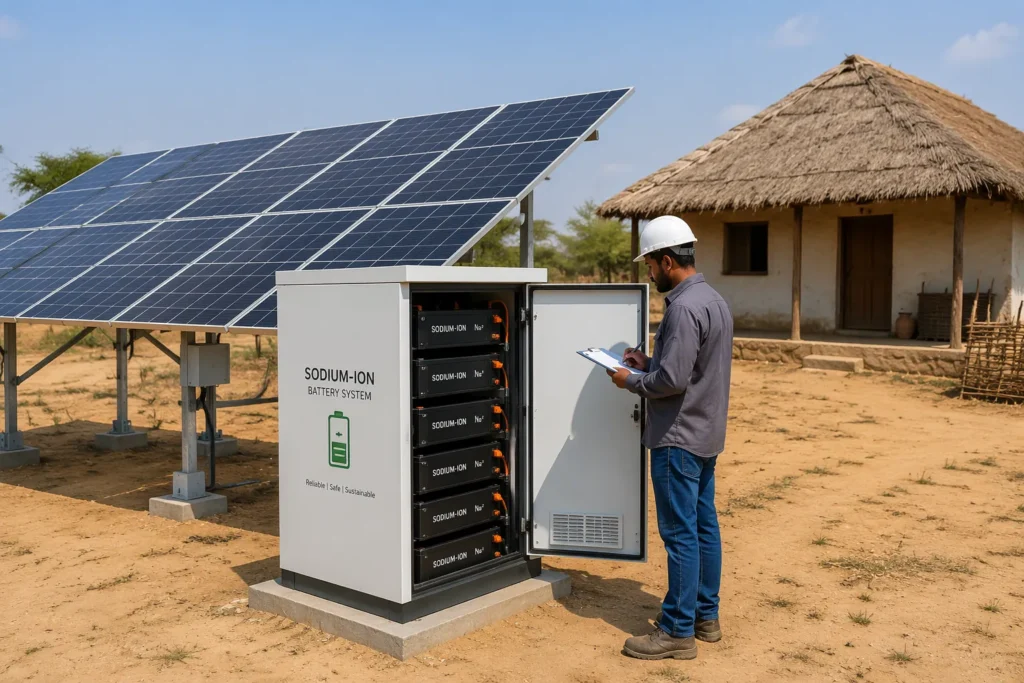
Heat kills batteries. A solar home system in the Sahel or the Australian outback bakes its cells day after day. Sodium-ion handles that punishment well. The chemistry keeps working across a wider temperature band than many lithium options, and it holds charge more gracefully when the mercury drops.
Why does this matter for rural electrification? Remote sites rarely have air-conditioned battery rooms. A cell that tolerates heat needs less cooling, fewer fans and less maintenance. That saves money over a twenty-year project life.
Cold matters too. Solar projects in high-altitude regions face freezing nights. Sodium-ion keeps a usable capacity in those conditions, which means fewer surprises on winter mornings.
LFP still fits best in temperate climates with stable temperatures and tight space budgets. It’s a mature, proven choice. Sodium-ion simply adds an option where heat or cold dominates the design brief.
Cycle Life and Safety
Cycle life looks strong. Sodium-ion cells tolerate deep discharges well, which suits daily solar cycling. A home system that charges by day and discharges by night asks a lot of its cells. Sodium-ion answers that demand without drama.
Safety deserves a careful word. Sodium-ion offers a favourable safety profile in many configurations. Yet it relies on organic electrolytes, just like lithium-ion. It is not inherently non-flammable. A proper battery management system (BMS) remains essential for voltage limits, temperature control and cell balancing. Don’t let any supplier tell you otherwise.
The self-sufficiency numbers are compelling. Sodium-ion storage for photovoltaic systems can raise self-sufficiency from 62 to 99 per cent. That’s a huge jump for an off-grid household. It means the solar array carries almost the entire load, and the diesel generator stays silent.
Here’s a quick comparison of where each chemistry shines:
Strength | Sodium-Ion | LFP |
|---|---|---|
Extreme heat tolerance | Strong | Good |
Cold-weather capacity | Strong | Moderate |
Energy density | Lower | Higher |
Supply security | Strong | Established |
LFP wins on energy density and maturity. Sodium-ion wins on temperature range and material availability. Neither chemistry embarrasses the other. The right pick depends on the site.
One more point on safety. A well-designed Sodium-Ion Batteries pack with a quality BMS performs reliably in hot, remote installations. Specify the BMS, test the enclosure, and commission properly. Good engineering beats chemistry claims every time.
Deployment Evidence
Lessons from Early Projects
Real installations now back the lab claims. UK homeowners have fitted sodium-ion systems from Eleven Energy, and those units run in ordinary homes with ordinary loads. A $10.6 million project is also developing modular, expandable sodium-ion batteries tuned for renewable energy applications. Modular design matters here. A rural clinic can start small and add capacity later without ripping out the whole bank.
India offers the clearest lesson. The country deployed standalone solar home lighting systems to rural households in 2019 and 2020. Those systems ran on lithium-based cells, and they worked. Sodium-ion’s lower energy density shows up in this context. To store the same energy, a sodium-ion pack takes more space and more weight. A roof-mounted home unit has room to spare, so the trade-off costs little. A handheld lantern does not, so designers must plan the enclosure carefully.
Fit for Solar Home Systems
Africa and Latin America show where the chemistry earns its keep. Off-grid programmes in both regions battle high daytime temperatures and long distribution chains. Sodium-ion cells tolerate the heat, and their material base eases reordering across borders. Field teams report fewer thermal worries than with older lithium packs.
Solar home systems suit Sodium-Ion Batteries well for one more reason: daily deep cycling. A household charges by day and drains the pack by night, year after year. Sodium-ion handles that rhythm without complaint.
The fit isn’t universal, though. Where a system must stay compact and light, LFP still leads. Where heat, supply continuity and simple expansion dominate the brief, sodium-ion has a growing track record behind it.
The Hybrid Microgrid Formula
System Architecture and Sizing
Picture a village microgrid. The design pairs 50 kW of solar with 200 kWh of sodium-ion storage. That combination cuts diesel consumption by 70 to 90 per cent. The exact figure depends on load patterns and sunshine hours, yet the direction is clear: the generator becomes a backup, not the workhorse.
Sizing follows the load, not the other way round. Engineers start with the daily energy demand, add a margin for cloudy days, then match the array and the bank to that number. A 200 kWh bank gives the village roughly a full day of stored energy at modest loads. The inverter must handle peak demand, and the battery management system keeps every cell inside its limits.
Levelised Cost of Energy
Levelised cost of energy (LCOE) is the average cost of every kilowatt-hour a system delivers over its whole life. It bundles upfront hardware, installation, fuel, maintenance and replacement into one number. That makes it the fairest way to compare a diesel-only plant with a hybrid solar-plus-storage design.
The calculation is straightforward in principle. Add all lifetime costs, then divide by all lifetime energy delivered. Lifetime costs include capital spend, discounted operating costs and fuel. Lifetime energy sums the annual output across the project life. A hybrid microgrid scores well here, because diesel savings shrink the operating side of the fraction year after year.
Sodium-Ion Batteries strengthen that fraction further when heat or remote logistics push maintenance costs up. Run the numbers for your own site before you choose a chemistry.
Resilience and Grid-Forming Capability
Performance in Harsh Environments
Remote villages punish equipment. Dust coats every surface, temperatures swing hard between day and night, and the nearest technician may be hours away. Resilience starts with the cell. Sodium-ion keeps a usable capacity across a wide temperature band, so a battery bank in a hot, exposed shelter keeps delivering when a temperature-sensitive pack would derate. 🌡️
Enclosure design matters just as much. A sealed cabinet with filtered vents keeps dust out. Shade structures cut the worst of the afternoon sun. These are cheap measures, and they stretch the life of any chemistry. Sodium-ion simply gives the designer more headroom when cooling is limited or unreliable.
Humidity and altitude bring their own tests. Coastal sites corrode terminals, and high-altitude sites stress insulation. Specify the right ingress protection rating, and commission the battery management system on site rather than trusting factory defaults.
Grid-Forming Inverter Integration
A grid-forming inverter sets the voltage and frequency for the microgrid. It doesn’t follow an external grid; it creates one. That capability turns a battery bank into the backbone of a village network, and it lets the system run without a diesel generator spinning in the background.
Pairing sodium-ion storage with a grid-forming inverter for a rural microgrid works well because the battery must absorb and release large blocks of power on demand. The inverter needs a fast current response from the bank, and the BMS must communicate with the inverter over a shared protocol. Ask the supplier for a compatibility statement before you order.
What about expansion? Modular sodium-ion racks let an operator add capacity as demand grows. The inverter must be sized for the final build, not just the first phase. Plan the architecture once, and the site can grow for years without a redesign.
Total Cost of Ownership
Maintenance and Replacement Economics
Sticker price tells half the story. Sodium-ion battery total cost of ownership adds up every cost across the project life — hardware, installation, servicing, cooling and replacement. That sum often looks very different from the quotation.
Maintenance favours sodium-ion in tough sites. The chemistry tolerates heat, so the battery room needs less cooling equipment and fewer service visits. Remote villages pay a premium for every technician trip. Fewer trips mean real savings.
Replacement timing drives the rest. A pack that survives daily deep cycling for longer pushes the replacement cost further into the future. Sodium-ion handles that cycling rhythm well, which stretches the interval between bank swaps.
LFP still wins where space is tight. A smaller, lighter bank cuts enclosure and mounting costs. Match the chemistry to the site, and the lifetime maths works out.
Diesel Savings and Payback
Diesel is the biggest line item in most off-grid budgets. A hybrid microgrid with 50 kW of solar and 200 kWh of sodium-ion storage cuts diesel consumption by 70 to 90 per cent. That’s fuel not bought, hauled and guarded.
Payback follows from those savings. The upfront premium on sodium-ion cells shrinks against years of avoided diesel. Add lower maintenance and fewer replacements, and the gap narrows further.
Cost line | Diesel-only plant | Hybrid solar plus sodium-ion |
|---|---|---|
Fuel | Continuous | Reduced by 70–90 per cent |
Servicing | Frequent engine work | Periodic battery checks |
Replacement | Engine overhaul cycles | Cell bank swaps |
Run the numbers for your own load profile. Sunshine hours, fuel prices and haulage distances change the answer fast. A site with expensive fuel recovers the premium sooner. A site with cheap fuel and stable temperatures may find LFP the smarter buy today.
Key Challenges
The Current Cost Premium
Nobody pretends the price gap is painless. A procurement officer comparing quotes in 2026 sees sodium-ion cells sitting above LFP on the page. That stings when a tender is tight and every line item gets challenged.
Here’s the thing, though. The premium is temporary and chemistry-specific. It reflects young factories and small production runs, not a flaw in the technology. LFP looked expensive once too, back when its supply chain was finding its feet. Scale fixed that, and scale will fix this.
So don’t treat the extra cost as a reason to walk away. Treat it as a timing question. Projects with a long horizon can absorb the premium and recover it through heat tolerance and fewer service trips. Projects with a short payback window may wait for the 2028 parity milestone. Either way, the decision rests on lifetime value, not the first invoice. 💡
Energy Density Trade-Offs
Physics sets a hard limit here. To store a given amount of energy, sodium-ion cells must be larger and heavier than equivalent lithium-based cells. That’s not a manufacturing weakness; it’s a property of the chemistry.
What does that mean on site? A sodium-ion bank needs more floor space and stronger mounting. A roof-mounted home unit usually has room to spare, so the penalty stays small. A handheld lantern or a wall-mounted cabinet in a cramped clinic has far less slack. Designers must size the enclosure around the real pack, not the brochure.
Weight matters for transport too. Remote villages often receive equipment by motorbike or on foot. Heavier packs raise haulage effort and handling risk. Plan the delivery route before you fix the chemistry.
None of this disqualifies sodium-ion. It simply means the trade-off belongs in the design brief from day one, alongside temperature band and budget.
So what’s the 2026 verdict? Sodium-Ion Batteries earn their place where extreme heat, strict safety needs or shaky supply chains dominate the brief. LFP stays the default for cost-sensitive, space-tight jobs. Neither chemistry loses here — the site decides.
Run your project through four quick checks:
Temperature band: does the site bake or freeze?
Safety requirements: what does the regulator demand?
Procurement constraints: can you reorder cells reliably?
Budget horizon: short payback or long horizon?
Mark 2028 in the diary. Price parity should trigger a fresh look at your pipeline.
One next step: pilot a hybrid sodium-ion and LFP setup in your next rural electrification tender. Compare real numbers, then scale what works. 🔋
FAQ
Are sodium-ion batteries cheaper than LFP in 2026?
No. Sodium-ion cells still carry an upfront premium over LFP this year. Young factories and small production runs explain most of the gap. Most analysts expect price parity around 2028, so compare both chemistries on lifetime cost rather than sticker price. 🔋
Do sodium-ion batteries catch fire?
They can. Sodium-ion uses organic electrolytes, just like lithium-ion, so it is not inherently non-flammable. A proper battery management system remains essential for voltage limits, temperature control and cell balancing. Treat any “fireproof” marketing claim with suspicion.
Which chemistry suits a hot, remote solar home system?
Site condition | Better fit |
|---|---|
Sodium-ion | |
Tight space or weight budget | LFP |
Uncertain cell supply | Sodium-ion |
Short payback window | LFP |
Sodium-ion tolerates a wider temperature band and eases reordering. LFP stays the default where space is tight and budgets are lean.
How much diesel can a sodium-ion microgrid save?
A village microgrid pairing 50 kW of solar with 200 kWh of sodium-ion storage cuts diesel consumption by 70 to 90 per cent. Exact savings depend on load patterns and sunshine hours. The generator becomes a backup rather than the workhorse.
Is sodium-ion proven in real projects yet?
Yes, on a modest scale. UK homeowners have installed Eleven Energy sodium-ion systems, and a $10.6 million project is developing modular packs for renewables. India’s 2019–2020 rural solar lighting rollout shows the application fit, though sodium-ion’s lower energy density demands careful enclosure sizing.