
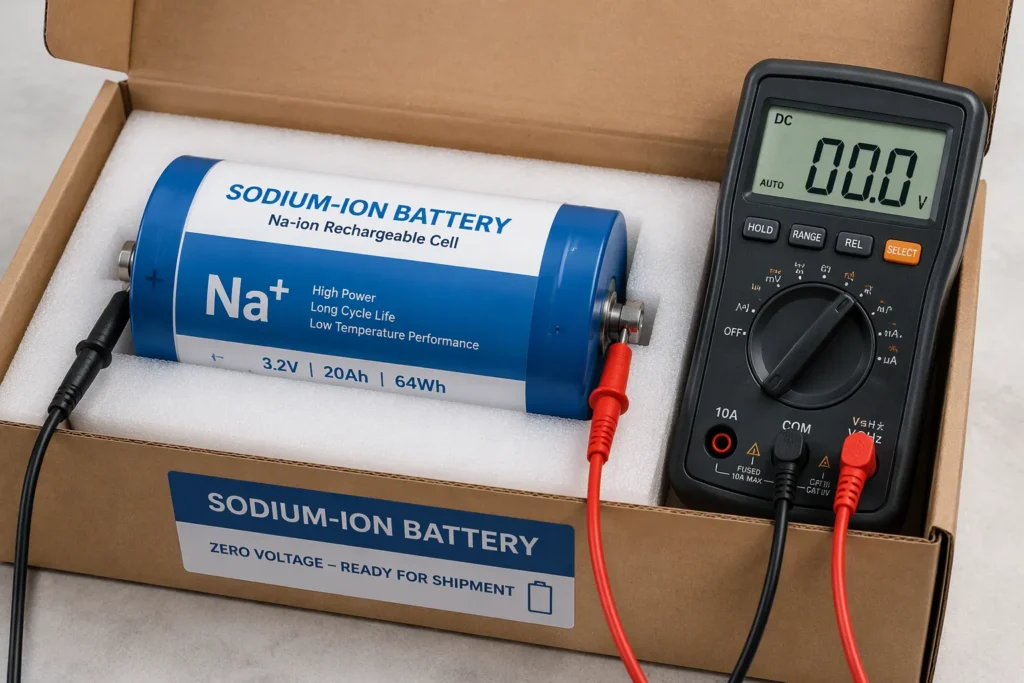
Yes, sodium-ion batteries shipped at 0V are possible, but only under certain conditions. The answer depends on three things: cell design, UN 38.3 testing and carrier acceptance. If any one of these is wrong, your shipment may not move.
Some sodium-ion cells can handle full discharge without damage. Others cannot. That is why the chemistry alone does not guarantee approval.
You will want the technical basis first. Then the transport rules, the practical prep steps and a fair look at partial-SoC shipping. Each piece matters before you book a freight slot.
One quick note: sodium-ion batteries shipped at 0V are not automatically compliant. Testing and paperwork decide that.
Key Takeaways
Sodium-ion batteries can be shipped at 0V if the cell design, UN 38.3 testing, and carrier acceptance all match up.
Zero volts lowers the risk of a short circuit, as the cell holds almost no energy.
UN 38.3 test summaries must include the discharged state for 0V shipping.
Get a full set of papers ready: the test summary, the safety data sheet, the shipping declaration, and the discharge record.
Pick 0V for long storage or sea journeys; pick partial charge for short trips and quick use.
Why Sodium-Ion Batteries Can Be Shipped at 0V
Voltage Behaviour of Sodium-Ion Cells
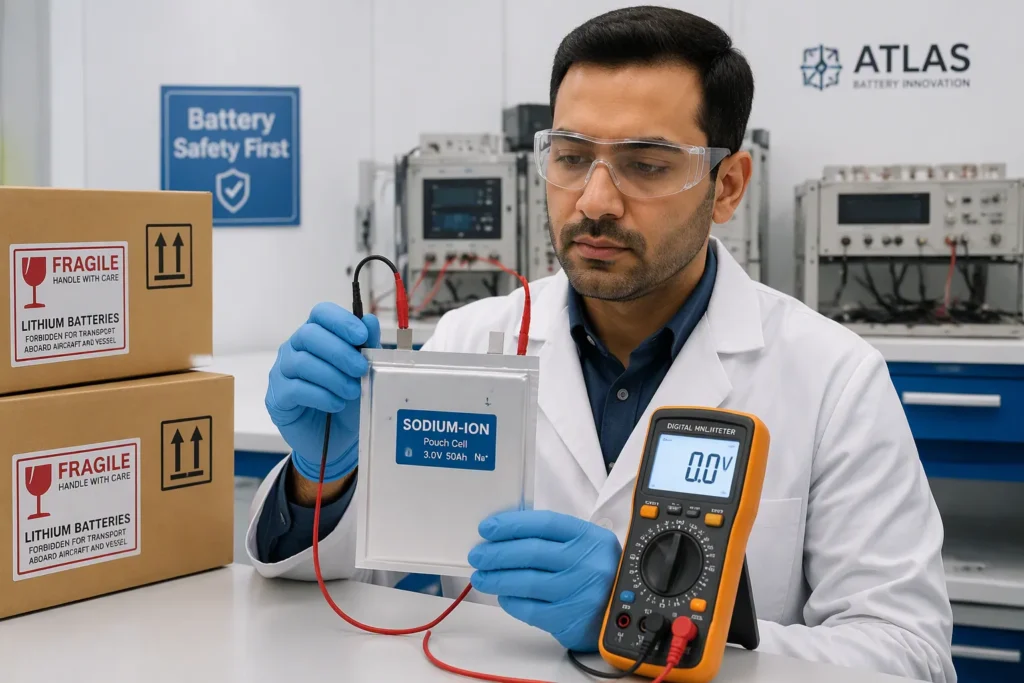
Here’s the core reason this works. Sodium does not alloy with the aluminium current collector inside the cell. Lithium does. Push a lithium-ion cell too low and copper dissolution begins, which can grow dangerous copper dendrites that pierce the separator later. Sodium-ion cells sidestep that failure mode entirely. You can take them fully discharged safely to 0 V without wrecking the cell.
That changes the shipping maths. A sodium-ion battery resting at zero volts holds no usable energy. The nominal voltage of a typical cell sits near 3.0 V, so the drop is total. During normal charge and discharge the operating voltage swings across a wide window, and the chemistry tolerates the bottom of it. Sodium-ion cells don’t need a protective floor the way lithium cells do.
The current collector detail matters more than it sounds. Aluminium is cheap, light and stable. Sodium ions slip in and out of the electrode structure without bonding to the foil. No alloy forms, no foil thins, no internal resistance creeps upward. That’s the physical basis for taking a cell all the way down. That stability is why the chemistry shrugs off abuse that would kill a lithium cell. Batch consistency helps too, because one weak cell can drag a whole pack out of balance.
Safety at Zero Volts
Picture an empty cell as a capacitor with almost nothing stored. Short the terminals and very little happens. Energy release scales with stored charge, so a drained cell has little to give. A shorted pack at full charge dumps its energy as heat in seconds. An empty pack has nothing to dump. That’s why the risk of thermal runaway from a short circuit falls sharply. Transporting sodium-ion batteries shipped at 0V removes the main ignition source.
Don’t get complacent, though. Stress can still produce heat, gas and toxic vapours, even at zero volts. A crushed, punctured or overheated cell doesn’t care about its state of charge. So you still watch the environment during transport — temperature, packaging integrity, ventilation, signs of swelling.
Zero volts lowers the risk. It does not remove the need for care.
Cell design earns its keep here. VEKEN‘s sodium batteries tolerate deep discharge, and they’ve passed nail penetration tests without fire or explosion. The range runs from small cylindrical cells to large prismatic ones, so you can match pack size to the job. Cold-climate users get stable output down to -40 °C, and the cells are rated for more than 4000 cycles. That track record supports safe long-distance transport and storage. For na-ion batteries crossing borders, it’s a real advantage.
One last contrast. A lithium pack at zero volts is often a dead pack. A sodium-ion battery at zero volts is usually a sleeping one. You ship it, you store it, you wake it up when you need it. That difference turns zero-volt shipping from theory into practice.
Rules for Shipping Sodium-Ion Batteries at 0V
UN 38.3 and Transport Rules
This is where the paperwork really matters. UN 38.3 is the test manual that every lithium and sodium cell must pass before it can travel. It covers altitude simulation, thermal cycling, vibration, shock, external short circuit, impact, overcharge and forced discharge. A cell design that passes these tests earns its transport ticket.
So when is zero volts allowed? The rules do not give you a simple yes. UN 38.3 tests a cell in the state it will be shipped. A fully discharged cell is a different test article from a charged one. You need test summaries that match your actual shipping setup. That is the first gate.
Air freight adds another layer. Sodium ion batteries can fly under IATA rules, and the Dangerous Goods Regulations set the packing instruction and state-of-charge limits. Here is the catch: carrier acceptance varies. One airline may accept your documents without a blink. Another may ask for extra evidence. Treat approval as something you earn per carrier, not something the chemistry guarantees. Check before you book.
Preparation and Documentation
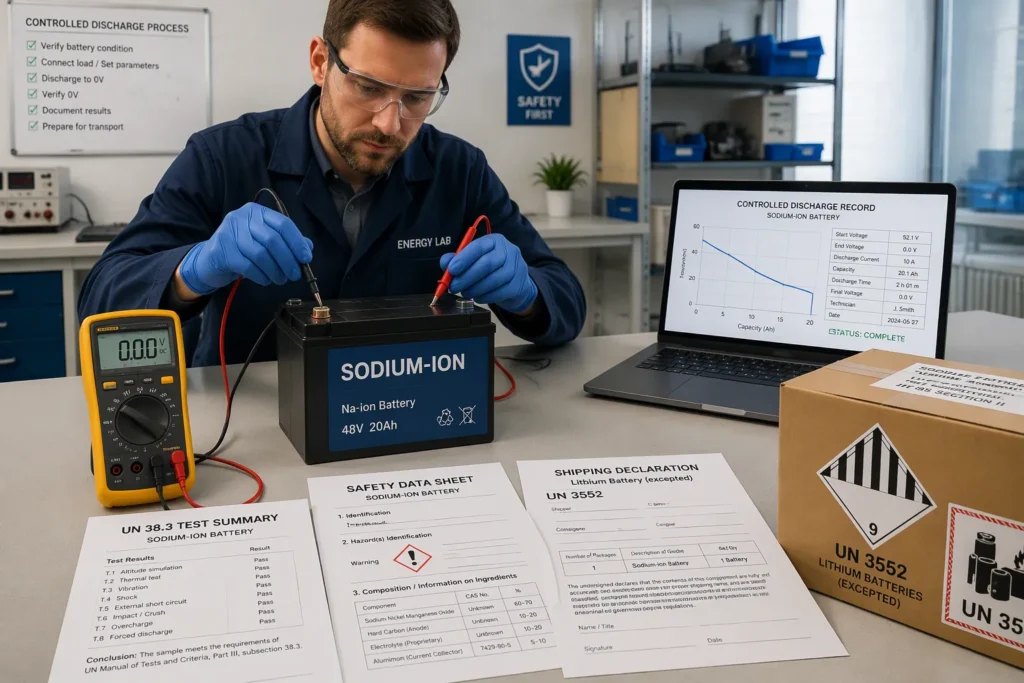
Now the practical side. Start with a controlled discharge. Take the battery pack down to 0 V using the manufacturer’s procedure, not a dead short. Record the final voltage and the discharge method. That record becomes part of your file.
Next, confirm your UN 38.3 test summary covers the discharged state. Keep the test report, the summary and the cell specification sheet together. Then label the package correctly for the mode of transport. Air shipments need the right hazard class, UN number and packing instruction on the box.
Your document pack should include the test summary, a safety data sheet, the shipping declaration and the discharge record. Missing one page can stall a shipment for days. Photograph the labels before the pallet leaves your dock.
One honest caveat: regulations shift, and national authorities interpret them differently. Confirm the current requirements with your carrier and a dangerous goods professional before every new route. That is not bureaucracy. It is how you keep sodium-ion batteries shipped at 0V moving without surprises.
0V Versus Partial State of Charge
Performance and Application Fit
Both options work. The question is which one suits your route and your timeline. Sodium-ion batteries shipped at 0V arrive empty, so you must charge them before use. That adds a step at the receiving end.
Here’s the trade-off. Storing sodium-ion cells at an extremely low voltage state for a long duration can raise internal resistance. Cycling stability may slip a little too. So shipping at low voltage suits long storage and long sea routes for these batteries. Partial state of charge keeps the battery nearer its comfort zone. If you use the battery pack soon after delivery, partial-SoC shipping may fit better.
Now compare the chemistries. A na-ion battery handles charge and discharge much like a lithium one, yet its operating voltage window is wider. Na-ion batteries shrug off a state that would leave a lithium cell severely over-discharged. A discharged cell is not a damaged one here. Leave a lithium cell there and it may never come back.
Think about the job. Cold-climate users, deep-cycle users and high-power users want different things. VEKEN’s sodium range covers all three. The cells hold stable output down to -40 °C, tolerate deep discharge and deliver strong high-rate current. Match the shipping state to the application.
Compliance and Cost
Rules differ by state of charge. A sodium-ion battery at zero volts still needs valid UN 38.3 data for that condition. Partial-SoC shipments face their own limits, especially by air. Check both paths with your carrier first. Ask for the test summary in writing and keep it with the shipping papers.
Cost follows the same logic. Zero-volt shipping can simplify handling and cut risk. Partial-SoC shipping skips the recharge step and the resistance penalty. Neither wins everywhere. A short domestic road trip rarely needs zero volts. A long ocean crossing often does. Weigh freight mode, storage time and how soon the battery goes to work.
So, can you ship sodium-ion batteries at 0V? Yes — but only when the technical and regulatory boxes are ticked. Your cell design must cope with being fully discharged. Your UN 38.3 testing must cover that discharged state. Labels and paperwork must be right, and your carrier must accept the shipment.
If you miss any one of those, partial-SoC shipping remains a sensible fallback. It works well for short routes and packs used soon after delivery.
Check each condition before you book. That habit keeps sodium-ion batteries shipped at 0V moving smoothly, and it keeps every battery in your supply chain safe.
FAQ
Is it legal to ship sodium-ion batteries at 0V?
Yes, when the rules all match up. Your cell design must survive being fully discharged. Your UN 38.3 test summary must cover that discharged state, and your carrier must accept the shipment. Miss one and the answer becomes no. Always check with your carrier before you book.
Do the cells lose capacity after sitting at zero volts?
Not usually. Sodium does not alloy with the aluminium foil, so a drained cell rests rather than dies. Long storage at very low voltage can push internal resistance up, though. Charge the pack before use and you will hardly notice. 😴
Can you fly sodium-ion batteries by air?
You can, under IATA rules. The Dangerous Goods Regulations set the packing instruction and state-of-charge limits. Carrier acceptance still varies, so ask your airline early. Keep the test summary and shipping declaration ready. Air freight rewards good paperwork.
What paperwork do you need before shipping?
Build a file with four parts: the UN 38.3 test summary, a safety data sheet, the shipping declaration and your discharge record. Label the package for the way it travels. Photograph the labels before the pallet leaves. One missing page can hold everything up.
When should you choose partial state of charge instead?
Pick partial SoC for short routes and packs used soon after delivery. It skips the recharge step and avoids the resistance penalty of long storage at low voltage. Zero volts suits long sea crossings and extended storage. Match the shipping state to your timeline.