
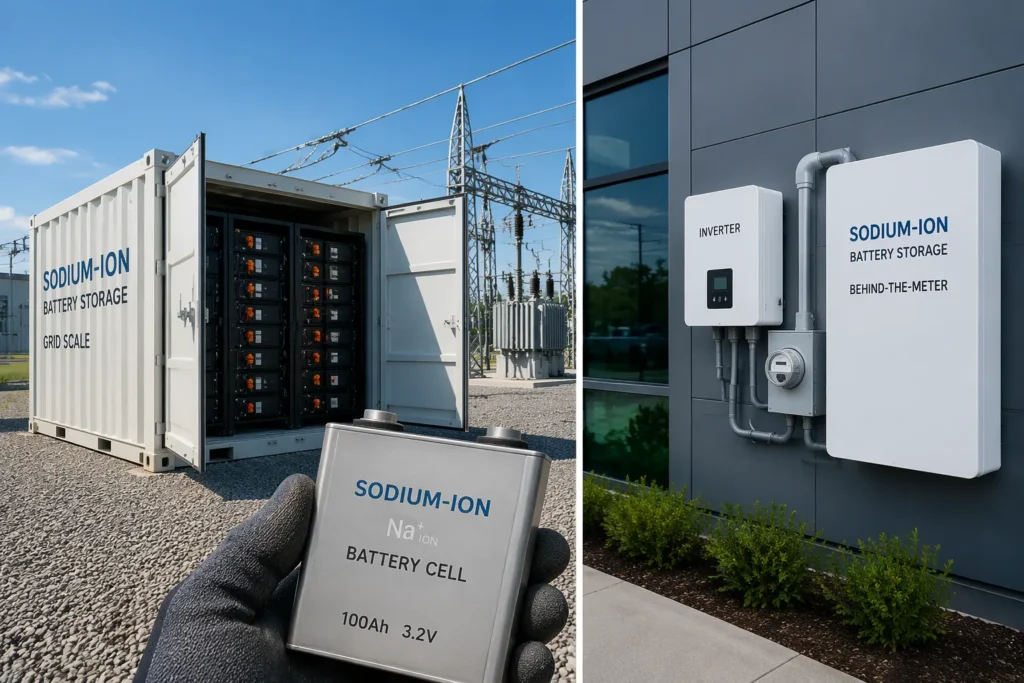
Sodium-Ion Cells Fit Best in grid-scale storage for steady, long-lasting jobs. They also suit behind-the-meter storage at sites with space limits, safety worries or tight budgets.
Each scale rewards different strengths. Grid-scale projects value long cycle life and plenty of raw materials. Customer-side installations value compact packs, built-in safety and low upkeep. Sodium-ion chemistry serves each case without the same trade-offs.
This comparison weighs technical performance, application fit, regulatory compliance and cost at both scales. It shows where Sodium-Ion Cells Fit Best today, and where they remain a practical option for near-term use.
Key Takeaways
Sodium-ion cells are great for grid-scale storage that lasts a long time and cycles every day, because they can handle over 4000 cycles.
They also work well for behind-the-meter sites that have little space or high safety needs, because they are small and safe against fire.
Sodium-ion cells work from −40℃ to 80℃, so they need less heating or active cooling.
Sodium is easy to find, so costs stay steady, which helps both grid projects and customer-side projects.
Pick the right chemistry for the job: grid-scale storage cares most about low lifetime cost, while behind-the-meter storage cares most about safety and small size.
Two Scales Of Battery Energy Storage System
Grid-Scale Requirements
Grid-scale storage sits on the network side of the meter. Operators call this front-of-the-meter storage. These plants connect straight to the power grid and serve the whole network, not just one customer. A utility or grid-scale battery storage site usually provides peak shaving, frequency response and long-duration shifting of renewable output.
The duty cycle shapes the design. Long-duration duty favours cheap, plentiful materials and steady cycle life over small size. A grid-scale battery energy storage system often runs daily deep cycles for many years. Planners therefore treat storage duration as a main specification. Long-duration energy storage, or LDES, aims for many hours of discharge. LDES projects accept a bigger footprint in return for low cost per stored kilowatt-hour. A large BESS also needs strong grid interconnection and remote monitoring.
Behind-The-Meter Requirements
Behind-the-meter storage sits on the customer side. It serves homes, commercial and industrial sites and small campuses. These systems manage bills, shift load away from peak tariffs and give backup power during outages. A compact battery storage system must fit into a plant room or a garage, so footprint matters as much as capacity.
Customer-side units also win faster grid interconnection. They cut site demand and ease pressure on local feeders. A well-sized battery energy storage system can lower a site’s peak import and trim its charges. Owners of these battery storage systems expect low maintenance and simple operation. Safety certification and quiet running often decide the purchase. Each scale therefore sets different priorities for the same battery energy storage technology.
Sodium-Ion Batteries: Core Characteristics
Energy Density And Cycle Life
Sodium-ion batteries are lower than lithium chemistries in energy density. A sodium-ion cell holds less energy for its weight and volume. That gap matters little in a fixed installation. A battery energy storage plant on a concrete pad can take the extra footprint without penalty.
Cycle life tells a stronger story. Prismatic sodium-ion cells from VEKEN go past 4000 cycles. The chemistry also handles deep discharge well. Users can run a pack close to empty without the damage that shortens lead-acid life. Sodium-ion batteries therefore suit daily charge and discharge patterns in battery energy storage.
Safety And Temperature Range
Safety comes from the chemistry itself. Sodium-ion cells have passed nail penetration tests with no fire or explosion. That result supports safe long-distance transport and long-term storage on site.
The operating window is wide. VEKEN sodium-ion cells run from −40℃ to 80℃. Output stays steady in cold conditions, so outdoor cabinets need no heated enclosure. This range sets sodium-ion cells apart from high-temperature sodium-sulphur designs, which need constant heat. Sodium-ion batteries work at ambient temperature instead.
Parameter | Sodium-ion cell performance |
|---|---|
Cycle life | Over 4000 cycles (prismatic cells) |
Operating range | −40℃ to 80℃ |
Nail penetration | No fire, no explosion |
Cooling demand | Reduced, ambient operation |
Low system complexity follows. A battery energy storage system built on this chemistry needs less active cooling and fewer thermal parts. Fewer parts mean fewer failure points. Each energy storage system also carries a lower auxiliary load, which lifts round-trip efficiency on site.
Sodium-Ion Cells Fit Best At Grid Scale
Long-Duration And Stationary Use
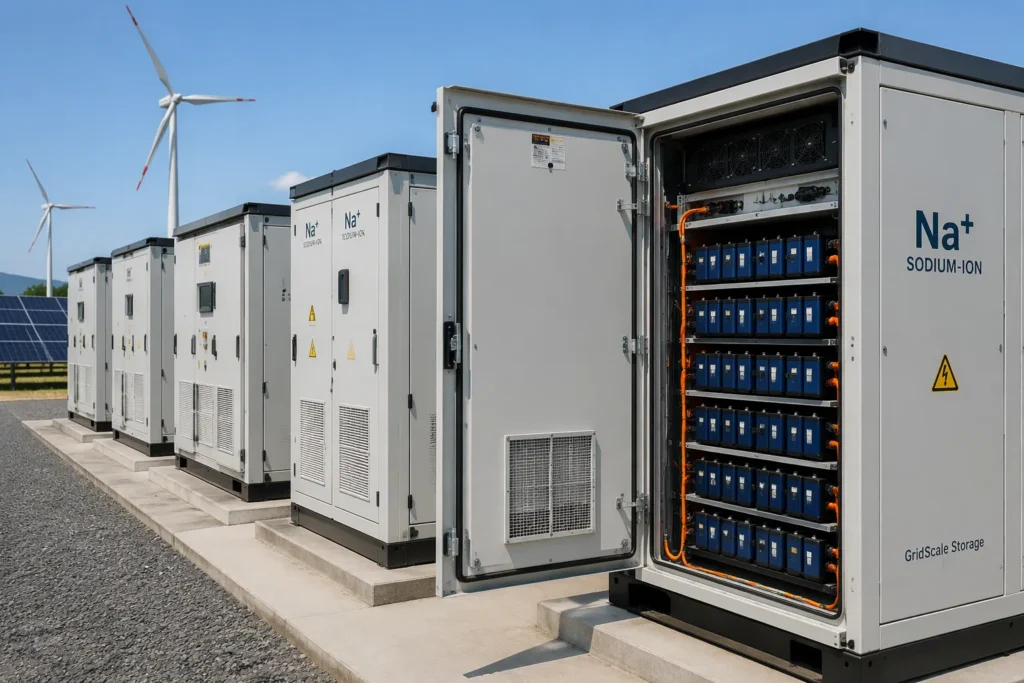
Stationary duty rewards patience, not lightness. A grid-scale battery energy storage system stays in one place for decades. It charges and discharges every day. Sodium-ion cells fit best here because the chemistry handles steady, deep cycling without the wear that shortens other designs.
Long-duration energy storage moves extra renewable power across many hours. Planners of grid-scale LDES projects accept a larger footprint in return for low cost per stored kilowatt-hour. Sodium-ion batteries hold less energy than lithium chemistries. That gap costs little on a concrete pad. The same trait hurts a vehicle, where weight matters. A fixed battery energy storage plant can take the extra volume without penalty.
Storage duration shapes the design of every LDES project. A BESS built for longer durations needs cells that keep capacity across thousands of cycles. Prismatic sodium-ion cells from VEKEN go past 4000 cycles. The cells also run from −40℃ to 80℃, so outdoor cabinets need no heated enclosure. VEKEN supplies these cells as customizable packs for industrial energy storage systems. Buyers can set capacity, voltage and pack dimensions to match the site. This flexibility makes sodium-ion a competitive solution for LDES developers who plan around lifetime cost rather than peak power.
Sodium Supply And Cost
Material abundance supports the cost case. Sodium is one of the most common elements on earth. Supply chains for sodium-ion batteries therefore face less pressure than those built on scarcer metals. A grid-scale battery energy storage solution depends on predictable material costs across a multi-year build. Sodium offers that predictability.
Cell cost falls further through simple system design. Sodium-ion batteries need less active cooling than chemistries that run hot. Fewer thermal parts cut the auxiliary load on each energy storage system. A leaner energy storage system has fewer failure points and lower upkeep. Operators of a grid-connected BESS then spend less on maintenance across the asset life.
The table below summarises the fit between sodium-ion traits and grid duty.
Grid requirement | Sodium-ion response |
|---|---|
Long duration, daily cycling | Over 4000 cycles on prismatic cells |
Low cost per stored kWh | Abundant sodium, simple thermal design |
Outdoor siting | −40℃ to 80℃ operating range |
Remote operation | Reduced cooling, fewer parts |
Sodium-ion cells fit best where the grid needs steady energy over many hours. Cost-driven, stationary projects gain the most from this chemistry. The next section turns to customer-side sites, where space and safety reshape the case.
Sodium-Ion Cells Fit Best Behind The Meter
Space, Safety And Backup
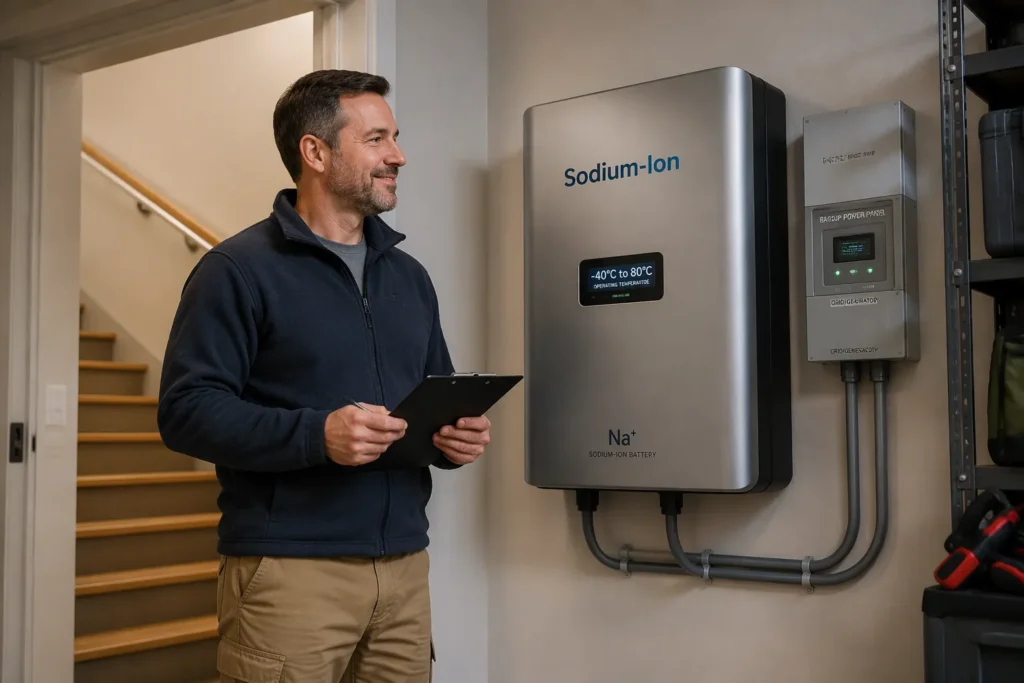
Customer-side sites set a different test. A home garage or a shop plant room offers little floor area. Owners of a battery energy storage system at this scale count every centimetre. Sodium-ion cells fit best where the pack must sit close to people and property. The chemistry removes the fire risk that shapes enclosure design. Nail penetration tests on these cells produce no fire and no explosion. That result lets designers place a unit beside a stairwell or inside a utility cupboard.
Backup duty adds a second demand. A household or a small business needs power during an outage, often within seconds. Deep-discharge tolerance keeps useful capacity in reserve. Users can draw a pack low without the damage that shortens lead-acid life. Prismatic cells from VEKEN exceed 4000 cycles, so daily cycling does not wear down the reserve quickly.
Temperature range decides siting too. Cells rated from −40℃ to 80℃ work in an unheated outbuilding or a hot roof space. The table below sets out the fit.
Site constraint | Sodium-ion response |
|---|---|
Small footprint | Compact prismatic and cylindrical packs |
Fire risk near occupants | No fire or explosion in nail penetration tests |
Cold or hot rooms | −40℃ to 80℃ operating range |
Backup readiness | Deep-discharge tolerance, over 4000 cycles |
Cost-Sensitive Installations
Households and small firms watch capital cost and upkeep together. A maintenance-free design removes service visits from the budget. Sodium-ion batteries need less active cooling than chemistries that run hot. Fewer thermal parts mean fewer failures and lower running costs across the asset life.
Material supply supports the price case. Sodium is abundant, so cell prices face less pressure than chemistries built on scarce metals. That stability helps a buyer who plans a battery energy storage purchase years ahead. An energy storage solution for a home or a backup cabinet therefore carries a predictable lifetime cost.
VEKEN supplies sodium-ion batteries for home energy storage and UPS backup. The 钠电 range covers cylindrical and prismatic formats with custom pack options. Buyers can set capacity, voltage and dimensions to suit a plant room or a rack. Commercial and industrial sites use the same cells for peak shaving and standby power. A behind-the-meter grid connection then needs no oversized cabinet. Each battery energy storage system at this scale gains from simple thermal design and quiet running. Sodium-ion batteries suit these duties without the space penalty of a large plant. The next section compares both scales side by side.
Comparing Both Battery Storage System Scales
Performance And Application Fit
The two scales reward different traits. A grid-scale battery energy storage system runs deep daily cycles for many years. Prismatic sodium-ion cells exceed 4000 cycles, so this duty suits them. A behind-the-meter battery storage system cycles less deeply and values compact size instead. Sodium-ion energy density sits below lithium, and that gap costs little on a concrete pad but matters in a garage.
Application fit follows the same split. LDES projects shift renewable output across many hours. Planners of LDES accept a larger footprint for a low cost per stored kilowatt-hour. LDES developers therefore treat sodium-ion as a strong candidate. Home and commercial units serve bill management and backup, where safety near occupants decides the design. Nail penetration tests on these cells produce no fire and no explosion. Both scales gain from the −40℃ to 80℃ range, which removes heated enclosures at either site.
Criterion | Grid scale | Behind the meter |
|---|---|---|
Cycle pattern | Daily deep cycling | Shallow cycling, backup |
Footprint | Tolerant | Tight |
Safety priority | High | Critical |
Temperature range | −40℃ to 80℃ | −40℃ to 80℃ |
Compliance And Cost
Compliance duties differ by scale. Grid-connected plant faces grid interconnection studies and network codes before construction. A customer-side battery storage system meets product safety certification and local electrical rules instead. Both routes demand documented test evidence, and sodium-ion cells supply that through nail penetration and drop testing.
Cost structures diverge too. Grid-scale battery energy storage spreads capital cost across many megawatt-hours, so material abundance drives the case. Sodium supply is plentiful, which steadies cell prices across a multi-year build. Behind-the-meter battery storage systems carry higher cost per kilowatt-hour, and buyers there weigh purchase price against maintenance savings. A maintenance-free design and reduced cooling help both scales. Neither scale wins outright. Grid-scale suits long-duration, stationary, cost-driven work. Customer-side sites suit space-limited, safety-critical, budget-aware installations. BESS applications in each category simply call for different priorities, and sodium-ion serves both.
Sodium-ion cells work best at grid scale for long, steady jobs that stay in one place. Projects driven by cost gain the most from plentiful sodium and a long cycle life. Behind the meter, this chemistry suits sites with tight space, high safety needs and careful budgets. Homes and small firms like the small packs and low upkeep.
One lesson guides the choice. Match the chemistry to the job, not to one headline number. Grid-scale battery energy storage rewards low lifetime cost. Customer-side storage rewards safety and a small footprint. Sodium-ion cells serve both jobs today, and they stay a practical option as projects grow.
FAQ
Where do sodium-ion cells fit best in a battery energy storage system?
Sodium-ion cells work best in grid-scale battery energy storage for long-duration, stationary duty. They also suit behind-the-meter sites with tight space or strict safety needs. Each scale rewards different strengths, so the duty cycle decides the fit.
How long do sodium-ion cells last in daily cycling?
Prismatic sodium-ion cells from VEKEN go past 4000 cycles. The chemistry also handles deep discharge without the damage that shortens lead-acid life. A battery storage system that charges and discharges daily therefore keeps its capacity across many years of service.
Do sodium-ion cells need active cooling?
The cells run from −40℃ to 80℃, so outdoor cabinets need no heated enclosure. A battery energy storage system built on this chemistry needs less active cooling and fewer thermal parts. Each energy storage system then carries a lower auxiliary load and fewer failure points.
Are sodium-ion cells safe near homes and workplaces?
Yes. Sodium-ion cells have passed nail penetration tests with no fire and no explosion. That result supports safe transport and long-term storage on site. Designers can place a compact battery storage system beside a stairwell or inside a utility cupboard.
Why do LDES developers favour sodium-ion chemistry?
LDES projects accept a larger footprint in return for low cost per stored kilowatt-hour. Sodium is abundant, so cell prices face less pressure across a multi-year build. LDES planners therefore treat sodium-ion as a strong candidate for stationary, cost-driven battery energy storage.