
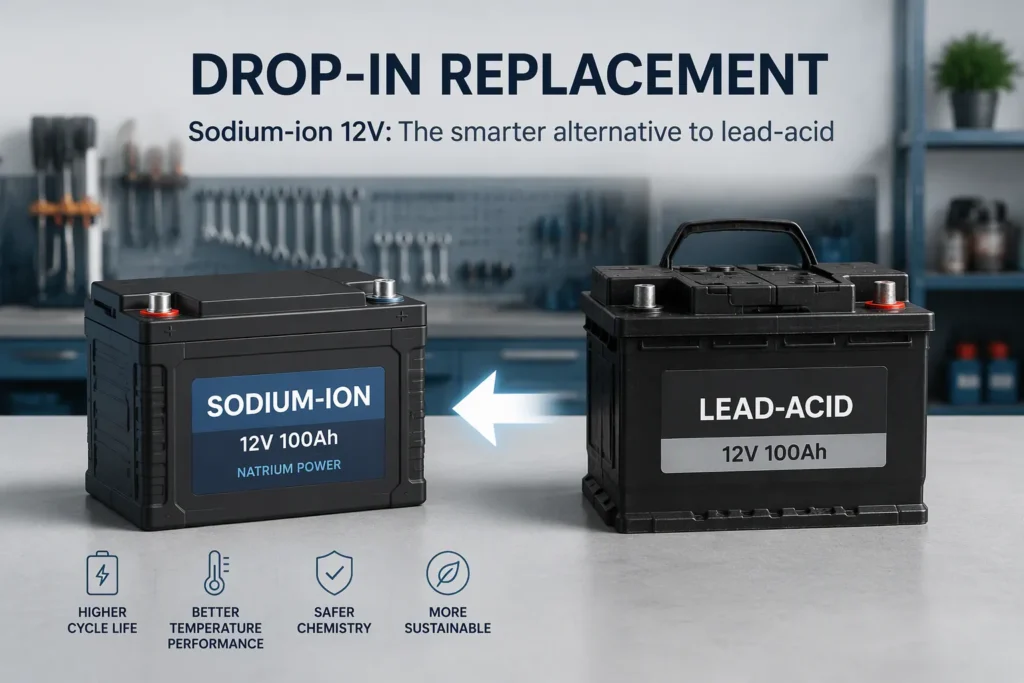
Can you swap a lead-acid 12V battery for a sodium-ion one without touching your equipment, charger, or wiring? The honest answer is: it depends. This isn’t a simple yes or no. A true drop-in only works when a few conditions line up.
Think about what’s at stake for you. Equipment compatibility, charging behaviour, safety, and cost all shift with your application. Get one wrong, and you could damage your gear or waste money.
Sodium-ion vs lead-acid isn’t a contest with one winner. Each suits different jobs. Stay with me, and you’ll finish with a clear checklist to judge your own case.
Key Takeaways
Check five things before you swap: voltage, charger, BMS, physical fit, and your application.
Your charger needs a setting that fits what the sodium-ion battery requires.
The battery management system (BMS) must work well with your equipment.
Check the size of your battery space and its terminals so the battery fits properly.
Pick the battery that fits your job: sodium-ion works well for deep cycling, and lead-acid works well for light use.
The Conditional Answer
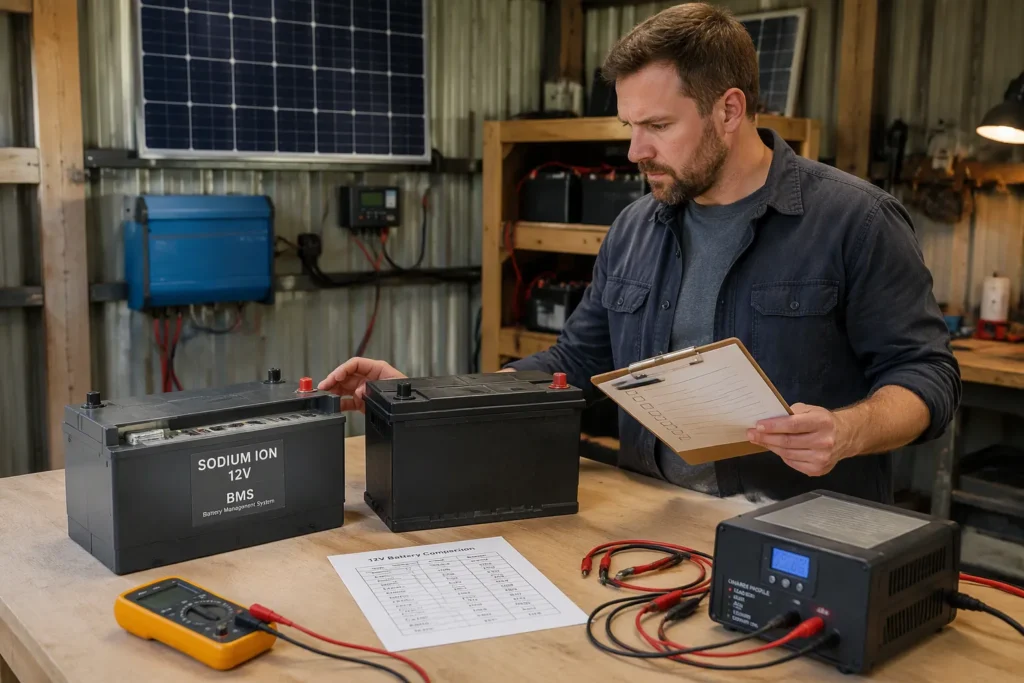
Here’s the straight answer. Sodium-ion batteries are not a universal drop-in replacement for lead-acid. They become one only when a specific set of conditions lines up for your setup. Miss a single condition, and the swap turns into a small project rather than a straight exchange.
So what has to line up? Five things, and each one deserves a quick check before you spend a penny:
The voltage window of the new pack must suit your equipment.
Your charger profile must match what the sodium-ion pack expects.
The battery management system (BMS) must integrate cleanly with your system.
The physical size and terminals must fit your existing space.
Your application must actually suit sodium-ion chemistry.
Get all five right, and the swap feels effortless. Get one wrong, and you’ll notice fast.
When a Drop-In Works
A true drop-in happens when your equipment already tolerates a wider voltage swing. Modern chargers with selectable profiles often handle it well. So do systems built around a smart BMS that talks to the pack. If your battery bay takes a standard case size and your load is a deep-cycle one, the odds improve further.
Think about a solar shed or a backup power box. You control the charger, the wiring is simple, and the load is gentle. In that setting, a sodium-ion 12V battery drop-in replacement is realistic. The pack slots in, the BMS does its housekeeping, and you carry on.
When It Does Not
Now picture an older vehicle with a fixed alternator setpoint and a charger that assumes lead-acid behaviour. Here, charging becomes the sticking point. The pack may never reach a full state, or the alternator may push a profile the BMS rejects. That’s not a fault of sodium-ion chemistry. It’s a mismatch between two designs.
Physical fit can also trip you up. A taller case or a different terminal layout means brackets, cables, or a new tray. That’s no longer a swap. It’s an install.
None of this makes lead-acid a bad choice. It remains a proven, affordable option for plenty of jobs. The point is simpler. Sodium-ion vs lead-acid is a question of fit, not of superiority. Treat the replacement as conditional, verify the five points above, and you’ll know within minutes whether your case qualifies.
Voltage Range and Compatibility
Nominal Voltage Differences
Both packs have “12V” on the label. But that label hides a real difference. A normal lead-acid battery rests at about 12.6V to 12.9V when fully charged. When you charge it, the voltage rises to between 13.8V and 14.7V, depending on the charging method.
Sodium-ion acts in a different way as its charge level changes. Its working window is in a similar range, but the curve is flatter in the middle and shifts at the edges. Your equipment sees voltage, not chemistry. So the shape of that curve matters as much as the nominal figure.
What Equipment Expects
Gear built around lead-acid expects certain cut-offs. Check these typical thresholds:
Threshold Type | Typical Voltage | Condition / Notes |
|---|---|---|
Float charging voltage | Less than ~2.4 V per cell | Constant-voltage float charger held low to limit current and reduce overcharge damage |
Discharge cut-off voltage | ~1.75 V per cell | Varies with temperature and discharge rate; the manufacturer should specify values |
Now ask a simple question. Does your charger or load stop at those points? A charger that floats at a lead-acid setpoint may never fully top up a sodium-ion pack. An inverter that cuts off at a lead-acid discharge point may stop early, leaving usable capacity behind.
Before any sodium-ion 12V battery drop-in replacement, check two things. First, confirm your charger’s absorption and float voltages. Second, confirm your equipment’s low-voltage disconnect. A quick check with the manufacturer’s datasheet settles it. If the numbers don’t match, plan for a charger or setting change. That’s the difference between a swap and a project.
Charging Profile and Charger Suitability
How Sodium-Ion Charges
Sodium-ion doesn’t charge like lead-acid. Lead-acid likes a slow finish and a long float stage. Sodium-ion packs accept current more readily across the bulk of the cycle, and their low internal resistance keeps that flow steady. The result is efficient charging with less wasted heat.
Your pack’s BMS runs the show. It watches cell voltages and trims current near the top of the charge. That behaviour is a feature, not a quirk. It protects the cells and keeps the pack balanced over thousands of cycles.
Here’s the catch. A charger built for lead-acid may hold a float voltage the sodium-ion BMS reads as “done” too early. Or it may push a finish stage the pack doesn’t want. Battery University’s guidance on charging lead-acid versus other chemistries shows how much the profiles diverge. The lesson is simple: match the profile, not just the plug.
Checking Your Charger
Start with the label on your charger. Look for a selectable lithium or sodium-ion mode. Many modern chargers offer one. If yours only lists lead-acid, check the absorption and float settings against the pack datasheet.
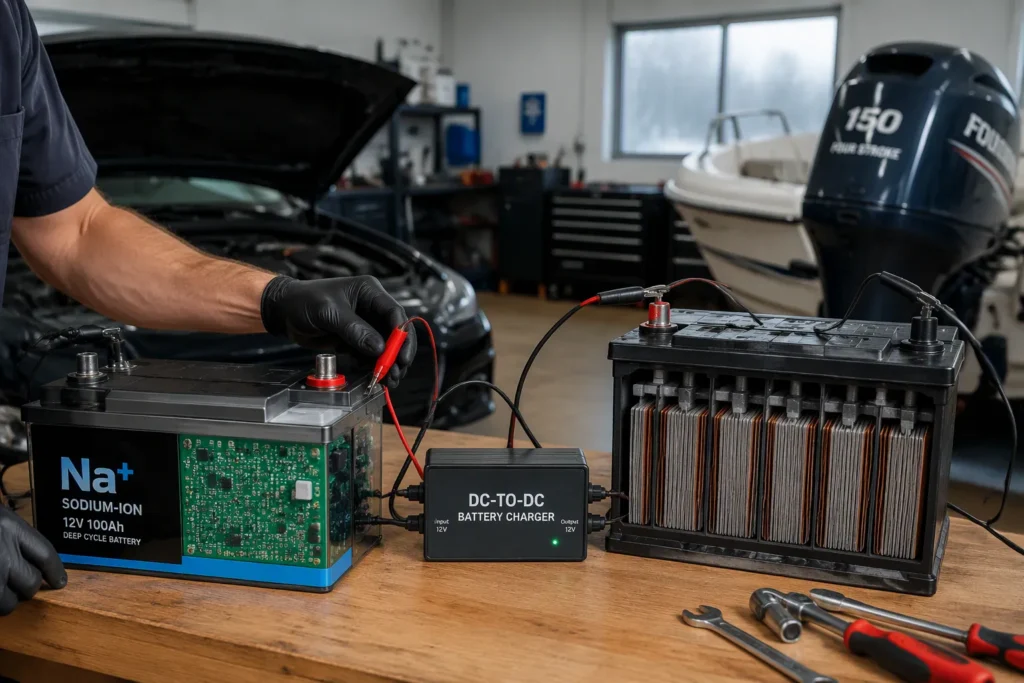
Vehicle setups need extra care. Standard alternators run a fixed setpoint tuned for lead-acid. Charging from an alternator this way can leave a sodium-ion pack short of full. A dc to dc charger installed between the alternator and the pack solves this. It steps the voltage up or down to suit the pack.
Camper and boat owners often use split charge relays or split charge systems to link starter and house batteries. Those setups assume lead-acid behaviour. Swap in a dc to dc charger instead, and alternator charging becomes predictable. Split charge relays simply can’t give you a proper charge profile for sodium-ion.
Some sources warn that sodium-ion is not universally drop-in compatible. Treat that as a prompt to verify, not a reason to walk away. Check your chargers, confirm the profile, and the swap stays simple.
BMS Requirements and Integration
Why a BMS Matters
A sodium-ion 12V pack is more than just cells in a box. The battery management system is the brain of the pack. It keeps every cell inside its safe range, and it decides how much current flows in and out.
Here is what a good BMS does for you:
It checks temperature, voltage and current, and keeps them within safe limits.
It handles heat by adjusting cooling and starting safety cut-offs when needed.
It limits charge and discharge to stop overcharging and deep discharge.
It estimates charge level and battery health, and records fault data.
It talks to your charger and motor controller to plan safe charging.
That last point matters most for a sodium-ion 12V battery drop-in replacement. A strong BMS works with your charger, so the pack charges correctly even when the charger wasn’t made for it. It also adds low-temperature protection, which keeps cells safe in the cold. The payoff is protection plus longer life, on top of sodium-ion’s naturally low fire risk.
Wiring Considerations
Wiring needs a careful look before you commit. Check the cable size against the pack’s maximum discharge current. Sodium-ion handles high-rate discharge well, so cables that are too small become the weak link.
Terminal layout is the next check. Positive and negative posts may sit differently from your old battery. Make sure your existing leads reach without strain.
If you run a split charge relay between starter and house batteries, plan for a change. That setup assumes lead-acid behaviour. A dc to dc charger gives the pack a proper profile instead.
Finally, keep the BMS communication line in mind. Some packs share data with the charger or controller. Confirm the wiring supports that link, or ask your supplier how the pack behaves without it.
Physical Dimensions and Fitment
Case Sizes and Terminals
You’ll see Group 31 and other standard formats marketed as direct swaps. That’s a helpful starting point, not a guarantee. Case dimensions vary between makers, and a few millimetres can decide whether the lid closes or the bracket fits.
Terminal layout deserves the same scrutiny. Post height, post diameter and the distance between posts all matter. Check your cable lugs before you buy. A positive post on the wrong side turns a five-minute job into a rewiring session.
Grab a tape measure and compare three things: length, width and height. Then check the terminal positions against your old lead-acid battery. If the numbers match, you’re in good shape. If they don’t, plan for a new tray or longer cables.
Weight and Mounting
Here’s a pleasant surprise. A sodium-ion 12V battery can be up to 60% lighter than an equivalent lead-acid or AGM battery. That difference changes how you handle the install. Lifting a heavy agm battery out of a tight bay is a two-person job. The sodium-ion pack often comes out with one hand.
Less weight also eases the load on mounting brackets and trays. Check that your hold-down clamp still grips the new case firmly. A lighter pack can shift if the clamp was sized for a heavier block. Add a spacer or adjust the bracket if needed.
Finally, confirm the case sits flat and secure. Vibration is the enemy of any battery. A snug fit protects the terminals and keeps the pack stable on rough roads or in a moving vehicle.
Cold-Weather Performance
Sodium-Ion in Low Temperatures
Cold mornings are hard on any battery. Sodium-ion copes well with them. Sodium-ion packs can discharge as low as -30°C, so your equipment still starts when the temperature drops. That is important for a snow plough, a cold-store backup, or a solar box at a winter cabin.
Discharge holds up well in freezing weather. Sodium-ion keeps better capacity in the cold than lithium-ion chemistry does. The charging side needs more care. As the temperature falls, the electrolyte gets thicker, ionic conductivity drops, and internal resistance rises. Each sodium ion must shed its solvent shell before it enters the hard carbon anode, and that step slows a lot in the cold. If you push current too fast, metallic sodium plates onto the anode, which permanently costs you capacity. A well-built BMS limits the current to protect the cells. Warm the pack before a full top-up and you get the full rate back.
Lead-Acid in Low Temperatures
The older chemistry feels the cold too, and it is worth knowing how. Usable capacity shrinks as the temperature drops, and the reaction inside slows down. Cranking power falls with it. That is why a tired lead-acid battery often quits on the first frosty morning rather than in summer.
The chemistry still works, though. It remains a dependable choice in mild climates and for seasonal use. The real difference is headroom. Sodium-ion keeps more of its punch when the temperature drops, so cold-climate users get a wider working margin. Match the battery to your winter conditions and either chemistry can serve you well.
Sodium-Ion vs Lead-Acid: Application Fit
Automotive, Marine, and Recreational
Start with the everyday car. It needs a big burst of current for a few seconds, then a steady top-up from the alternator. A lead-acid starter battery does this job well and costs little. Sodium-ion also gives strong cranking power, and VEKEN builds motorcycle batteries with cold cranking amps from 52.5A to 135A. The problem is charging. Standard alternators run a fixed setpoint tuned for lead-acid, so a sodium-ion pack may never reach full. Fit a dc to dc charger between the two and the profile lines up.
Boats and campers raise the stakes. You often run a lead-acid starter battery for the engine and a standard lead-acid leisure battery for the cabin. A split charge relay links them, and that relay assumes lead-acid behaviour. Swap the leisure battery for sodium-ion and the relay can’t give it a proper profile. Boat batteries and marine batteries usually do better with a smarter setup. Marine batteries face constant vibration and damp air, so a sealed pack with a solid BMS earns its place. Sodium-ion marine batteries suit deep-cycle house loads well. Keep the lead-acid block for starting if your alternator and chargers are fixed.
Solar, UPS, and Stationary Storage
Here the picture flips in sodium-ion’s favour. A solar shed or home storage bank cycles hard, day after day. Sodium-ion handles deep discharge and keeps a long cycle life, which suits that rhythm. VEKEN supplies packs for home energy storage, industrial energy storage and emergency power. A UPS rarely discharges, but it must fire on demand. Sodium-ion’s stable output in the cold helps a backup unit in an unheated room.
Lead-acid still fits stationary jobs where budget rules and cycling stays shallow. A standby bank that rarely drains can last years at low cost. So match the chemistry to the duty cycle. Heavy cycling favours sodium-ion. Light cycling on a tight budget favours lead-acid.
Application | Sodium-Ion Fits Best When | Lead-Acid Fits Best When |
|---|---|---|
Automotive | You add a dc to dc charger | The alternator setpoint is fixed |
Marine and recreational | House loads cycle deeply | Starting duties dominate |
Solar and home storage | Daily deep cycling | Shallow cycling, low budget |
UPS and emergency power | Cold rooms, long standby | Rare discharge, cost-first |
Neither column wins outright. Your duty cycle decides.
Regulatory Compliance and Safety
Transport and Shipping Rules
Shipping a sodium-ion 12V battery follows rules that are close to lithium, but not the same. If you get the paperwork wrong, your parcel will get stuck at the depot. Two points matter most:
Aspect | Requirement for Sodium-Ion Batteries |
|---|---|
Marking and labelling | The old “Lithium Battery Mark” is now the “Battery Mark”. It covers both lithium-ion and sodium-ion packs, so you need to update your labels. |
Classification and handling | Sodium-ion shares UN numbers and packaging rules with lithium-ion, but it is classified separately with its own handling instructions. |
A few extra rules apply to waste and returns. Your quality system must keep the combined total of lithium and sodium-ion cells under 333 kg per transport unit. Packages going for disposal or recycling need the right wording, such as “SODIUM ION BATTERIES FOR DISPOSAL”. Under ADR special provision 670, small cells built into household equipment are exempt when they are not the main power source and the equipment protects them. Other shipments to an intermediate facility can also travel exempt if packed to packing instruction P909 and kept within that 333 kg limit. It is worth reading the UNECE ADR guidance before your first shipment.
Safety Standards and Certification
Safety is where sodium-ion earns trust. The chemistry has a low fire risk by design, and independent testing backs that up. VEKEN’s sodium battery passed nail penetration tests without fire or explosion. That result matters for long-distance transport and storage, where a damaged cell must not become a hazard.
Certification still deserves a check. Ask your supplier for test reports covering penetration, extrusion and drop. Confirm the pack meets the standards your insurer or port expects. Do this before you order, not after. A certified pack keeps your charging setup, your marine batteries and your boat batteries covered on paper as well as in practice.
Cost and Total Cost of Ownership
Upfront Cost and Cycle Life
Sodium-ion packs usually cost more at the till than a basic lead-acid block. That gap narrows fast once you look at how long each one lasts. VEKEN’s sodium battery delivers over five times the cycle life of lead-acid, and its prismatic cells exceed 4000 cycles. A lead-acid battery in deep-cycle duty often needs replacing several times over the same span.
Picture a solar shed that cycles every day. You buy the lead-acid block cheaply, then buy it again, and again. The sodium-ion pack costs more once, then keeps working. That is the heart of the sodium-ion vs lead-acid cost story. Upfront price tells you little on its own.
Calculating Total Cost of Ownership
Work out cost per cycle. Take the purchase price and divide it by the number of cycles you expect. A pack at twice the price with five times the cycles wins clearly. Add the extras too: labour for each swap, downtime, and any charger change your charging setup needs.
Then weigh usable capacity against your daily draw. A pack that holds its capacity deep into its life gives you more useful work per pound spent. Check the datasheet for the cycle count at a stated depth of discharge, and compare like with like.
Finally, list the hidden costs. A dc to dc charger, new cables, or a tray adds to the bill. Factor those in before you decide. Run the numbers for your own duty cycle, and the answer usually becomes obvious.
A Simple Decision Checklist
Questions Before Swapping
Run through these questions before you spend a penny. A “no” on any line means you’re planning a small project, not a swap.
Does your charger offer a profile that suits the pack, or can you add one?
Do your alternators hold a setpoint the pack’s BMS accepts?
Will your equipment’s low-voltage cut-off leave usable capacity behind?
Does the case fit your tray, and do the terminals match your lugs?
Does your duty cycle involve deep, regular cycling?
Answer them honestly. A sodium-ion 12V battery drop-in replacement is realistic when most answers come back positive. Charging is the usual sticking point, so check that first.
When to Stick with Lead-Acid
Sometimes the older chemistry simply fits better. Keep your lead-acid battery if your alternators run a fixed setpoint and you won’t fit a dc to dc charger. Keep it if your leisure battery only sees shallow cycles and your budget is tight. Keep it for starting duties on a boat, where a proven block does the job at low cost.
Marine batteries deserve a fair hearing here. A sealed lead-acid block handles starting loads well, and marine batteries are cheap to replace. Boat batteries in a simple split-charge setup stay predictable too. Sodium-ion marine batteries shine for deep house loads, but only once your chargers and wiring support them.
So weigh your own case. If the checklist comes back mostly green, make the swap. If it comes back mixed, stay with what works. Neither choice is wrong. The right answer depends on your equipment, your climate and your duty cycle.
So, is a sodium-ion 12V battery drop-in replacement a true swap? Only when five things line up: voltage, charging, BMS, physical fit and your application. Miss one, and you’re planning a project.
Use the checklist above to reach your own verdict. Answer each question honestly. A mostly green result means go ahead. A mixed result means stay put for now.
Don’t assume a universal swap. Match the technology to your job. The sodium-ion vs lead-acid debate has no single winner. Both have valid roles. Pick the one your equipment, climate and duty cycle actually support, and you’ll get years of reliable service either way.
FAQ
Is a sodium-ion 12V battery a true drop-in replacement for lead-acid?
It only works when five things match up: voltage window, charger profile, BMS integration, physical fit and your application. Get all five right and the swap is easy. Miss one and you’re planning a small project instead. Check each point before you buy.
How do I know if my charger suits a sodium-ion pack?
Look for a selectable sodium-ion or lithium mode on the charger label. If it only lists lead-acid, compare its absorption and float voltages against the pack datasheet. In a vehicle, a dc to dc charger gives you a charging profile you can rely on. Check first, then swap.
How does sodium-ion battery cold weather performance compare with lead-acid?
Sodium-ion can discharge as low as -30°C, so cold starts stay reliable. Lead-acid loses usable capacity and cranking power as the temperature falls. Both chemistries work in mild climates. In hard winters, sodium-ion simply gives you more headroom.
How long will a sodium-ion 12V battery last compared with lead-acid?
VEKEN’s sodium battery gives over five times the cycle life of lead-acid, and its prismatic cells go beyond 4000 cycles. A deeply cycled lead-acid block often needs replacing several times over the same span. Divide price by expected cycles to see the real cost.