
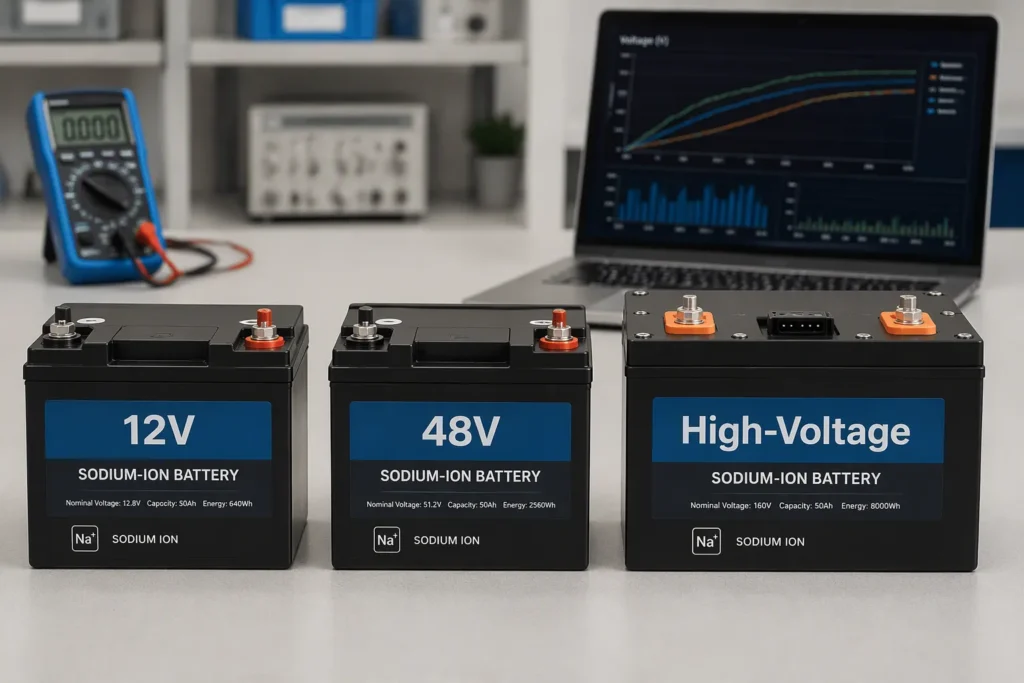
No single voltage suits every sodium-ion battery module. The right choice follows the application. A 12V unit serves small standalone systems and drop-in replacement duties. A 48V pack fits light mobility and modest stationary storage. High voltage suits larger traction and grid-connected systems.
Performance, application fit, compliance and cost all shift across these three classes. Buyers weighing a 12V sodium-ion battery module against a 48V pack or a high-voltage string need to judge each class on its own terms. Clear selection criteria help match the pack to the load profile and the system architecture. The correct voltage is the one the job demands.
Key Takeaways
Choose the voltage class that matches your application’s power and scale needs.
A 12V module suits small standalone systems and drop-in replacements.
A 48V pack fits light mobility and modest stationary storage.
High voltage serves large traction and grid-connected systems.
Always check inverter compatibility and BMS protocol before purchase.
Sodium-ion Battery Module Comparison at a Glance
Performance and Application Fit
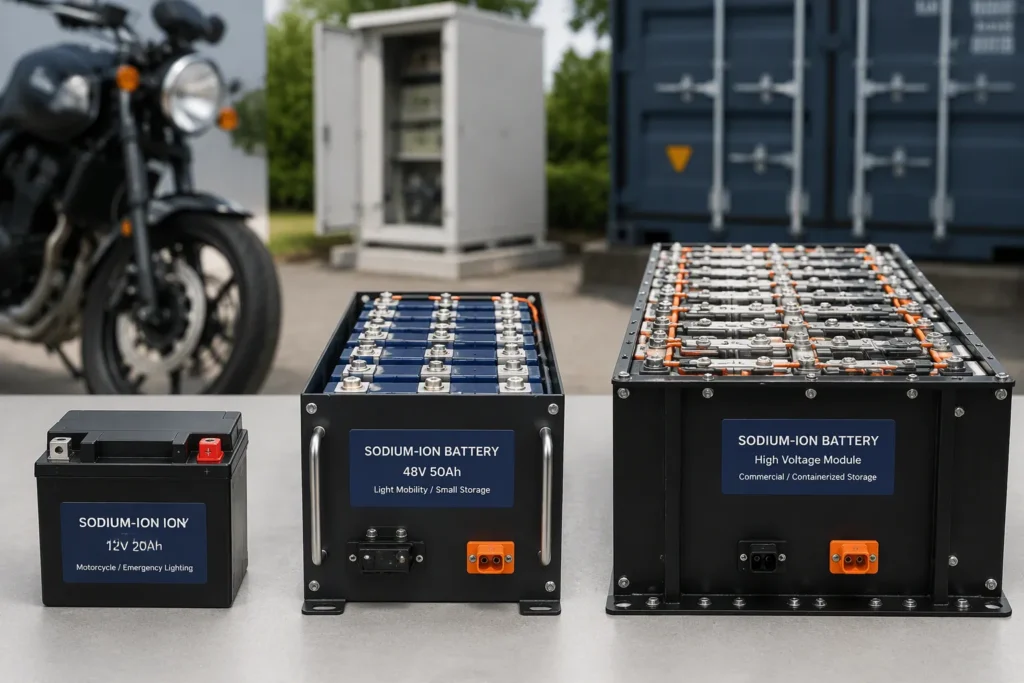
The table below sets the three classes side by side. Each row reflects the design intent of that class rather than a ranking. A 12V sodium-ion battery module targets short, high-current bursts. A 48V pack targets daily cycling at moderate power. A high-voltage string targets sustained throughput at scale.
Attribute 🔍 | 12V module | 48V module | High-voltage module |
|---|---|---|---|
Typical format | Single 12V block, series/parallel optional | 16s string, roughly 24V to 68.8V | Many cells in series, custom rated voltage |
Discharge profile ⚡ | High-rate bursts for engine start | Steady mid-rate cycling | Continuous high power |
Temperature window 🌡️ | Wide, suited to outdoor cabinets | Wide, suited to containerised sites | |
Cycle life 🔁 | Long deep-discharge tolerance | Over 4000 cycles with prismatic cells | Over 4000 cycles with prismatic cells |
Best fit ✅ | Motorcycles, agricultural machinery, emergency lighting | Light mobility, small stationary storage | Whole-home backup, C&I storage, traction |
BMS complexity 🧠 | Simple | Moderate, manages wide pack span | Layered, scales with series count |
Compliance route 📋 | Transport and safety testing | Transport, safety and inverter checks | Higher-voltage safety and grid rules |
Cost profile 💰 | Low system complexity, drop-in retrofit | Cheaper retrofit than high voltage | Higher upfront, stronger at scale |
Sodium-ion products are still maturing in the 12V, 24V and 48V formats used for recreational vehicles and similar applications. Availability and maturity therefore vary by class. Buyers comparing battery modules should confirm stock, documentation and test reports for the exact format they need. The same caution applies across battery chemistry choices, including NMC, LFP and even sodium cells, where datasheet depth differs between suppliers.
Compliance and Cost Overview
Compliance work scales with voltage. A 12V module carries the lightest paperwork burden. Transport testing and safety verification usually suffice for small standalone duties. A 48V pack adds inverter compatibility checks, because the pack span can exceed the operating window of common hybrid inverters. High-voltage systems attract the heaviest regime, with higher-voltage safety standards and grid-connection rules shaping the design.
Cost follows the same curve. Low voltages win on simplicity and retrofit speed. High voltages win on whole-system economics once cable sizing and conversion losses matter. Mid voltages sit between the two, and that position explains much of their popularity in light mobility and modest storage.
Readers who want verified performance figures for sodium-ion cells can review the VEKEN sodium battery range, which lists cold cranking amps from 52.5A to 135A for 12V motorcycle units and prismatic cells from 50Ah to 170Ah.
12V Sodium-ion Battery Module
Best-Fit Applications for 12V
A 12V sodium-ion battery module suits small standalone systems first. Motorcycles, agricultural machinery, emergency lighting and start-stop duties all rely on this rail. Each application needs a compact block that starts equipment quickly and tolerates repeated deep discharge. A drop-in replacement for lead-acid makes the swap simple, because mounting points and terminal layouts stay familiar.
The 12V rail also remains the main low-voltage rail in mild hybrid vehicles. Bidirectional converters link it to the 48V rail, so the two systems share energy. This arrangement keeps conventional loads running while the higher rail handles heavier duties.
VEKEN‘s Sodium Battery range covers this class well. The 12V motorcycle batteries deliver cold cranking amps from 52.5A to 135A. Buyers can also request customisable series and parallel configuration for larger 12v battery packs.
Performance, Compliance and Cost
High-rate discharge defines the 12V duty cycle. Engine start demands a short, powerful burst, and sodium cells supply it without strain. Deep-discharge tolerance adds headroom for accessories that drain the pack during storage. A wide operating temperature range keeps output stable in cold conditions, down to -40℃.
Compliance work stays light at this level. Transport and safety testing usually cover the requirements for low-voltage packs. A simple bms monitors the pack, and the modest voltage range keeps protection circuitry straightforward. Users should confirm the charge voltage against the vehicle or charger specification before installation.
Cost favours this class. Lower system complexity reduces engineering effort, and drop-in retrofit avoids rewiring. These modules therefore offer a practical entry point for buyers who need reliable starting power without a full architecture change.
48V Sodium-ion Battery Module and Battery Management Systems
Best-Fit Applications for 48V
Light electric vehicles and e-mobility form the core of this class. Small stationary storage and retrofit home storage follow closely behind. A 48 v battery pack sits at a useful middle point. It delivers higher efficiency than a 12V rail and costs less than a high-voltage architecture. That balance explains its popularity in light mobility and modest storage.
Battery management systems carry more responsibility here. A 48V 16s pack built from cells connected in series spans roughly 24V to 68.8V. This total voltage range can exceed the 38–66V operating window of some 48V inverters, such as the MultiPlus II. The bms must therefore track the full span and protect every cell.
Inverter Compatibility and Cost
Buyers should verify five points before purchase:
Confirm the inverter’s stated DC input window.
Compare it against the pack’s full voltage range, not its nominal figure.
Check the charge voltage profile against the inverter’s charging algorithm.
Confirm the bms communication protocol matches the inverter.
Request test documentation for the exact pack format.
VEKEN’s Sodium Battery and sodium battery custom pack options suit this class. Both lines pass nail penetration, extrusion and drop testing, which supports safe 48V pack design. Compliance work covers transport, safety and inverter checks. The retrofit path stays simpler and cheaper than a high-voltage build, and that saving often decides the project.
High-voltage Sodium-ion Battery Module
Best-Fit Applications for High-voltage
Large whole-home backup systems lead this class. Commercial and industrial storage follows, along with larger traction systems and grid-connected applications. These duties share one trait: sustained power over long cable runs. A high voltage architecture suits them because efficiency and cable sizing matter more than retrofit simplicity. Designers accept a more involved installation in exchange for lower current at the same power.
Traction duty shows the pattern clearly. Electric buses and heavy vehicles commonly run 400 v to 800 v or 1000 v packs, and light commercial platforms increasingly adopt 800 v battery pack designs. Charging infrastructure has followed, with 800 and 1000 v battery packs now matched by chargers rated for those rails. Stationary projects reach similar levels, where a single high voltage sodium-ion battery module may sit inside a much longer string.
Battery Management Systems and Compliance
Battery management systems scale with series count. More cells connected in series mean more sense lines, more balancing channels and tighter timing across the stack. Cell voltage range shapes the design too. Layered-oxide sodium cells span roughly 2V to 4V, while poly-anion sodium cells span roughly 1.5V to 4V. That spread sets the total voltage range the bms must track, and it decides the charge voltage ceiling for the string.
VEKEN’s Sodium Battery and sodium battery prismatic cells suit this work. Capacities run from 50Ah to 170Ah, cycle life exceeds 4000 cycles, and rated voltage and configuration are customisable for high-voltage packs. Compliance grows heavier at higher voltages, with safety standards and grid rules shaping the build. Upfront cost runs higher than lower voltages, yet whole-system economics improve at scale as cable and conversion losses fall. Buyers should match battery chemistry and module count to the inverter’s stated window before committing.
Choosing the Right Voltage
Decision Criteria for Sodium-ion Battery Modules
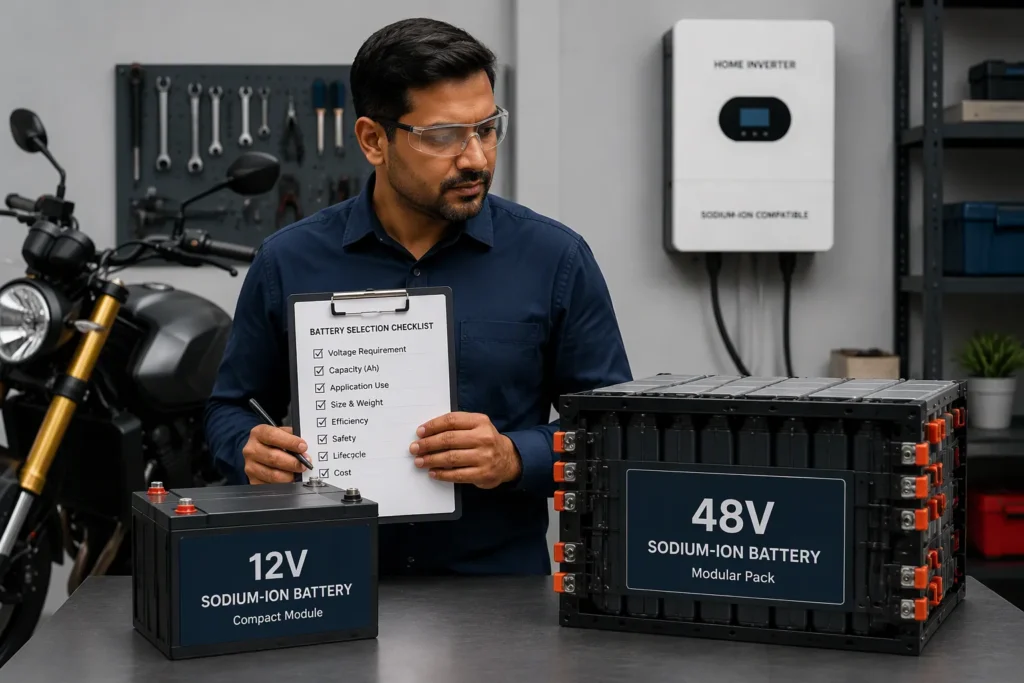
Six criteria settle the choice. Load profile comes first. A pack rated at 0.5C delivers half its capacity in one hour, so a 5 kWh pack supplies only 2.5 kW. Heat pumps and EV chargers demand more, and inverter, BMS and equipment ratings still cap usable output.
System architecture follows. Low-voltage designs typically use 48V rails, while high voltage designs use manufacturer-defined module arrangements. Lower current cuts heat loss and cable size at the same power. The voltage label alone does not prove compatibility.
Retrofit versus new-build shapes the budget. A drop-in swap keeps existing wiring and mounting points. A new-build frees the designer to pick any class.
Inverter compatibility is a binding criterion. The exact battery, BMS, controller, inverter, firmware and design rules must align. A physical battery port does not prove support. Expansion rules depend on the product family and manufacturer guidance, not on architecture alone.
Compliance route scales with voltage. Transport and safety testing cover low-voltage packs. Higher-voltage systems attract safety standards and grid rules.
Total cost of ownership closes the list. Purchase price, cabling, conversion losses, maintenance and expected service life all count.
Worked Examples by Application
A motorcycle start battery shows the 12V case. The rider needs a compact block with high cold cranking amps, deep-discharge tolerance and stable output in cold weather. A 12V module with 52.5A to 135A cranking capability meets the duty, and the retrofit keeps the original terminals.
A retrofit home storage system shows the 48V case. The installer checks the inverter’s DC input window against the pack’s full voltage range, confirms the BMS protocol and requests test reports. Modular designs help here: one sodium-ion module can provide 4.5 kWh, and up to four modules stack per stack in some systems. That flexibility suits households that plan to expand.
A whole-home or commercial backup system shows the high voltage case. Sustained power over long cable runs favours lower current, and traction platforms already run 800 V packs. Chargers rated for 800 V rails now match those packs, and stationary projects reach similar levels. Upfront cost runs higher, yet whole-system economics improve at scale.
VEKEN supplies sodium-ion solutions across all three classes, so the choice should follow the application rather than the supplier. Buyers should weigh load profile, architecture, inverter compatibility, compliance route and total cost before committing.
The right voltage class follows application scale and system architecture. No single option wins everywhere. A 12V module suits small standalone systems and drop-in replacement duties. A 48V pack fits light mobility and small stationary storage. High-voltage strings serve larger traction and grid-connected systems.
Buyers should weigh load profile, system architecture, inverter compatibility, compliance route and total cost before deciding. The bms must match the chosen inverter, and the pack’s full voltage span matters more than its nominal figure. VEKEN supplies sodium-ion solutions across all three classes and welcomes specific requirements.
FAQ
Which voltage suits a small standalone system?
A 12V module fits this duty best. It starts engines with high-rate bursts and tolerates deep discharge. Cold cranking amps from 52.5A to 135A cover motorcycle and agricultural machinery needs. The low voltage keeps system complexity down and allows a drop-in retrofit.
Why does a 48V pack need careful inverter checks?
A 16s sodium-ion pack spans roughly 24V to 68.8V. That voltage range can exceed the 38–66V window of some 48V inverters, such as the MultiPlus II. Buyers should compare the full span against the inverter’s stated input window before purchase. The bms must also match the inverter protocol.
What role does the BMS play in a high-voltage pack?
Series count rises with system size. Each added cell brings more sense lines and balancing channels. The bms must track the whole stack and respect cell chemistry limits. Layered-oxide cells span roughly 2V to 4V, while poly-anion cells span roughly 1.5V to 4V.
Can one module size cover every application?
No. A single module format cannot serve a motorcycle start duty and a containerised grid site at once. Load profile, architecture and compliance route all shift with scale. VEKEN supplies sodium-ion solutions across 12V, 48V and high-voltage classes, so the application should guide the choice.
Which figures should a buyer verify before ordering?
Buyers should confirm the pack’s full voltage span, the inverter’s DC input window, the charge profile and the bms communication protocol. Test reports for the exact format matter too. Transport and safety documentation should match the intended market.