
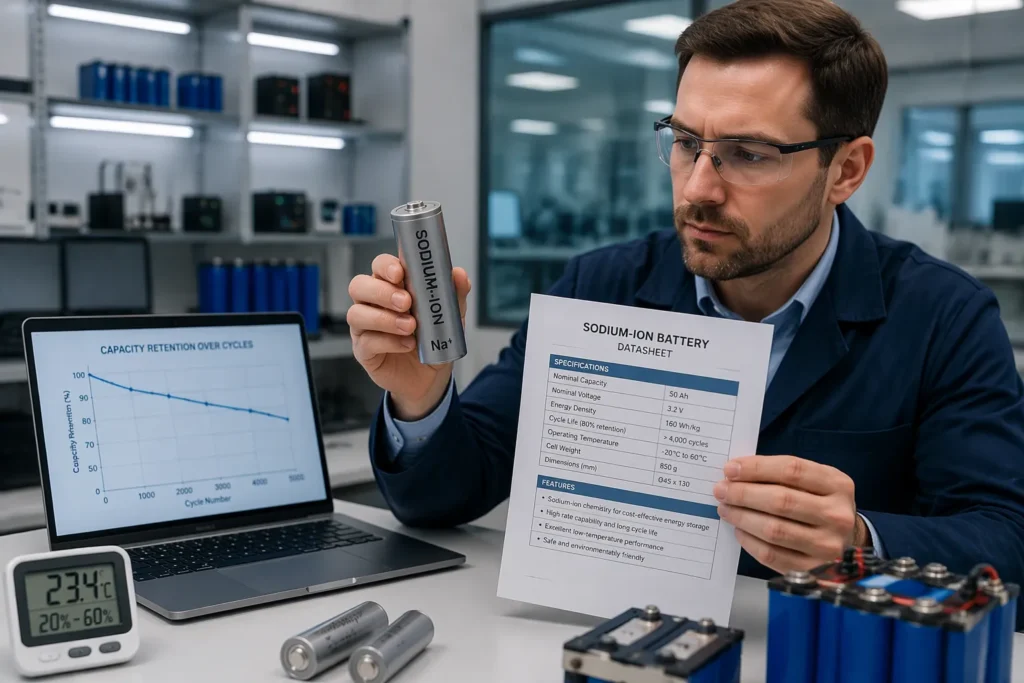
Four parameters on sodium-ion battery datasheets decide whether a cell suits a given application: capacity, cycle life, C-rate and temperature range. Get any one wrong, and the system design suffers.
The problem is simple. Headline figures come from specific test conditions. A capacity number means little without its C-rate and temperature. The same applies across sodium-ion batteries and every other chemistry.
This article defines each parameter, shows typical values and comparisons, and closes with practical guidance on matching specifications to application needs. Readers who want a fair view of sodium-ion battery technology should start with the test conditions behind each number 🔍.
Key Takeaways
Always check the test conditions for capacity, cycle life, C-rate, and temperature.
Match cycle life to your replacement policy and the stated end-of-life threshold.
Pick a C-rate range that handles your heaviest load, including quick charging bursts.
Check that the lowest working temperature is low enough for your coldest site. Also check the charging limits on their own.
Only compare datasheet values when the test conditions are the same, so the comparison is fair.
Capacity on Sodium-Ion Battery Datasheets
Rated, Typical and Minimum Capacity
Capacity shows how much charge a cell can hold. Datasheets hardly ever give just one number. They list a rated value, a typical value and a minimum value. Each figure comes from a set C-rate and a set temperature. The rated value is the promised lowest level. The typical value shows what average production gives. The minimum value is the worst case a buyer should accept.
This setup matters because usable battery capacity depends on the test rate. One tested sodium-ion cell gave about 0.65 Ah at a C/2 rate. A slower discharge would probably give more charge. A faster discharge would give less. So readers who compare sodium-ion battery datasheets must check the test conditions before they trust a headline figure 📊.
Capacity Compared with Other Chemistries
Cell capacity changes a lot within every chemistry, so the table below shows typical positioning rather than fixed numbers. Sodium-ion batteries sit close to lithium iron phosphate cells in energy terms. Lithium-ion cells lead on energy density. Lead-acid cells are still the low-cost choice for stationary backup.
Chemistry | Typical capacity positioning | Where it fits best |
|---|---|---|
Sodium-ion | Moderate; competitive with lithium iron phosphate | Stationary storage, backup, cold-climate sites |
Lithium-ion | High energy density per cell | Portable devices, electric vehicles |
Lead-acid | Low energy density, heavy per Ah | Cost-sensitive backup, remote off-grid |
A single sodium-ion battery cell seldom wins on raw capacity. The chemistry wins on cost, safety and cold-weather behaviour. Designers should size the pack around the application, not around the biggest number on the sheet.
Cycle Life
End-of-Life Thresholds Explained
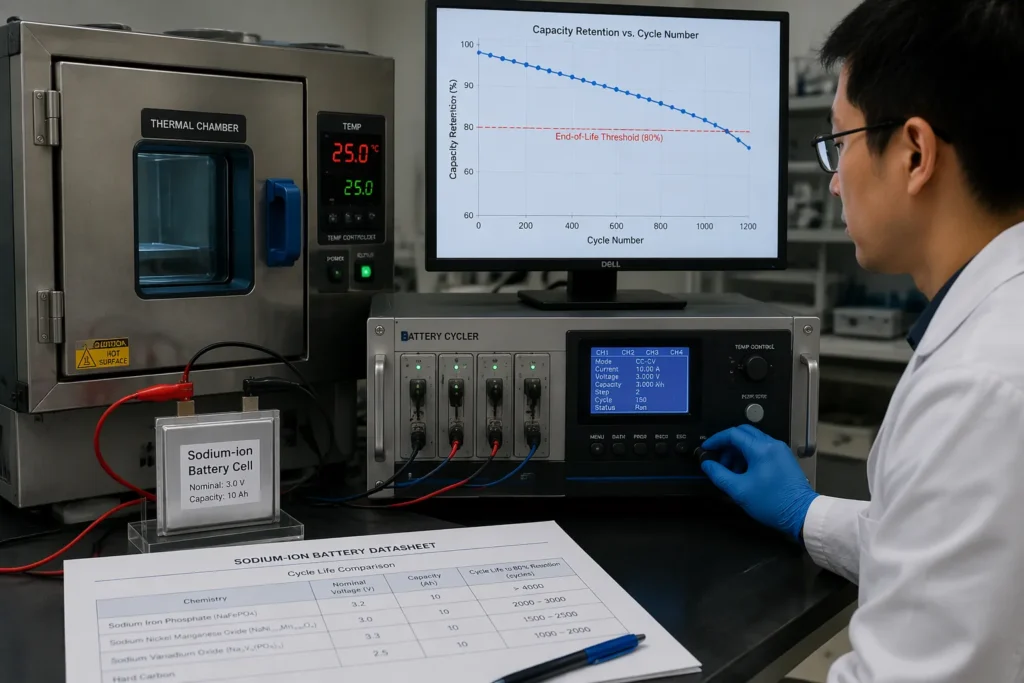
Cycle life counts the charge–discharge cycles a cell completes before its capacity drops to a stated end-of-life threshold. That threshold is a percentage of the original capacity, and the datasheet should name it. A cell rated for 3,000 cycles to 80% end of life will not reach 3,000 cycles at 90%. Readers of sodium-ion battery datasheets must match the threshold to their own replacement policy.
Three test conditions shape the result. Depth of discharge (DoD) sets how far each cycle drains the cell; shallow cycles usually allow more cycles than deep ones. C-rate sets the current, and faster cycling normally shortens life. Temperature plays a big part too, because heat speeds up ageing and cold slows the chemistry. A cycle count without these conditions tells the reader very little.
Cycle Life Across Chemistries
Many commercial sodium-ion cells today fall in the 1,000–4,000 cycle range. This range suits stationary storage, backup systems and daily-cycling duties. One warning applies here. High energy densities in anode materials do not automatically lead to high capacity retention or a long service life. Anode chemistry, electrolyte formulation and cell design all affect how well a cell holds its capacity over thousands of cycles. Buyers should treat anode energy density and cycle life as separate claims, and each one needs its own evidence.
The table below compares typical positioning across chemistries. Figures vary by manufacturer and test conditions, so designers should check each value against the supplier’s own test report.
Chemistry | Typical cycle life positioning | Where it fits best |
|---|---|---|
Sodium-ion | Moderate; commonly 1,000–4,000 cycles | Stationary storage, backup, daily cycling |
Lithium-ion | Often higher; varies widely by chemistry | Electric vehicles, portable devices |
Lead-acid | Lower; sensitive to deep discharge | Shallow-cycle backup, cost-sensitive sites |
Sodium-ion batteries offer a balanced package. They give a longer working life than lead-acid in many cycling duties, and they avoid the cost and supply pressure of lithium. Lithium-ion still leads where the highest cycle counts matter most. Lead-acid remains workable for infrequent, shallow cycling.
A practical check helps here. Compare cycle life only at the same DoD, C-rate and temperature. A sodium-ion battery quoted at 80% end of life and a moderate rate may beat a rival quoted at a gentler rate. Match the test conditions first, then compare the numbers. This habit turns a datasheet figure into a real estimate of service life.
C-Rate
How C-Rate Affects Usable Capacity
C-rate is a ratio with no units. It links the charge or discharge current to the nominal capacity. A 2 Ah cell discharged at 2 A runs at 1C. The same cell at 4 A runs at 2C. A 0.5C rate means a two-hour discharge. This ratio lets readers compare cells of different sizes fairly ⚡.
High charge/discharge rates such as 15C may be supported. A 15C charge fills a cell in about four minutes. That figure looks impressive on sodium-ion battery datasheets. Usable capacity still changes with rate. The tested cell that gave roughly 0.65 Ah at C/2 would deliver less at a much faster rate. Cycle life shifts too. Fast charging and discharging rates push heat into the cell, and heat shortens service life. Buyers who plan fast charging must read the rate column, not just the headline amp-hour figure.
Matching C-Rate to the Load Profile
The right cell covers the application’s real load profile inside its stated C-rate window. Start with the peak current the load draws. Divide that current by the cell’s nominal capacity. The result is the peak C-rate. Repeat the step for the average current. Now compare both figures with the datasheet window.
A backup system that draws a steady low current needs only a modest rate. A power tool or a drone motor demands short bursts at high charge/discharge rates. Sodium-ion batteries handle these bursts well, and their fast charge and discharge capabilities suit duty cycles with frequent pulses. The charging performance comparison across chemistries favours sodium-ion batteries for rapid charging capability in cold sites. Fast charging still costs some capacity and some cycle life. A sodium-ion battery chosen for fast charge and discharge capabilities should carry a rate window that covers the worst-case pulse, not the average draw. Check the temperature column alongside the rate column, because cold cells accept charge more slowly.
Temperature Range and Cold Weather Performance
Minimum Operating Temperature and Sodium Ion Battery Cold Weather Performance
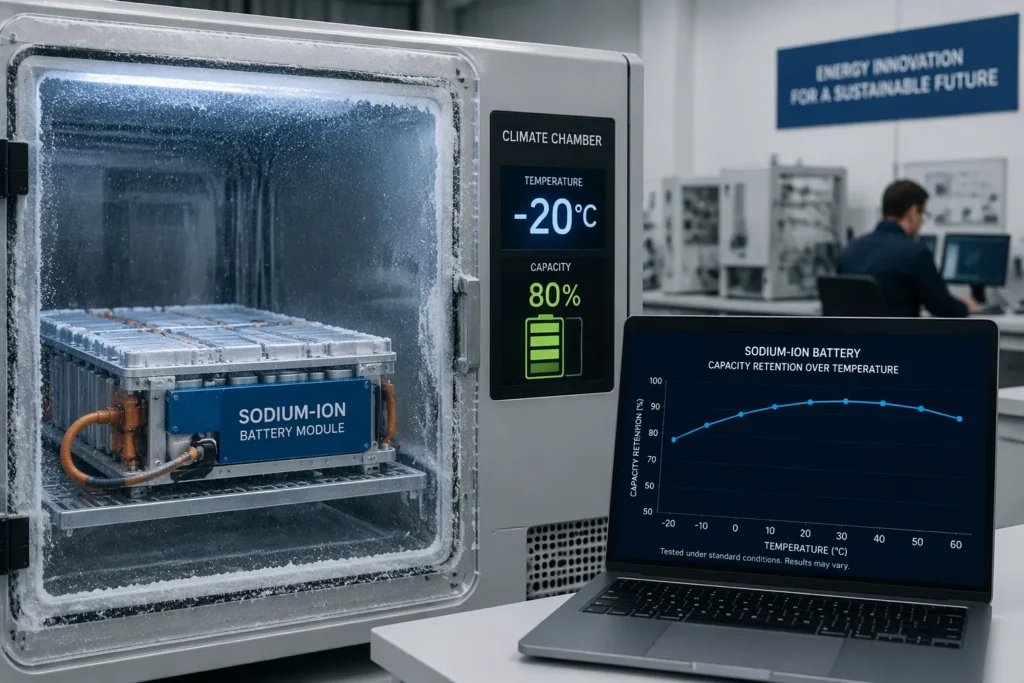
Datasheets show two different temperature figures. The operating temperature range covers the conditions a cell can run in. The storage figure covers idle periods, and it is usually wider. Readers of sodium-ion battery datasheets should never swap one for the other. The minimum operating temperature is the coldest point where the cell can still give out charge and take it in safely. Below that point, performance drops and the risk of damage goes up.
Sodium-ion cells have shown excellent capacity retention from -20°C to +60°C. That spread gives a wide range of temperatures for outdoor cabinets, unheated sheds and remote sites. A manufacturer claim of -40°C operation needs careful reading. It usually means discharge at 0.5C with about 70% capacity kept. At -20°C, cells can charge to 80% capacity. This difference matters for sodium ion battery cold weather performance, because discharge and charge limits are not the same. The safe charging temp sits above the discharge limit in most designs.
The table below sets out a temperature range comparison for planning purposes.
Condition | What the datasheet typically states |
|---|---|
Discharge at -40°C | Supported at 0.5C, about 70% capacity retained |
Charge at -20°C | Cells can charge to 80% capacity |
Retention window | -20°C to +60°C |
Cold weather operation suits sodium ion battery cold climate performance well. Sodium-ion batteries keep more usable charge in frost than many rival chemistries. That edge helps cold climate home storage applications and backup units in winter. Designers should still confirm the charge limit, because fast charging a cold cell puts stress on it.
Cycle Life in Cold Conditions
Cold changes the ageing story. A studied NaNi1/3Fe1/3Mn1/3O2/hard carbon battery showed different capacity degradation at 0°C, 25°C and 50°C. Discharge rate changed the result too. This evidence shows that cycle life in cold conditions differs from room-temperature figures. A cycle count quoted at 25°C does not carry over to a freezer or a winter cabinet.
Temperature fluctuations add another layer. Repeated swings between warm days and freezing nights put stress on the cell in ways a steady test cannot capture. Sodium ion battery cold climate performance therefore depends on the enclosure and the duty cycle, not the cell alone. Sodium-ion battery storage guidance should cover both the operating temperature range and the idle case. Sodium-ion batteries handle temperature variations better than many options, yet the datasheet still governs.
A practical rule helps. Match the minimum operating temperature to the coldest real deployment condition, then add margin. Check the charge limit separately from the discharge limit. Review cycle life at the expected temperature, not the lab figure. This approach turns a sodium-ion battery datasheet into a reliable planning tool for cold sites.
Four checks turn a datasheet into a design tool ✅:
Read capacity at the stated C-rate and temperature.
Check cycle life against the named end-of-life threshold.
Confirm the C-rate window covers the real load profile, including fast charging pulses.
Verify the minimum operating temperature covers the coldest deployment site.
Datasheet values stay comparable only when test conditions match. Sodium-ion batteries should earn a place in a design because they fit the application, not because of big headline numbers. Sodium-ion battery selection rewards readers who check the conditions behind each figure. That habit keeps a system safe, and it keeps service life predictable.
FAQ
What capacity should a reader expect from a sodium-ion cell?
Capacity depends on the test rate and temperature. One tested cell gave about 0.65 Ah at a C/2 rate. A slower discharge gives more charge, and a faster one gives less. Readers should compare sodium-ion batteries only at the same C-rate and temperature 🌡️.
How long do sodium-ion batteries last?
Many commercial cells today reach 1,000–4,000 cycles. The count only holds at the stated end-of-life threshold, depth of discharge, C-rate and temperature. Sodium-ion batteries quoted at 80% end of life suit daily cycling and stationary storage duties.
Can a sodium-ion battery charge in four minutes?
Some cells support a 15C rate, which fills a cell in about four minutes. Usable capacity and cycle life still drop at such speeds. A sodium-ion battery chosen for fast charging needs a rate window that covers the worst-case pulse.
How do sodium-ion batteries perform in cold weather?
Cells have shown strong capacity retention from -20°C to +60°C. A -40°C claim usually means discharge at 0.5C with about 70% capacity kept. At -20°C, cells can charge to 80% capacity. Sodium-ion batteries therefore suit cold sites, as long as designers check the charge limit.
Does a high-energy anode guarantee long cycle life?
No. High energy densities in anode materials do not automatically give high capacity retention. A studied NaNi1/3Fe1/3Mn1/3O2/hard carbon battery aged differently at 0°C, 25°C and 50°C. Buyers should treat anode energy density and cycle life as separate claims, and each one needs its own evidence.