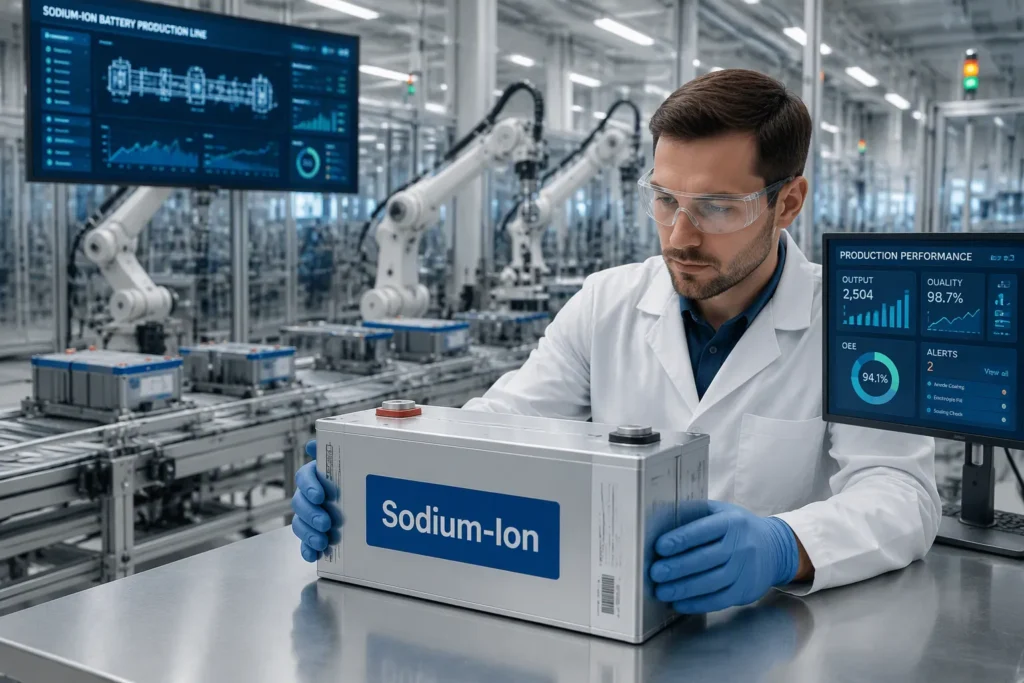
CATL, BYD, and HiNa lead the sodium-ion market in 2026. These three Chinese firms hold the largest production capacity and the most mature technology. Western players such as Faradion, Natron, and Altris trail behind. Financing gaps slow their path to commercial scale.
This list ranks each sodium battery manufacturer by production capacity, commercialization status, technology maturity, and 2026 deployment plans. China dominates volume. The West fights for funding.
CATL and BYD push sodium cells into electric vehicles and energy storage. HiNa focuses on grid and industrial use. Faradion, Natron, and Altris show promise, yet cash shortages delay their factories.
The gap between Chinese scale and Western ambition shapes every sourcing decision this year.
Key Takeaways
CATL, BYD, and HiNa lead sodium-ion battery production in 2026. They have large factories in China and ship many batteries.
Western companies like Faradion, Natron, Altris, and Tiamat have good technology. They struggle to get money to build big factories.
NFPP sodium-ion batteries are safer and cheaper for grid storage. They last over 10,000 cycles and cost about $40 per kWh.
Sodium-ion batteries now power some electric vehicles. CATL and Changan made the first mass-produced sodium-ion car in 2026.
Sourcing from China offers many suppliers and low costs. Buyers must also consider risks like tariffs and quality differences.
Leading Sodium Battery Manufacturers in 2026
CATL, BYD, and HiNa Dominate Global Production
The sodium-ion industry has a clear pecking order this year. A handful of companies produce at commercial scale. Others remain in pilot or development phases. The table below offers a quick reference for the major players.
Company | Headquarters | Status in 2026 |
|---|---|---|
CATL | China | Mass production |
BYD | China | Mass production |
HiNa (Zhongke Haina) | China | Mass production |
Faradion | UK | Pilot production |
Natron | US | Pilot production |
Altris | Sweden | Pilot production |
Tiamat | France | Pilot production |
KPIT Technologies | India | Development |
Guoxuan High-Tech | China | Pilot production |
EVE Energy | China | Pilot production |
CoPow | China | Development |
Three Chinese firms sit at the top. CATL, BYD, and HiNa each operate factories that ship sodium cells in volume. Their output serves electric vehicles, grid storage, and industrial applications. No Western company matches that scale today.
A sodium battery manufacturer in China benefits from established supply chains and government support. These advantages let Chinese firms ramp production faster than overseas rivals. The result is a market where geography determines capacity.
Western Startups Struggle with Financing
Western companies face a different reality. Faradion, Natron, Altris, and Tiamat all hold promising technology. Each one struggles to raise the capital needed for large factories. Pilot lines produce limited volumes. Commercial-scale plants remain years away for most.
Investors show caution toward hardware startups with long timelines. Sodium-ion competes with lithium-ion for funding attention. Lithium technology already has mature supply chains and proven returns. That track record makes sodium a harder sell to venture capital.
Government grants help bridge some gaps. They rarely cover the full cost of building a gigafactory. Without steady revenue from mass production, Western firms depend on each new funding round. A single failed raise can delay expansion by a year or more.
The financing gap creates a widening distance between Chinese and Western production. Chinese manufacturers reinvest profits into new capacity. Western startups spend their time courting investors instead of scaling factories.
CATL: Scaling Sodium-Ion Deployment in 2026
First-Generation Battery and 2026 Rollout
CATL founded its business in 2011. The company keeps its headquarters in Ningde, Fujian, China. In 2021, CATL announced its first-generation sodium-ion battery. That cell reached an energy density of 160 watt-hours per kilogram. Future generations should exceed 200 Wh/kg.
The company confirmed large-scale deployment plans at a supplier conference in December 2025. CATL will push sodium cells into multiple battery applications during 2026. This sodium battery manufacturer now moves from pilot output to volume shipments.
Production Capacity and Applications
CATL plans wider adoption across four main areas in 2026. The table below lists each application and its supporting detail.
Planned Application (2026) | Supporting Detail |
|---|---|
Battery swapping | Sodium-ion batteries expected to see wider adoption in battery swapping from 2026 |
Passenger vehicles | CATL and Changan announced the world’s first mass-production sodium-ion passenger vehicle in February 2026, with the Naxtra battery delivering over 400 km range (Cell-to-Pack + intelligent BMS), and 500–600 km projected for future variants |
Commercial vehicles | Wider adoption planned from 2026 |
Energy storage | In April 2026 CATL signed a three-year agreement to ship 60 GWh of sodium-ion batteries to Beijing HyperStrong Technology for energy storage systems |
The passenger vehicle launch marks a turning point. CATL and Changan built the world’s first mass-production sodium-ion car. The Naxtra battery delivers over 400 km of range. Future variants should reach 500 to 600 km.
Energy storage shows equal ambition. CATL agreed to ship 60 GWh of sodium-ion batteries to Beijing HyperStrong Technology over three years. That deal alone signals serious volume.
Battery swapping and commercial vehicles round out the plan. Both segments offer steady demand and predictable duty cycles. CATL uses them to build production scale before pushing further into consumer markets.
BYD: A Major Sodium-Ion Contender
Technology Investments and Commercialization
BYD ranks among the top sodium battery manufacturer names in 2026. The company built its reputation on lithium iron phosphate cells. Now it pours heavy investment into sodium-ion research and production. That spending covers new factories, cell design, and supply chain partnerships.
BYD has reached commercial production status. The company ships sodium cells in volume from its Chinese plants. This achievement places BYD alongside CATL and HiNa at the top of the market. Few rivals can match that level of output.
The company’s third-generation polyanion technology uses NFPP chemistry. This design favors long operational life over raw energy density. BYD made a deliberate choice with that trade-off. The company targets applications where durability matters more than peak performance.
Production Capacity and Target Markets
BYD directs its sodium-ion output toward specific segments. The company does not chase every possible market. Its strategy differs from CATL and Changan Automobile, which pushed sodium cells into passenger vehicles. BYD stays away from that segment for now.
The company focuses on stationary energy storage systems. Grid storage applications form the core of its sodium-ion business. A dedicated 189Ah, 2.9V heavy-duty cell architecture supports this work. That cell design suits the steady, long-cycle demands of grid infrastructure.
BYD also allocates sodium-ion cells to heavy machinery and stationary infrastructure. These applications prioritize long operational life over energy density. Equipment in these categories runs for years with predictable duty cycles. Sodium-ion chemistry fits that profile well.
The target markets reflect a practical view. Grid operators need affordable storage that lasts. Heavy machinery owners want cells that tolerate deep cycling. BYD positions its sodium line to serve both groups.
HiNa: China’s Sodium-Ion Specialist
Zhongke Haina’s Technology and Scale
HiNa stands for Zhongke Haina. The company operates from China and ranks among the top three sodium-ion producers in 2026. It shares that tier with CATL and BYD. Unlike those two giants, HiNa built its business around sodium-ion from the start. This focus gives the firm deep expertise in the chemistry.
HiNa holds a strong position as a sodium battery manufacturer with a narrow specialty. The company develops layered oxide cathodes and hard carbon anodes. These materials support cells with solid cycle life and stable performance. HiNa also invests in supply chain control. It secures raw material sources and refines its own production methods. That vertical approach keeps costs down and quality steady.
Production Capacity and Applications
HiNa runs commercial-scale production lines. The company ships sodium-ion cells in volume from its Chinese facilities. Its output supports grid storage, industrial equipment, and backup power systems. These applications tolerate lower energy density in exchange for lower cost and longer life.
A 2026 commercial solar battery and BESS guide names HiNa among the manufacturers that entered the commercial stationary storage market with sodium-ion systems during 2025–2026. CATL appears on that same list. The primary use case is large, cost-sensitive stationary storage. Ground-mounted installations and warehouse settings fit well because floor space is not a constraint. In these cases, sodium-ion may offer a cost advantage over LFP within 12–24 months as production scales.
The picture looks different for smaller projects. LFP remains the recommended specification for most commercial rooftop BESS projects in 2026. Sodium-ion still sits in the commercial pilot stage in the US rather than the mainstream. HiNa’s growth therefore depends on large-format deployments where its cost profile shines.
Western Sodium-Ion Manufacturers to Watch
Faradion, Natron, Altris, and Tiamat
Four Western firms anchor the region’s sodium-ion efforts. Each one brings distinct technology and a different path to market.
Company | Founding Year | Key Developments |
|---|---|---|
Faradion | 2011 | Founded in Sheffield, England; described as the world’s first sodium-ion battery company; develops layered metal oxide and hard carbon organic electrolyte systems; acquired by India’s Reliance New Energy Solar Ltd for £100 million in 2021 |
Natron | 2012 | Founded in Santa Clara, California by Stanford University scientists; uses Prussian blue electrodes; received UL1973 certification in 2020; opened a plant in Holland, Michigan in 2024; announced a $1.4 billion Gigafactory in Edgecombe County, North Carolina in August 2024 |
Altris | 2017 | Founded in Uppsala, Sweden; specializes in cathode materials; launched a patented Prussian White cathode material with 160 mAh/g capacity in June 2023; partners with Stora Enso, Volvo Cars, Clarios, and Polarium |
Tiamat | 2017 | Founded in Amiens, France; supported by CNRS; produces cells with high power density and super-fast charging; plans a 5 GWh per year plant in Amiens for data centers, small appliances, and electric vehicles |
Faradion pioneered the field and now operates under Reliance ownership. Natron pursues Prussian blue chemistry for data centers and grid frequency regulation. Altris supplies cathode materials to major partners. Tiamat targets fast-charging applications.
KPIT Technologies and Emerging Startups
KPIT Technologies works on sodium-ion development from India. The company remains in the development phase rather than mass production.
A wave of startups adds depth to the Western field. Blue Current, Peak Energy, Inlyte, Alsym Energy, TAISAN, UNIGRID, LiNa Energy, and Moonwatt each pursue their own designs. Most stay in early funding rounds. Each one needs capital to move past pilot lines.
The financing gap shapes this group. A sodium battery manufacturer in the West must raise money before scaling factories. That hurdle separates promise from production.
NFPP Sodium-Ion Batteries for Grid Storage
Safer, Lower-Cost Alternative to Lithium-Ion
NFPP stands for sodium iron pyrophosphate. This polyanion chemistry uses iron and phosphorus instead of cobalt or nickel. Sodium is abundant, and NFPP can avoid lithium, cobalt, and nickel entirely. That reduces exposure to certain material constraints. The supply chain still needs processed materials, factories, equipment, and technical expertise. Abundant raw materials help, yet turning that advantage into affordable batteries at scale remains the next step.
The cost and lifetime numbers favor NFPP for grid duty cycles.
Metric | NFPP Sodium-Ion Cell | LFP Lithium-Ion Cell |
|---|---|---|
Target cell cost | $40/kWh | ~$55–$70/kWh |
Targeted cycle life | >10,000 full cycles | ~5,000 full cycles |
A $40 sodium cell delivering 10,000 cycles could cut the simplified lifetime cell-cost measure by about two-thirds against a $60 LFP cell delivering 5,000 cycles. Safety adds another edge. NFPP cells release less gas and heat during failure than layered-oxide sodium cells, which helps engineers manage risk in large installations alongside cooling, monitoring, and fire protection. High-purity metallic sodium rings at 99.7% purity support stable ion transfer and long service life in grid-connected storage stations.
Key Manufacturers and 2026 Deployments
Ronbay Technology leads NFPP cathode material supply. Its material reaches 15,000 charge-discharge cycles and an electrode compaction density of 2.5 g/cm³. Ronbay plans to scale from 6,000 tons to 28,000 tons by the end of 2026. CATL runs a broad sodium-ion platform, though it does not focus on NFPP specifically. BYD uses NFPP chemistry in its third-generation polyanion cells, which favor long life over peak energy density.
Deployment activity centers on large, cost-sensitive stationary storage. Ground-mounted and warehouse installations fit well because floor space is not a constraint. A sodium battery manufacturer targeting this segment competes on lifetime cost rather than upfront price. LFP remains the safer specification for most commercial rooftop projects in 2026, so NFPP growth depends on large-format builds where its economics shine.
Market Outlook and Trends for 2026
Global Capacity Growth and Regional Leadership
China controls the sodium-ion supply chain in 2026. The country holds most of the world’s production capacity for sodium cells and cathode materials. CATL, BYD, and HiNa each run commercial-scale factories inside China. No other region matches that output.
Government support and mature supply chains give Chinese firms a clear edge. Raw materials, equipment, and skilled labor all sit within reach. That infrastructure lets a sodium battery manufacturer in China scale faster than rivals elsewhere. Western startups still depend on pilot lines and investor funding. The capacity gap between China and the West will likely widen through 2026.
Commercialization Status and Emerging Applications
Sodium-ion technology has moved past the laboratory. It now serves real customers in two major segments. Energy density still trails lithium, so adoption focuses on applications where cost and safety matter more than weight.
Sodium-ion batteries are especially suited for grid-scale storage and low-speed electric mobility, but their energy density still lags behind lithium, and they remain in the early stages of commercialization.
The table below summarizes where each application area stands this year.
Application Area | Commercialization Status in 2026 | Supporting Evidence |
|---|---|---|
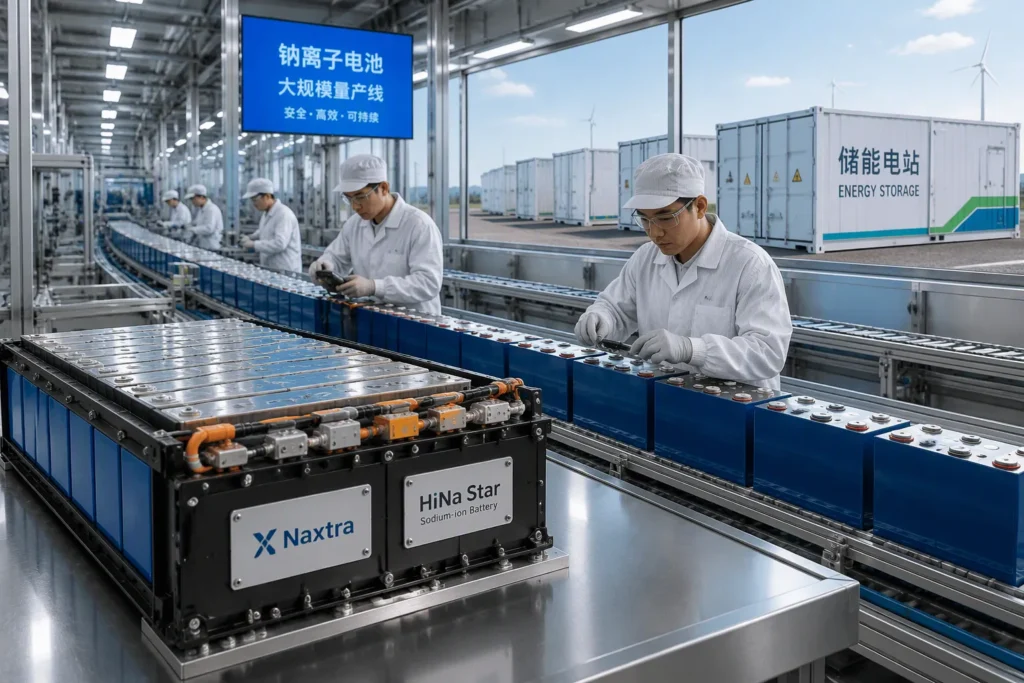
Electric Vehicles | Early commercialization; passenger EV battery now mass-produced | CATL’s Naxtra, unveiled April 21, 2025, is the world’s first mass-produced sodium-ion battery for passenger EVs, with 175 Wh/kg energy density and a 500 km range. Pilot applications also include two-wheeled vehicles and commercial vehicles such as HiNa Battery’s “HiNa Star” solution for delivery trucks and buses. |
Grid Storage | Operational at grid scale | A 100 MWh sodium-ion storage facility in Hubei Province, developed by HiNa Battery and inaugurated by China Datang Corporation in June 2024, stores 100,000 kWh per charge and supplies peak-period electricity to 12,000 households daily. It is the first phase of a 200 MWh roadmap. |
Consumer Electronics | No evidence found | The retrieved results do not address sodium-ion battery commercialization in consumer electronics. |
Grid storage leads in maturity. The Hubei facility shows sodium-ion works at utility scale. Electric vehicles follow close behind with CATL’s Naxtra cell. Consumer electronics remain an open question. No major deployment has appeared in that segment yet.
Sourcing from China: Pros and Cons
Advantages of Chinese Sodium Battery Manufacturers
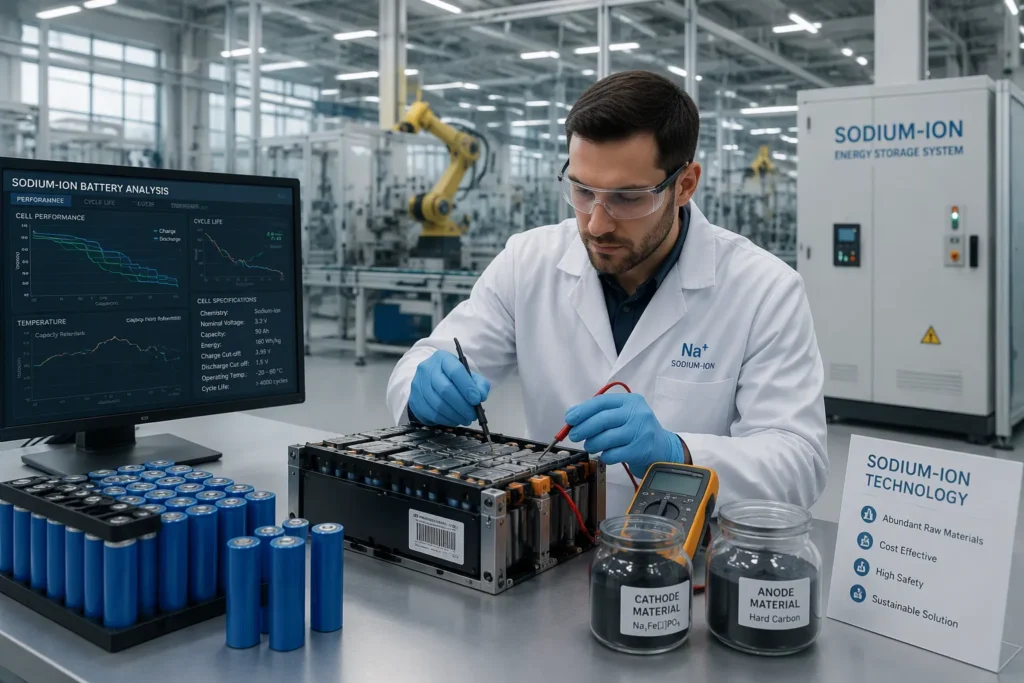
China offers buyers a deep pool of suppliers. Companies such as CATL, Zhongke Haina, BYD, Guoxuan High-Tech, EVE Energy, and CoPow all produce sodium-ion cells. Each one serves different product types and application needs. A buyer can select a sodium battery manufacturer based on cells, packs, or full energy storage systems.
The country also holds a complete industry chain. Cathode materials, anode materials, electrolytes, cells, battery management systems, packs, and energy storage systems all sit within one ecosystem. This integration leaves substantial room for cost reductions as production scales and yields improve. GWh-scale production lines already operate in China. Suppliers have delivered 10MWh to 100MWh sodium-ion energy storage projects. Buyers gain flexibility for samples, small-batch testing, and volume production.
Customization adds another advantage. Suppliers like CoPow adjust voltage, capacity, dimensions, BMS settings, CAN or RS485 interfaces, connectors, heating systems, enclosures, and IP ratings. Chinese sodium-ion batteries already serve energy storage, commercial vehicles, low-speed vehicles, starter batteries, forklifts, AGVs and AMRs, and telecom backup power. Buyers can leverage existing experience instead of building solutions from scratch.
Challenges and Considerations
Geopolitical risks top the list of concerns. Trade tensions between China and Western nations can trigger tariffs, export controls, or supply disruptions. A buyer who depends on a single Chinese supplier may face sudden cost increases or shipment delays.
Quality consistency varies across suppliers. Some factories maintain tight process control. Others show wider variation between production batches. Buyers should audit facilities and test samples before committing to large orders.
Intellectual property protection raises another flag. A buyer who shares proprietary designs with a Chinese partner risks unauthorized copying. Clear contracts and legal safeguards help reduce that exposure.
Logistics present practical hurdles. Ocean freight from China to Western markets takes weeks. Port congestion and customs clearance add uncertainty. Buyers should plan for longer lead times and carry buffer stock. These challenges do not erase the cost and scale advantages. They simply require careful planning and strong supplier relationships.
CATL, BYD, and HiNa control sodium-ion production in 2026. Faradion, Natron, Altris, and Tiamat stand as the strongest Western contenders. Each Western firm still waits on funding for large factories.
NFPP chemistry gives grid storage a safer, cheaper option. China leads the world in capacity and supply chain depth. Western startups face a widening financing gap.
Buyers who need customized sodium-ion battery solutions can reach out for tailored sourcing and consultation. A trusted partner will match the right cell to the right application.
FAQ
Which companies lead sodium-ion battery production in 2026?
CATL, BYD, and HiNa hold the top spots. All three run commercial-scale factories in China and ship cells in volume. Faradion, Natron, Altris, and Tiamat remain in pilot production. No Western firm matches Chinese output today.
What makes NFPP chemistry a good fit for grid storage?
NFPP uses iron and phosphorus instead of cobalt or nickel. Cells target over 10,000 full cycles at a target cost near $40/kWh. They also release less heat and gas during failure. Those traits suit large, cost-sensitive stationary installations.
Do sodium-ion batteries power electric vehicles yet?
Yes, early commercialization has begun. CATL and Changan launched the world’s first mass-production sodium-ion passenger vehicle in February 2026. The Naxtra battery delivers over 400 km of range. Two-wheeled and commercial vehicles also use sodium cells in pilot programs.
Why do Western sodium-ion startups lag behind?
Financing gaps slow their progress. Hardware startups with long timelines struggle to attract venture capital. Lithium-ion already offers proven returns. Western firms depend on grants and new funding rounds, so a single failed raise can delay factory expansion by a year or more.
What are the main risks of sourcing sodium cells from China?
Buyers face geopolitical risks, including tariffs and export controls. Quality consistency varies between factories, so audits and sample testing matter. Intellectual property exposure and long ocean freight lead times add further hurdles. Careful planning and strong supplier relationships reduce these risks.