
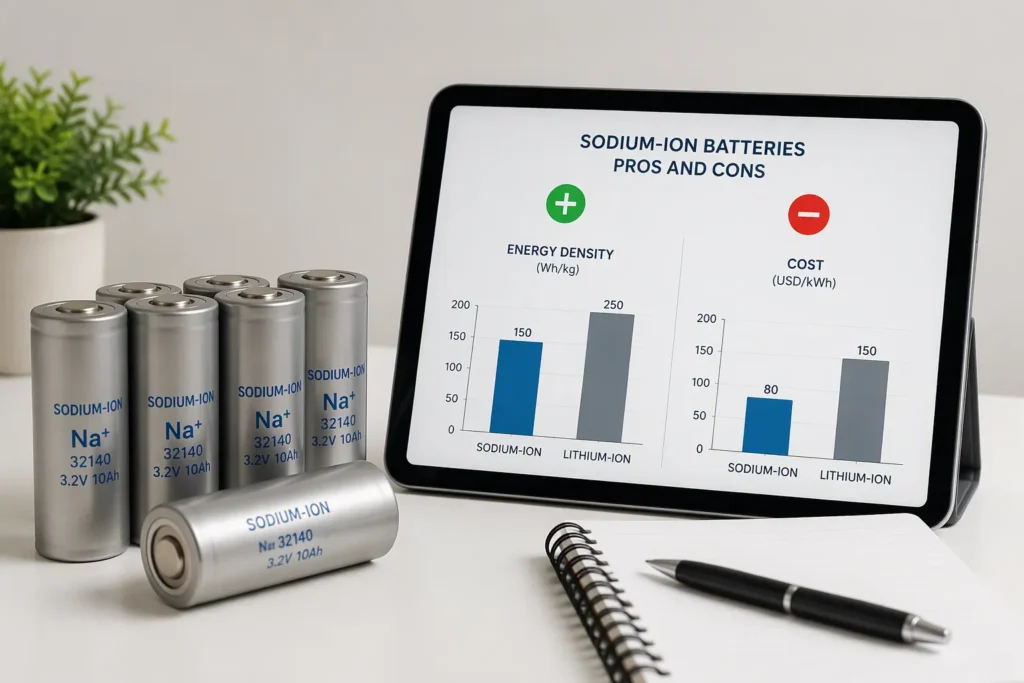
Sodium-ion batteries offer a promising alternative to lithium-ion. They bring cost and environmental benefits. They also face real challenges, especially lower energy density. You see this technology move from labs into real products in 2026. That shift makes this topic important right now.
This post explains how sodium-ion batteries work. You will also get a fair look at the sodium-ion battery advantages and disadvantages. That way, you can judge whether they fit your needs.
Key Takeaways
Sodium-ion batteries cost less because sodium is abundant and cheap.
They perform well in cold weather, keeping over 90% capacity at -20°C.
Sodium-ion batteries store less energy per kilogram than lithium-ion batteries.
Grid storage and cold climates benefit most from sodium-ion batteries today.
Research aims to improve energy density and cycle life for wider use.
What Are Sodium-Ion Batteries?
How They Work
You can think of a sodium-ion battery as a shuttle service for charged particles. When you charge the battery, sodium ions leave the cathode and travel through a liquid electrolyte to the anode. They settle into the anode material and stay there. When you use the battery, the process reverses. Sodium ions flow back to the cathode, and this movement releases electricity to power your device.
This back-and-forth motion is the core of how the battery stores and delivers energy. The design mirrors lithium-ion batteries closely. That similarity matters because manufacturers can adapt existing production lines for sodium-ion cells.
Key Components
Every sodium-ion battery has four main parts: an anode, a cathode, an electrolyte, and a separator. The anode stores ions during charging. The cathode releases them during discharge. The electrolyte carries ions between the two electrodes. The separator keeps the anode and cathode from touching, which would cause a short circuit.
Sodium is far more abundant and cheaper than lithium. That abundance gives sodium-ion batteries a natural cost advantage. However, sodium ions have a larger atomic radius and heavier mass than lithium ions. This size and weight difference directly limits how much energy the battery can store per kilogram.
The table below shows where sodium-ion energy density stands today compared to lithium-ion.
Battery Type | Energy Density (Wh/kg) | Notes |
|---|---|---|
Sodium-ion (current) | 110–140 | Roughly equivalent to lithium-ion a decade ago |
Sodium-ion (projected 2024) | 150 | Bloomberg New Energy Finance projection |
Sodium-ion (CATL 2021) | 160 | Claimed by Contemporary Amperex Technologies |
Sodium-ion (reported) | 145 | Can be cycled 4,500 times |
Lithium-ion NMC | >200 | For comparison |
Lithium-ion LFP | ~160 | For comparison |
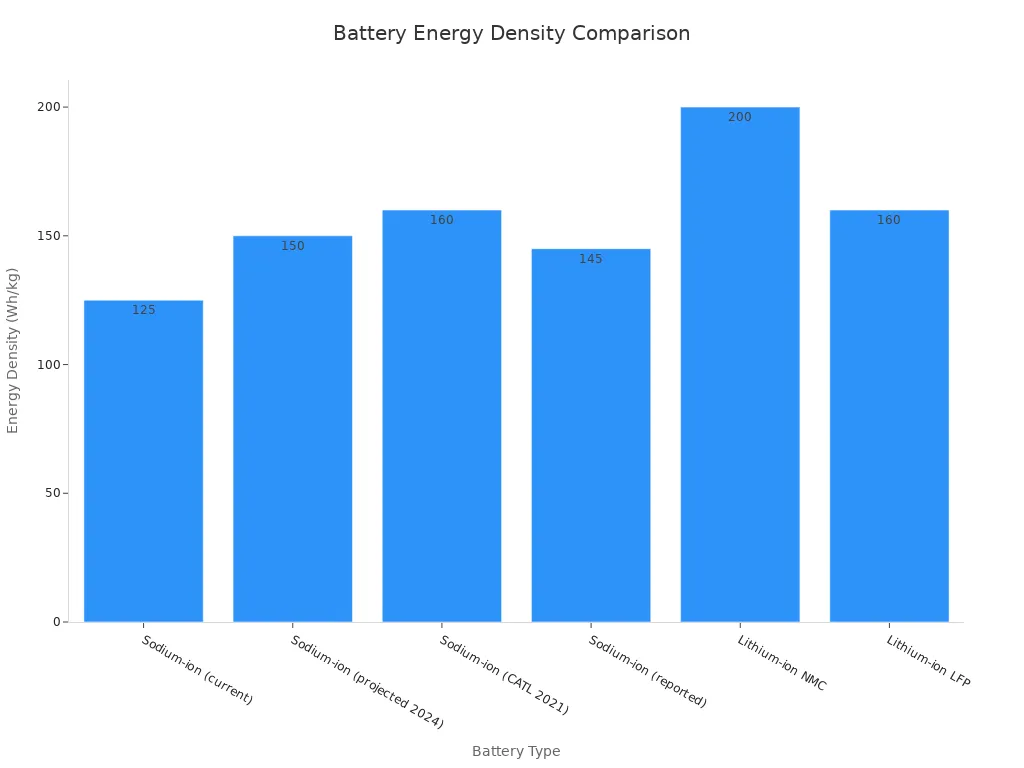
Despite the current lower energy density of Na-ion batteries compared to lithium-ion counterparts, this research focuses on enhancing the energy density through the development of novel anode and cathode materials.
Sodium-Ion vs. Lithium-Ion
Design Similarities
Sodium-ion and lithium-ion batteries share the same basic blueprint. Both use an anode, a cathode, an electrolyte, and a separator. Both move charged ions back and forth between electrodes to store and release energy. This shared design makes sodium-ion a drop-in candidate for some applications. Manufacturers can adapt existing lithium-ion production lines with modest changes. You get a familiar form factor without rebuilding a factory from scratch.
That compatibility matters for grid storage and stationary power. A utility can swap in sodium-ion cells where lithium-ion packs once sat. The system architecture stays largely the same. The benefits come from the material swap, not a radical redesign.
Key Differences
The biggest gap between these two technologies is energy density. Sodium-ion batteries store less energy by weight and by volume. You need a bigger, heavier battery to hold the same amount of power. That limits sodium-ion use in compact devices and long-range electric vehicles. A lithium-ion pack of the same physical size simply carries more energy.
Cost once favored sodium-ion strongly. That advantage has narrowed as lithium prices fell and sodium-ion production scaled up. Sodium-ion has lost some of its early cost edge. Still, it beats lithium-ion in certain areas. Cold weather is the clearest example.
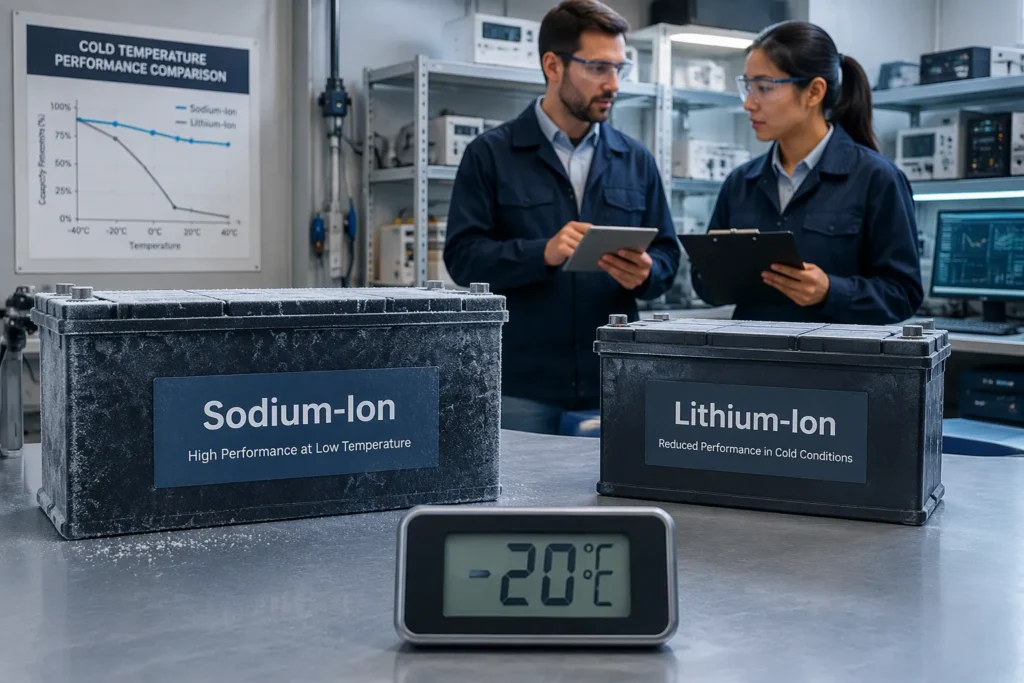
Sodium-ion batteries retain over 90% of power capacity at -20°C. Lithium-ion and lead-acid batteries can lose up to around 50% of power capacity at the same temperature. Sodium-ion also demonstrates better fast-charging performance in low temperatures. At -40°C, sodium-ion holds roughly 80% discharge capacity retention. Lithium-ion falls below that mark. Most current sodium-ion tech still limits charging to above -20°C. At -40°C, you must heat the battery to accept charge. That heating adds energy consumption to your system sizing.
Aspect | Sodium-Ion | Lithium-Ion |
|---|---|---|
Discharge capacity retention at -40°C | ~80% | Lower than sodium-ion |
Charging temperature limit | Limited to above -20°C for most current tech | Similar limitation |
Practical note at -40°C | Battery must be heated to accept charge, adding energy consumption to system sizing | — |
HiNa Battery is cited as one of the few players offering technology that potentially allows charging down to -40°C, with prismatic cells reaching 145 Wh/kg, making it a promising option for northern climates.
This cold-weather strength shapes the sodium-ion battery advantages and disadvantages in a real way. You gain reliability in freezing conditions. You give up energy density in return. For a northern grid installation, that trade can favor sodium-ion. For a compact phone or a long-range car, lithium-ion still wins.
Sodium-Ion Battery Advantages and Disadvantages
Cost and Material Abundance
Sodium wins on raw material supply. You find it everywhere, and you pay far less for it than you pay for lithium. The numbers make this clear.
Metal | Abundance in Earth’s Crust (wt%) | Crust Concentration (mg/kg) |
|---|---|---|
Sodium | 2.36 × 10^4 | |
Lithium | 0.006 | 2.0 × 10^1 |
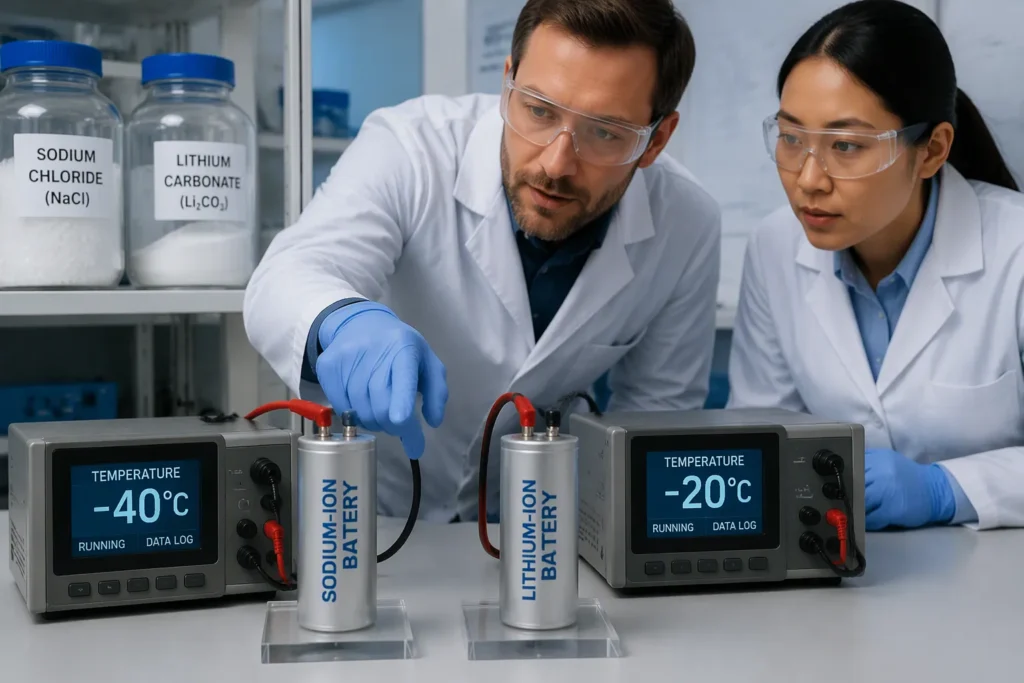
Sodium is about 1,180 times more concentrated than lithium in the Earth’s crust. That gap lowers material costs and reduces your reliance on critical minerals. Sodium extraction also leaves a smaller environmental footprint than lithium extraction, which can damage ecosystems and drain water resources. These points sit at the heart of the sodium-ion battery advantages and disadvantages debate.
The cost picture has shifted, though. Lithium prices fell, and sodium-ion production scaled up. Sodium-ion has lost some of its early cost edge. You still gain from abundant, widely available material, but you should not expect a dramatic price gap in 2026.
Safety and Cold Performance
Sodium-ion cells handle abuse better than many lithium chemistries. Their chemical structure and lower energy density reduce thermal runaway risk. They offer enhanced thermal stability, and they resist overcharging more effectively than lithium iron phosphate (LFP) packs. That safety profile matters for residential, industrial, and transportation uses.
Cold weather is where sodium-ion truly shines. These cells discharge at 0.5C down to -40°C and charge at 0.1C as low as -20°C. Lithium-ion and lead-acid batteries can lose up to around 50% of power capacity at -20°C, while sodium-ion retains over 90%.
Sodium-ion batteries have a major advantage over lithium-ion batteries in temperature performance, especially cold and high-temperature conditions. However, their energy density is lower than lithium-ion. The choice depends on the application: in very cold locations such as northern Yukon cell phone towers, sodium-ion can outperform lithium-ion, while in extremely hot desert conditions sodium-ion may continue working well where lithium-ion could fail catastrophically.
The drawbacks deserve equal weight. Sodium-ion batteries store less energy by weight and volume, so you need a larger pack for the same capacity. They currently cannot match rapid charging speeds without risking degradation. Their practical cycle life falls short of quality LiFePO4 packs, which reach 3,000–5,000+ cycles. Commercial production also remains limited, and scaling it presents real hurdles. Ongoing research must extend lifespan and improve efficiency before sodium-ion matches lithium-ion across the board.
Weigh these sodium-ion battery advantages and disadvantages against your own needs. A freezing cell tower favors sodium-ion. A slim phone or a long-range car still favors lithium-ion.
Disadvantages to Watch
Energy Density Limits
Energy density remains the biggest weakness. Sodium-ion cells store less energy per kilogram than modern lithium packs. You need a bigger, heavier battery to hold the same amount of power. This gap limits use in compact devices and long-range electric vehicles.
The table below shows how this plays out in real packs.
Metric | Sodium-ion | Modern LFP / NMC |
|---|---|---|
Energy density | ~160 Wh/kg | Higher than sodium-ion |
Effect on pack | Bigger, heavier packs for the same range | Smaller, lighter packs for the same range |
Example (60 kWh pack) | Takes up ~30% more space | Baseline for comparison |
A 60 kWh sodium-ion pack takes up roughly 30% more space than a lithium-ion pack of the same capacity. That extra bulk and weight make sodium-ion a poor fit for slim phones, tablets, and long-range passenger cars. You also face safety concerns because sodium deposits are highly reactive, and performance can degrade after many charge cycles.
Commercialization Gaps
Sodium-ion batteries are still early in commercialization. Fewer products exist, and supply chains are less mature than lithium-ion. In China, sodium-ion cells cost about 0.6 yuan/Wh versus roughly 0.4 yuan/Wh for lithium-ion, mainly due to an immature supply chain. That gap should narrow as CATL and BYD scale production.
Research on sodium-ion batteries addresses supply constraints and cost factors, making battery energy storage more inclusive and accessible. When paired with low-cost solar energy, it represents a techno-economically viable pathway to creating decarbonized, resilient communities.
Progress is real, though. CATL’s sodium-ion energy storage solution has reached full commercial maturity, with cumulative shipments expected to reach 1 GWh by the end of 2026. Domestic deliveries begin in September 2026, and international deliveries start in June 2027. In April 2026, CATL and HyperStrong signed a three-year, 60 GWh order, the world’s largest sodium-ion commercial contract. Changan Automobile also unveiled its global sodium-ion strategy in February 2026, with vehicles undergoing extreme cold validation beyond minus 40 degrees Celsius. These sodium-ion battery advantages and disadvantages show a technology maturing fast, yet still trailing lithium-ion in efficiency, cycle life, and fast-charging capability.
Real-World Applications in 2026
Grid Storage
Grid storage is the leading use case for sodium-ion batteries in 2026. Utilities care about cost, safety, and durability more than they care about squeezing every watt-hour into a small space. A shipping-container-sized battery bank can afford extra bulk. That makes lower energy density a minor concern for stationary power.
The commercial numbers back this up. CATL’s sodium-ion energy storage solution has reached full commercial maturity, with cumulative shipments expected to reach 1 GWh by the end of 2026. Domestic deliveries begin in September 2026, and international deliveries start in June 2027. In April 2026, CATL and HyperStrong signed a three-year, 60 GWh order, the world’s largest sodium-ion commercial contract. You also gain a safety edge here. Sodium-ion cells resist thermal runaway better than many lithium chemistries, which matters for installations near homes and businesses.
EVs and Devices
Electric vehicles and consumer devices remain a harder sell. A 60 kWh sodium-ion pack takes up roughly 30% more space than a lithium-ion pack of the same capacity. That extra bulk and weight hurt range and cabin space. Slim phones and tablets face the same problem on a smaller scale.
Progress is still real. Changan Automobile unveiled its global sodium-ion strategy in February 2026, with vehicles undergoing extreme cold validation beyond minus 40 degrees Celsius. That cold-weather strength suits northern fleets, where lithium-ion packs lose capacity. Current sodium-ion cells reach 110–140 Wh/kg, roughly equal to lithium-ion a decade ago. Costs in China sit near 0.6 yuan/Wh versus about 0.4 yuan/Wh for lithium-ion, a gap tied to immature supply chains. As CATL and BYD scale production, that gap should narrow. For now, you should match the chemistry to the job: stationary storage and cold-climate fleets favor sodium-ion, while long-range cars and compact electronics still favor lithium-ion.
The Road Ahead
Research and Development
Scientists are working hard to fix the weak points of sodium-ion cells. One major focus is energy density. Researchers study how sodium ions move inside cathode materials. They use advanced techniques like solid-state NMR to track ion movement at the atomic level. This work helps them design cathodes that store more energy. Teams also develop new sodium solid-ion conductors. They study interfaces and ion dynamics with tools like XPS and ToF-SIMS. These efforts aim to solve interface challenges in all solid-state sodium batteries.
Other teams target cycle life and fast charging. Better cathode and anode materials can extend how many times you can charge and discharge a cell. Improved electrolytes can also raise charging speed without damaging the battery. These gains matter because they directly shape the sodium-ion battery advantages and disadvantages for real buyers. As labs solve these problems, sodium-ion cells will close the gap with lithium-ion in more applications.
Market Outlook
Adoption is growing fast, but from a small base. As of 2025, global sodium-ion production stayed below 1% of lithium-ion production. Major manufacturers are now scaling up and deploying cells for grid-scale storage. The IEA projected in 2024 that sodium-ion could reach roughly 10% of annual global battery storage capacity additions by 2030.
Stationary storage remains the strongest fit. Size and weight matter less for grid installations. Sodium-ion also offers lower-cost materials, supply-chain diversity, and better thermal stability. Cold-climate use is another clear win. The technology still struggles against optimized low-cost lithium-ion, especially LFP. Your best choice depends on your specific needs.
Sodium-ion batteries in 2026 are a real, viable option, but the technology is still maturing. You get clear wins in cost, safety, and sustainability. You also accept real limits in energy density and fast-charging speed.
The trade-offs stay consistent. Sodium is abundant and cheap, cells resist thermal runaway, and they hold capacity in extreme cold. Yet they store less energy per kilogram, so packs grow bigger and heavier. Commercial supply chains also remain young.
Expect steady progress, not a sudden leap. Research keeps pushing energy density and cycle life upward, and major manufacturers keep scaling production.
Your use case decides the winner. Grid storage and cold-climate fleets favor sodium-ion today. Long-range cars and slim devices still favor lithium-ion.
FAQ
Are sodium-ion batteries better than lithium-ion?
Not across the board. Sodium-ion wins on material abundance, thermal safety, and cold-weather performance. Lithium-ion still stores more energy per kilogram. Your application decides the winner. Grid storage and freezing climates favor sodium-ion. Long-range cars and slim devices favor lithium-ion.
How do sodium-ion batteries perform in cold weather?
They hold over 90% of power capacity at -20°C. Lithium-ion and lead-acid packs can lose up to around 50% at that temperature. At -40°C, sodium-ion retains roughly 80% discharge capacity. Most current cells still need heating to accept a charge at that extreme.
Why do sodium-ion batteries cost less to make?
Sodium is about 1,180 times more concentrated than lithium in the Earth’s crust. That abundance lowers material costs and cuts reliance on critical minerals. Extraction also leaves a smaller environmental footprint. The price gap has narrowed, though. In China, sodium-ion cells cost about 0.6 yuan/Wh versus roughly 0.4 yuan/Wh for lithium-ion.
What limits sodium-ion battery energy density?
Sodium ions have a larger atomic radius and heavier mass than lithium ions. Current cells reach 110–140 Wh/kg. A 60 kWh sodium-ion pack takes up roughly 30% more space than a lithium-ion pack of the same capacity. That bulk rules out slim phones and long-range electric vehicles.
Are sodium-ion batteries available in 2026?
Yes, but supply chains remain young. CATL’s sodium-ion energy storage solution has reached full commercial maturity, with cumulative shipments expected to reach 1 GWh by the end of 2026. CATL and HyperStrong also signed a three-year, 60 GWh order in April 2026. The IEA projected roughly 10% of annual global battery storage capacity additions by 2030.