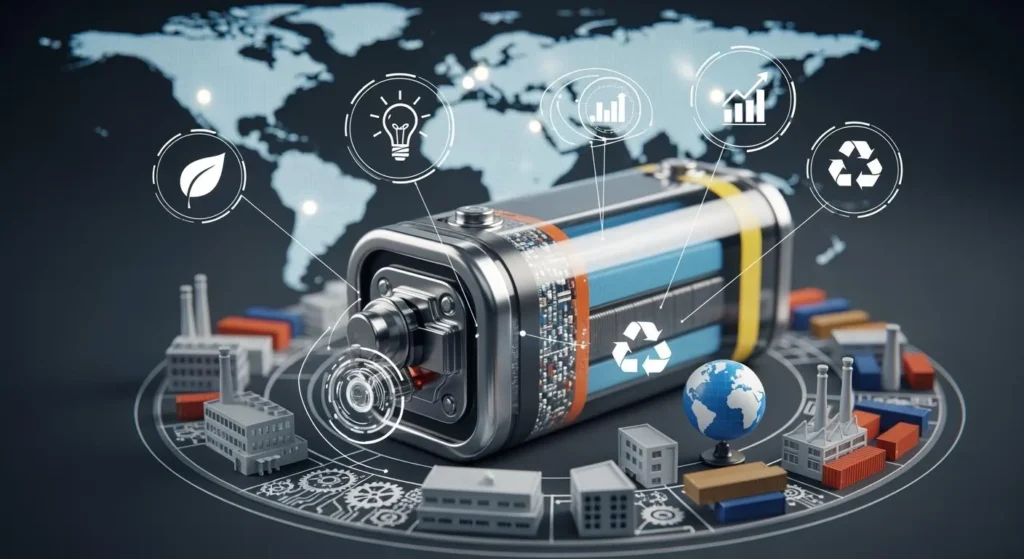
The top 10 global sodium-ion battery manufacturers for 2026 include CATL, BYD, Faradion, HiNa Battery, Natron Energy, VEKEN, Altris, TYCORUN, KPIT Technologies, and AMTE Power. These sodium-ion battery companies earn their place through advanced technology, strong production capacity, and significant market influence. The global sodium-ion battery market is projected to reach $1.08 billion in 2026, with a compound annual growth rate of 15.8%. Each manufacturer leads energy storage innovation, shaping the future of energy storage worldwide.
Key Takeaways
- Sodium-ion batteries are gaining popularity due to their cost-effectiveness and safety, making them a viable alternative to lithium-ion batteries.
- The global sodium-ion battery market is expected to reach $1.08 billion by 2026, with a growth rate of 15.8%, indicating strong demand for these technologies.
- Top manufacturers like CATL and BYD lead the market with advanced technology and high production capacities, ensuring they meet rising global energy storage needs.
- Sodium-ion batteries excel in extreme temperatures, operating reliably from -40°C to 80°C, which enhances their suitability for various applications.
- Investing in sodium-ion battery technology can support sustainability goals, as these batteries use abundant materials and avoid harmful substances like lead.
Selection Criteria for Top 10 Global Sodium-ion Battery Manufacturers
Selecting the top 10 global sodium-ion battery manufacturers requires a comprehensive evaluation of several critical factors. These criteria ensure that only the most advanced, reliable, and influential sodium-ion battery companies make the list. The global sodium-ion battery market continues to expand, making these standards essential for identifying industry leaders.
Technology and Innovation
Sodium-ion battery technology has evolved rapidly, with manufacturers focusing on power density, cycle life, coulombic efficiency, self-discharge rate, and safety. The table below summarizes the main technical criteria:
| Criteria | Definition | Importance |
|---|---|---|
| Power Density | Rate at which energy can be drawn from a battery (W/L or W/kg). | Crucial for applications needing rapid energy delivery, such as electric vehicles. |
| Cycle Life | Number of charge-discharge cycles before capacity drops to 80%. | Longer cycle life enhances sustainability and reduces replacement frequency. |
| Coulombic Efficiency | Ratio of charge extracted to charge put in during a cycle (percentage). | High efficiency ensures better energy utilization and minimizes energy loss. |
| Self-Discharge Rate | Rate of energy loss when not in use (percentage per month). | Low self-discharge improves reliability for intermittent-use applications. |
| Safety and Thermal Stability | Ability to operate safely without overheating or catching fire. | Essential for consumer electronics and electric vehicles. |
Manufacturers incorporate innovation by analyzing market needs, evaluating emerging technologies, and developing products that meet industry standards. They collaborate with research institutions to drive advancements in sodium-ion battery technology and improve cost-effectiveness.
Production Capacity
Production capacity determines a manufacturer’s ability to meet the rising demand for sodium-ion batteries. Leading global sodium-ion battery manufacturers invest in scalable production processes and efficient manufacturing. The chart below illustrates the production capacities of major players:
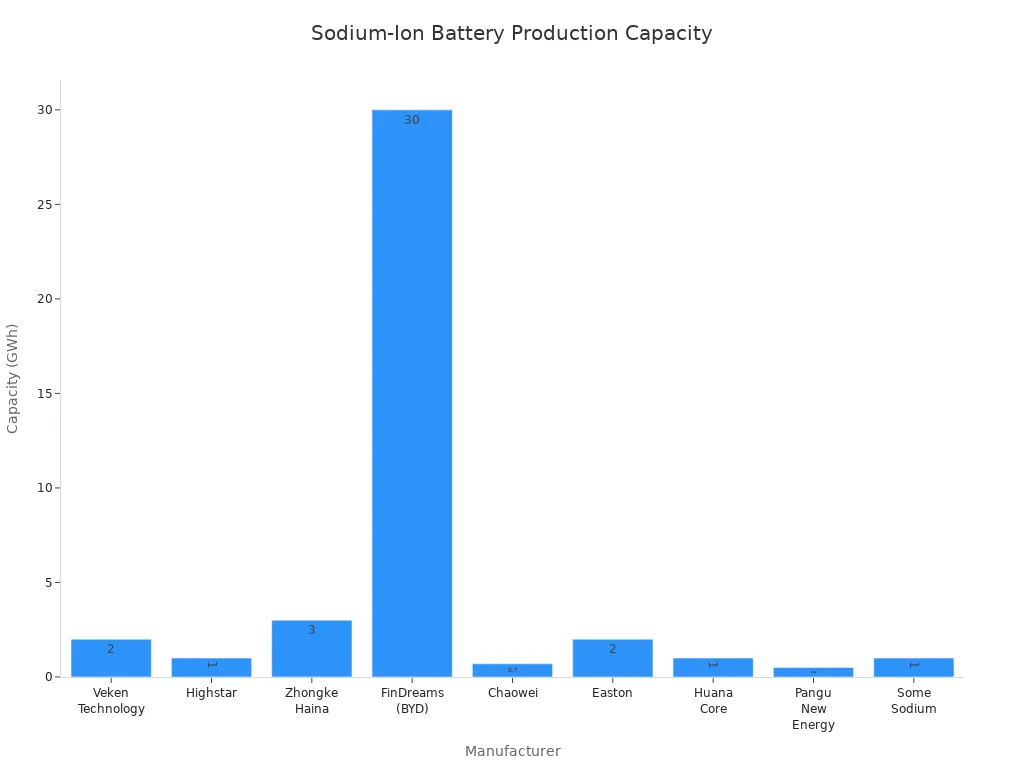
Manufacturers with higher production capacity achieve economies of scale, lower prices, and greater market reach. Sodium-ion batteries can be produced on existing lithium-ion lines with minor modifications, which helps address supply concerns and facilitates market entry.
Market Influence
Market influence reflects a manufacturer’s impact on the global sodium-ion battery market. Key metrics include company valuation, EV/EBITDA ratios, stock performance, and market share analysis.
| Metric | Description |
|---|---|
| Company Valuation | Assessment of the overall worth of a company. |
| EV/EBITDA Ratios | Comparison of enterprise value to earnings. |
| Stock Performance | Analysis of price return and volatility. |
| Market Share Analysis | Percentage of market controlled by each company. |
Major sodium-ion battery manufacturers expand their influence by adopting advanced manufacturing techniques, increasing research and development, and forming strategic partnerships with automotive brands. The global sodium-ion battery market is projected to grow significantly, driven by these efforts and the adoption of sodium-ion technology in diverse applications.
CATL – Leading Global Sodium-ion Battery Manufacturer
Company Overview
Contemporary Amperex Technology Co., Limited (CATL) stands as the world’s largest battery manufacturer, headquartered in Ningde, China. The company leads the global market in advanced energy storage solutions, supplying batteries for electric vehicles, grid storage, and industrial applications. CATL’s commitment to research and development has positioned it at the forefront of sodium-ion battery technology.
🌏 Learn more about CATL on their official website.
Sodium-ion Battery Technology
CATL’s sodium-ion batteries, branded as Naxtra, represent a breakthrough in the industry. These batteries achieve an energy density of 175 Wh/kg, the highest among sodium-ion batteries worldwide. They maintain 90% usable power at -40°C and operate reliably even at low states of charge. Naxtra batteries deliver over 10,000 charge-discharge cycles, which reduces maintenance costs and extends product life. CATL’s sodium-ion battery technology also features ultra-fast charging, reaching up to 520 km of range in just five minutes under optimal conditions. The use of abundant sodium resources enhances sustainability and reduces reliance on scarce minerals.
| Feature | Description |
|---|---|
| Energy Density | 175 Wh/kg, competitive with LFP batteries |
| Cycle Life | Over 10,000 cycles, ensuring long-term durability |
| Ultra-Fast Charging | 5C capability, rapid energy replenishment |
| Temperature Range | Operates from -40°C to +70°C |
| Safety | No fire or explosion risk under extreme conditions |
| Sustainability | Uses sodium, reducing environmental impact |
Production Capacity
CATL has established large-scale sodium-ion battery production lines in China. The company’s manufacturing facilities can deliver gigawatt-hour-level output, supporting the rapid adoption of sodium-ion batteries in electric vehicles, stationary storage, and commercial fleets. CATL’s flexible production model allows for seamless integration of sodium-ion technology alongside lithium-ion lines, ensuring efficient scaling as market demand grows.
Recent Developments
In 2023, CATL announced the successful mass production of Naxtra sodium-ion batteries. The company partnered with leading automotive brands to integrate sodium-ion battery packs into new electric vehicle models. CATL also launched pilot projects for grid-scale energy storage using sodium-ion batteries, demonstrating their performance in real-world applications. These initiatives highlight CATL’s role in accelerating the commercialization of sodium-ion battery technology.
Unique Strengths
CATL’s sodium-ion batteries offer unmatched temperature tolerance, ultra-fast charging, and exceptional safety. The company’s focus on sustainability and resource efficiency sets it apart from competitors. CATL’s global partnerships and robust supply chain ensure reliable delivery for large-scale projects. As a pioneer in sodium-ion battery innovation, CATL continues to shape the future of energy storage.
BYD – Top Sodium-ion Battery Manufacturer
Company Overview
BYD, headquartered in Shenzhen, China, stands as a global leader in battery manufacturing and electric mobility. The company has built a strong reputation for innovation and large-scale production. BYD operates in over 50 countries and supplies advanced energy solutions for electric vehicles, grid storage, and commercial fleets. 
🌐 Official BYD Website
Sodium-ion Battery Technology
BYD has invested heavily in sodium-ion battery technology to address the growing demand for cost-effective and sustainable energy storage. Their sodium-ion batteries deliver competitive energy density and perform well in cold environments. In 2023, BYD produced a 150Ah blade-type sodium cell with an energy density of 160Wh/kg and a cycle life exceeding 6,000 cycles. This performance matches many lithium iron phosphate batteries. BYD’s sodium-ion battery technology supports a wide range of applications, including electric vehicles, stationary storage, and backup power systems.
Production Capacity
BYD has established one of the largest sodium-ion battery production lines in the world.
Key highlights include:
- Initial annual capacity of 30 GWh for sodium-ion batteries.
- Scalable infrastructure to meet rising global demand.
- Integration with existing manufacturing lines for efficient output.
Recent Developments
In 2023, BYD completed pilot production of advanced sodium-ion batteries and began partnerships with automotive manufacturers. The company plans to launch its first electric vehicle model powered by sodium-ion batteries in Q1 2026. This move targets a competitive price point and aims to expand the adoption of sodium-ion battery systems in the automotive sector. BYD also collaborates with energy storage providers to deploy sodium-ion battery technology in grid-scale projects.
Unique Strengths
BYD’s sodium-ion battery technology offers several advantages:
- Lower production costs compared to competitors.
- Strong performance in low-temperature environments.
- High energy density and long cycle life.
- Versatility for use in electric vehicles, grid storage, and industrial applications.
🚗 BYD’s commitment to innovation and large-scale production positions the company as a top supplier of sodium-ion batteries for diverse global markets.
Faradion – UK Sodium-ion Battery Innovator
Company Overview
Faradion stands as a pioneer in the sodium-ion battery industry. The company began operations in the United Kingdom and has contributed to the sector for more than ten years. Faradion’s expertise and innovation have positioned it as a leader in the development of sodium-ion batteries. In 2021, Reliance Industries acquired Faradion for £100 million. This acquisition highlighted Faradion’s strategic importance in both the UK and global markets. The company’s focus on sustainable energy solutions has made sodium-ion battery technology a viable alternative to lithium-ion batteries, especially for large-scale energy storage.
Sodium-ion Battery Technology
Faradion’s sodium-ion battery technology uses layered oxide cathodes and hard carbon anodes. This design allows for high energy density and long cycle life. The batteries operate safely at a wide range of temperatures. Faradion’s technology does not rely on scarce or expensive materials. The company’s research team continues to improve the performance and cost-effectiveness of sodium-ion batteries. Faradion’s batteries are suitable for stationary storage, electric vehicles, and backup power systems.
Production Capacity
Faradion has established pilot production lines in the UK. The company partners with global manufacturers to scale up production. Faradion’s collaboration with Reliance Industries supports plans for gigawatt-hour-level manufacturing in India. This expansion aims to meet the growing demand for sodium-ion battery solutions in international markets.
Recent Developments
In recent years, Faradion has secured several commercial agreements for sodium-ion battery supply. The company has delivered batteries for renewable energy storage projects and electric mobility applications. Faradion continues to invest in research and development to enhance battery performance and reduce costs. The partnership with Reliance Industries accelerates the commercialization of sodium-ion batteries worldwide.
Unique Strengths
Faradion’s unique strengths include its established expertise, strong intellectual property portfolio, and flexible battery chemistry. The company’s sodium-ion batteries offer high safety, long cycle life, and stable performance in diverse environments. Faradion’s technology provides a sustainable and cost-effective solution for energy storage, supporting the transition to cleaner energy systems.
HiNa Battery – China Sodium-ion Battery Leader
Company Overview
HiNa Battery operates as a leading force in China’s sodium-ion battery industry. The company has built a reputation for innovation and reliability. HiNa Battery invests heavily in research and development, filing over 20 patents in sodium-ion technology. The company’s headquarters are located in Beijing, and its team includes experienced engineers and scientists. HiNa Battery supplies products to both domestic and international markets, focusing on energy storage and electric mobility solutions.
Sodium-ion Battery Technology
HiNa Battery’s sodium-ion battery technology emphasizes affordability, safety, and high energy density. The company designs batteries for long-lasting performance, targeting a wide range of applications. HiNa Battery engineers cube-shaped batteries for commercial-scale energy storage and cylindrical batteries for electric mopeds. The technology supports stable operation in diverse environments, making it suitable for energy storage systems, electric bicycles, and low-speed vehicles. HiNa Battery’s products deliver consistent output and maintain safety standards, even under demanding conditions.
Production Capacity
HiNa Battery maintains advanced manufacturing facilities in China. The company produces sodium-ion batteries at scale, meeting the needs of energy storage plants and small vehicle manufacturers. HiNa Battery’s production lines use automated processes to ensure quality and efficiency. The company continues to expand its capacity to support growing demand in both domestic and global markets.
Recent Developments
HiNa Battery has achieved several milestones in recent years. The company’s sodium-ion battery products now power small vehicles and energy storage plants across China. HiNa Battery introduced a new cube-shaped battery for commercial energy storage projects. The company also launched cylindrical batteries for electric mopeds, expanding its product portfolio. HiNa Battery collaborates with industry partners to develop new applications and improve battery performance.
Unique Strengths
HiNa Battery stands out among Chinese manufacturers for several reasons:
- Commitment to innovation, demonstrated by over 20 patents in sodium-ion technology.
- Focus on affordability and long-lasting performance.
- Versatile product range, including batteries for energy storage systems, electric bicycles, and low-speed vehicles.
- Proven safety and high energy density in all sodium-ion battery products.
HiNa Battery’s dedication to research and diverse applications positions the company as a leader in the sodium-ion batteries market.
Natron Energy – US Sodium-ion Battery Manufacturer
Company Overview
Natron Energy operates as a leading sodium-ion battery manufacturer based in California, United States. The company focuses on advanced energy storage solutions for industrial and commercial clients. Natron Energy has built a reputation for reliability and innovation in the field of sodium-ion batteries. Their team includes experienced engineers and scientists who drive research and development. Natron Energy partners with major industry players to deliver high-performance battery systems across the United States.
Sodium-ion Battery Technology
Natron Energy’s sodium-ion battery technology stands out for its use of Prussian Blue Analogue as a cathode material. This approach enables rapid power discharge and a long cycle life. The technology is tailored for demanding applications such as data center backup power and artificial intelligence workloads. Natron’s sodium-ion batteries are safer than many alternatives because they are less flammable and do not require containment systems. The batteries use abundantly available materials, which enhances sustainability and reduces reliance on conflict minerals. Natron’s sodium-ion battery systems deliver superior energy storage and release efficiency, making them a strong choice for industrial power applications.
Production Capacity
Natron Energy operates a state-of-the-art manufacturing facility in the United States. The company has invested in scalable production lines to meet the growing demand for sodium-ion batteries. Natron’s facility supports mass production for commercial and industrial clients. The company continues to expand its capacity to serve new markets and applications.
Recent Developments
Natron Energy has achieved several milestones in recent years. The company launched new sodium-ion battery products for data centers and AI infrastructure. Natron secured partnerships with leading technology firms to integrate sodium-ion battery systems into critical power applications. The company also expanded its reach into the materials handling sector, providing batteries for electrically-powered equipment.
Unique Strengths
Natron Energy’s sodium-ion batteries offer several unique advantages:
- Rapid power discharge and long cycle life
- High safety profile with low flammability
- Use of sustainable, widely available materials
- Tailored solutions for data centers, AI, and industrial power
The table below summarizes the main applications for Natron Energy’s sodium-ion battery systems:
| Application Type | Description |
|---|---|
| AI | High-powered applications for artificial intelligence |
| Data Centers | Uninterruptible power supply (UPS) systems |
| Peak Shaving | Reducing energy costs during peak demand |
| Power Quality Management | Maintaining power quality in industrial settings |
| Electrically-Powered Equipment | Materials handling equipment powered by electricity |
Natron Energy continues to lead the US market with innovative sodium-ion battery solutions for critical infrastructure and industrial applications.
VEKEN – Global Sodium-ion Battery Manufacturer
Company Overview
VEKEN operates as a comprehensive manufacturing and trading platform with roots in Ningbo, China. The company began in 1905 and has grown into a global supplier across multiple industries. VEKEN Battery, a specialized division, entered the energy sector in 2004. Today, VEKEN serves over 500 clients in more than 120 countries, offering advanced sodium-ion battery solutions for industrial, commercial, and consumer applications.
VEKEN Sodium Battery Technology
VEKEN engineers sodium-ion battery systems to deliver high safety, long cycle life, and reliable performance. The company’s sodium-ion batteries use advanced cell designs, including cylindrical and prismatic formats. These batteries maintain stable output in temperatures from -40°C to 80°C. VEKEN sodium-ion battery products support deep discharge and high-rate applications, making them suitable for motorcycles, agricultural machinery, and energy storage systems. The batteries pass rigorous safety tests, such as nail penetration, without fire or explosion.
Production Capacity
VEKEN leverages a strong industrial base and a network of partner factories to scale sodium-ion battery production. The company operates modern manufacturing lines capable of producing both small and large battery systems. VEKEN’s flexible production model allows for customization based on client requirements. This approach ensures consistent quality and timely delivery for global projects.
Recent Developments
In recent years, VEKEN expanded its sodium-ion battery portfolio to include new models for e-mobility, telecom backup, and home energy storage. The company introduced customizable battery packs with enhanced cold-cranking amps and longer cycle life. VEKEN also launched partnerships with international clients to deploy sodium-ion batteries in challenging environments.
Unique Strengths
VEKEN stands out for its commitment to safety, temperature tolerance, and deep-cycle performance. The company’s sodium-ion battery solutions offer environmental benefits by avoiding lead and heavy metals. VEKEN provides fully customizable batteries, meeting diverse needs in industrial and residential sectors. The company’s long history and global reach reinforce its position as a trusted sodium-ion battery manufacturer.
Altris – Sodium-ion Battery Manufacturer
Company Overview
Altris operates from Sweden and specializes in the development and production of sodium-ion battery technology. The company focuses on delivering sustainable energy solutions for industrial and commercial clients. Altris has built a reputation for advancing the performance and safety of sodium-ion batteries, positioning itself as a key player in the European market. The team at Altris includes experienced engineers and researchers who drive innovation in battery chemistry and manufacturing processes.
Sodium-ion Battery Technology
Altris designs sodium-ion batteries using unique chemistry that enhances both safety and sustainability. The company utilizes Prussian blue analogs for both anode and cathode materials, which improves energy density and recyclability. Altris employs a non-aqueous electrolyte to boost battery performance and reduce risks. The table below highlights the main features of Altris’s sodium-ion battery chemistry:
| Feature | Description |
|---|---|
| Anode and Cathode Materials | Utilizes Prussian blue analogs for both anode and cathode materials |
| Electrolyte | Employs a non-aqueous electrolyte for improved performance |
| Raw Material Availability | Benefits from abundant raw materials, enhancing sustainability |
| Safety | Designed with safety in mind, reducing risks associated with battery use |
| Recyclability | Focuses on recyclability, minimizing environmental impact |
| Cost Reduction | Contributes to lower overall costs of battery production |
| Energy Density | Aims for increased energy density compared to traditional batteries |
Altris’s sodium-ion battery technology supports applications in grid storage, renewable energy, and electric mobility.
Production Capacity
Altris continues to expand its manufacturing capabilities to meet rising demand for sodium-ion batteries. The company projects annual production capacity to reach 350 tonnes, which translates to approximately 175 MWh of sodium-ion cell output. This capacity places Altris among the leading European sodium-ion battery manufacturers. The scalable production model allows Altris to supply batteries for large-scale energy storage projects and commercial clients.
- Annual production capacity: 350 tonnes
- Sodium-ion cell output: 175 MWh
- Scalable manufacturing for industrial and grid applications
Recent Developments
Altris has made significant progress in commercializing sodium-ion batteries. The company announced new partnerships with energy storage providers and electric vehicle manufacturers. Altris launched pilot projects to demonstrate the reliability and efficiency of its sodium-ion battery systems in real-world conditions. The company also invested in research to further improve energy density and recyclability.
Unique Strengths
Altris stands out for its commitment to sustainable battery chemistry and scalable production. The use of abundant raw materials and focus on recyclability support environmental goals. Altris delivers sodium-ion batteries with enhanced safety and lower costs, making them attractive for industrial and grid-scale energy storage. The company’s expertise in Prussian blue analog technology positions it as a leader in the sodium-ion battery market.
TYCORUN – Sodium-ion Battery Manufacturer
Company Overview
TYCORUN operates as a prominent supplier in the sodium-ion battery industry. The company has established its headquarters in China and focuses on advanced energy storage solutions. TYCORUN serves a global client base, providing reliable products for both commercial and industrial applications. The company’s reputation for quality and technical expertise has positioned it as a trusted partner for businesses seeking alternative energy storage options.
Sodium-ion Battery Technology
TYCORUN invests in research and development to enhance sodium-ion battery technology. The company engineers batteries that deliver stable performance, long cycle life, and high safety standards. TYCORUN’s sodium-ion battery systems use advanced materials to improve energy density and maintain consistent output in a range of environments. The technology supports deep discharge and rapid charging, making it suitable for demanding applications. TYCORUN continues to refine its battery chemistry to meet evolving market needs.
Production Capacity
The company operates modern manufacturing facilities with scalable production lines. TYCORUN can adjust output to match fluctuations in market demand. The company’s flexible approach allows for the production of both small and large sodium-ion battery systems. TYCORUN maintains strict quality control throughout the manufacturing process to ensure each battery meets industry standards.
Recent Developments
TYCORUN has expanded its sodium-ion battery portfolio in recent years. The company introduced new battery models for electric vehicles and energy storage systems. TYCORUN has also formed partnerships with automotive and marine manufacturers to integrate sodium-ion batteries into their products. These collaborations have increased the adoption of sodium-ion battery technology in multiple sectors.
Unique Strengths
TYCORUN stands out for its ability to serve diverse markets with sodium-ion battery solutions. The company’s main markets include:
- Automobiles
- RVs
- Marine vehicles
TYCORUN’s sodium-ion batteries offer high safety, reliable performance, and adaptability for various applications. The company’s commitment to innovation and quality ensures that clients receive advanced energy storage solutions tailored to their needs.
KPIT Technologies – India Sodium-ion Battery Manufacturer
Company Overview
KPIT Technologies stands as a leading force in India’s battery innovation sector. The company has developed the nation’s first sodium-ion battery technology, marking a major milestone for sustainable energy solutions. KPIT Technologies collaborates with research institutions and industry partners to advance battery systems for electric vehicles and energy storage.
Sodium-ion Battery Technology
KPIT Technologies has introduced sodium-ion batteries that offer significant improvements over traditional lithium and lead-acid batteries. The technology, developed with the Indian Institute of Science Education and Research in Pune, features a lifespan ranging from 3,000 to 6,000 cycles. These sodium-ion batteries charge faster and perform reliably in cold temperatures. KPIT Technologies focuses on reducing costs, with sodium-ion battery systems expected to lower electric vehicle battery expenses by 25–30%. The company’s research team continues to refine battery chemistry, aiming for greater efficiency and safety.
Production Capacity
KPIT Technologies has partnered with Trentar Energy Solutions to commercialize sodium-ion battery technology. Trentar is investing in a 3 GWh manufacturing facility dedicated to these batteries. This commitment positions KPIT Technologies as a leader in India’s sodium-ion battery production landscape.
| Manufacturer | Production Capacity | Notes |
|---|---|---|
| KPIT Technologies | 3 GWh | Collaborating with Trentar, focusing on cost-effectiveness and sustainability. |
| Other Indian Makers | N/A | Varies, but generally less focus on sodium-ion technology. |
Recent Developments
KPIT Technologies has made rapid progress in the commercialization of sodium-ion batteries. The company’s partnership with Trentar Energy Solutions signals a strong move toward large-scale manufacturing. KPIT Technologies continues to invest in research, aiming to improve battery performance and expand applications in electric vehicles and grid storage.
Unique Strengths
- KPIT Technologies introduced India’s first sodium-ion battery technology.
- The company’s sodium-ion batteries deliver faster charging and longer lifespan.
- KPIT Technologies maintains a strong focus on cost reduction and sustainability.
- The partnership with Trentar supports large-scale production and market expansion.
KPIT Technologies demonstrates leadership in India’s sodium-ion battery industry through innovation, strategic partnerships, and a commitment to sustainable energy storage.
Comparative Table of Top Global Sodium-ion Battery Manufacturers
The top 10 global sodium-ion battery manufacturers lead the global sodium-ion battery market with advanced technology, strong production capacity, and significant market influence. The following table compares these global sodium-ion battery manufacturers across key features, technology, capacity, and market presence. Each company brings unique strengths to the global sodium-ion battery industry.
| 🌍 Manufacturer | 🌐 Location | ⚡ Key Technology | 🏭 Production Capacity | 💼 Market Influence | 🚀 Unique Strengths | 🔗 Official Site |
|---|---|---|---|---|---|---|
| CATL | China | Naxtra sodium-ion, 175 Wh/kg, ultra-fast charging | Gigawatt-hour scale | Top global sodium-ion battery market share | High energy density, rapid scaling | CATL |
| BYD | China | Blade-type sodium cell, 160 Wh/kg | 30 GWh | Top global sodium-ion battery companies | Cost-effective, strong EV partnerships | BYD |
| Faradion | UK | Non-aqueous sodium-ion, layered oxide cathode | Scaling to GWh with Reliance | Top in UK, expanding in India | Flexible chemistry, sustainability | Faradion |
| HiNa Battery | China | Cube/cylindrical sodium-ion, 20+ patents | Large-scale, automated lines | Leading in China, growing global | Versatile formats, safety focus | HiNa Battery |
| Natron Energy | USA | Prussian Blue Analogue, rapid discharge | Mass production for industry | Top in US, strong B2B focus | Data center and AI solutions | Natron Energy |
| VEKEN | China | Customizable sodium-ion, -40°C to 80°C, deep-cycle | Flexible, scalable, global reach | Top global sodium-ion battery manufacturers, 120+ countries | Safety, temperature tolerance, long cycle life | VEKEN |
| Altris | Sweden | Prussian blue analogs, non-aqueous | 175 MWh/year, scalable | Top in Europe, grid storage leader | Sustainability, recyclability | Altris |
| TYCORUN | China | Advanced sodium-ion, rapid charge/discharge | Modern, scalable lines | Global, strong in EV/marine | Adaptability, diverse applications | TYCORUN |
| KPIT Technologies | India | Fast-charging sodium-ion, 3,000–6,000 cycles | 3 GWh (with Trentar) | Top in India, cost reduction focus | First in India, EV innovation | KPIT |
| AMTE Power | UK | Solid-state sodium-ion, low-cost | Pilot to commercial scale | UK and EU market | Solid-state expertise, safety | AMTE Power |
🏆 The top 10 global sodium-ion battery manufacturers set industry standards for technology, safety, and sustainability. VEKEN stands out for its customizable solutions, exceptional safety, and proven performance in extreme temperatures, making it a preferred choice for global sodium-ion battery projects.
Technology Comparison
Global sodium-ion battery manufacturers use a range of advanced chemistries. CATL and BYD focus on high energy density and fast charging. Faradion and Altris lead in sustainable, non-aqueous and Prussian blue analog technologies. VEKEN delivers deep-cycle, customizable sodium-ion batteries with strong safety features. Natron Energy and HiNa Battery emphasize rapid discharge and versatile formats. Each top manufacturer brings unique innovations to the global sodium-ion battery market.
Capacity Comparison
Production capacity varies among global sodium-ion battery manufacturers. CATL and BYD operate at gigawatt-hour levels, supporting large-scale EV and grid projects. VEKEN uses a flexible, scalable model to serve over 120 countries. Altris and KPIT Technologies focus on scalable production for industrial and grid storage. Faradion, HiNa Battery, and TYCORUN continue to expand capacity to meet global demand.
Market Influence Comparison
The top 10 global sodium-ion battery manufacturers shape the global sodium-ion battery market through innovation, partnerships, and international reach. CATL and BYD hold leading market shares. VEKEN’s presence in over 120 countries demonstrates strong global influence. Faradion and Altris drive European and Indian market growth. Natron Energy and KPIT Technologies lead in the US and India, respectively. These global sodium-ion battery companies continue to expand their impact as the global sodium-ion battery market grows.
Explore more about sodium-ion battery technology and market trends at Battery University.
The top 10 global sodium-ion battery manufacturers stand out for their advanced technology, scalable production, and strong market influence. Innovation and safety drive their leadership in the industry. Sodium-ion battery manufacturers continue to expand applications, especially in grid storage and renewable energy. By 2030, sodium-ion batteries may reach 10% of the global market, fueled by cost-effectiveness and environmental benefits.
| Aspect | Details |
|---|---|
| Projected Market Share | 10% of global battery market by 2030 |
| Key Growth Area | Stationary storage, renewable energy transition |
| Driving Factors | Cost-effectiveness, safety, environmental benefits |
| Grid Storage Demand | Increased solar and wind deployment |
Industry leaders set new standards for energy storage. Readers should follow these companies for ongoing advancements in sodium-ion battery technology.
FAQ
What are the main advantages of sodium-ion batteries over lithium-ion batteries? ⚡
Sodium-ion batteries use abundant materials, offer strong safety, and perform well in cold environments. They provide a cost-effective alternative for large-scale energy storage. Learn more at Battery University.
Which industries benefit most from sodium-ion battery technology? 🏭
Industries such as grid energy storage, electric vehicles, telecom, and backup power systems benefit most. These batteries support applications that require high safety, long cycle life, and stable performance. See real-world use cases at CleanTechnica.
How do sodium-ion batteries perform in extreme temperatures? ❄️🌡️
Sodium-ion batteries maintain stable output from -40°C to 80°C. This wide temperature range makes them ideal for outdoor, industrial, and automotive applications. Read more at ScienceDirect.
Are sodium-ion batteries environmentally friendly? 🌱
Sodium-ion batteries do not contain lead or heavy metals. They use widely available resources, which reduces environmental impact. Their design supports sustainability goals for many organizations. Explore environmental benefits at IEA.