
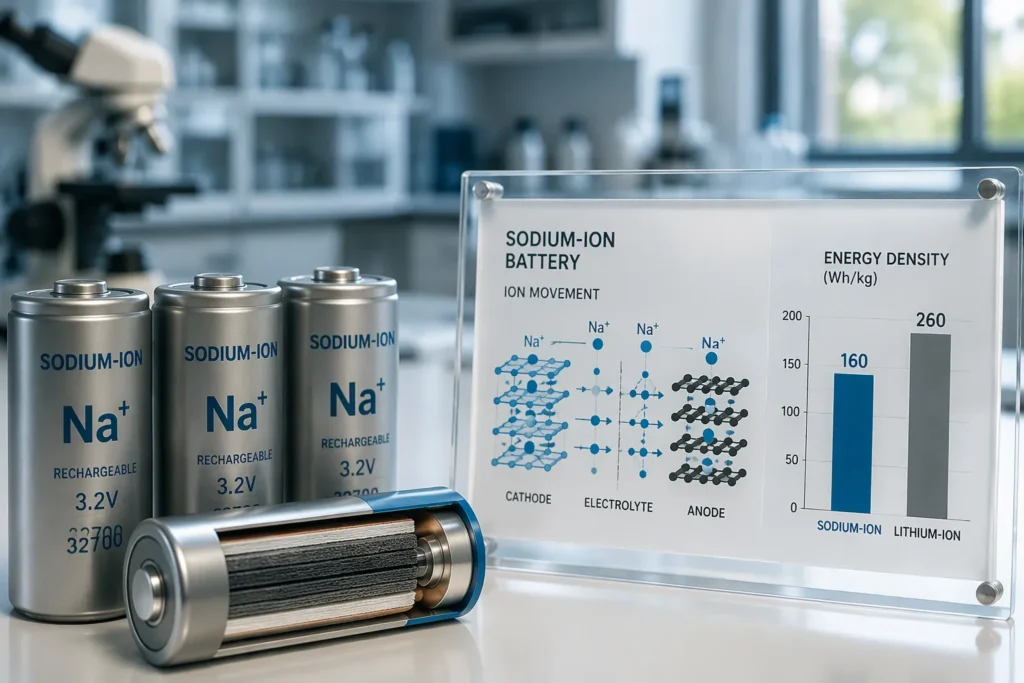
Sodium-ion batteries have moved from being tested in labs to being made and sold on a large scale. China is setting the pace for this change. The battery’s chemistry now fits uses where safety, cost and working in different temperatures matter more than how much energy it holds. In 2026, sodium-ion batteries became widely available for storing power on the grid and for electric vehicles. This key step is the base of the current plan. So the sodium-ion battery comes into the industry as a real option, not just a lab promise. Na-ion batteries offer a different mix of strengths from lithium-ion ones. Na-ion battery makers now focus on cost, safety and a wide supply chain. The na-ion route gives grid operators and vehicle makers one more choice. Performance figures, material progress and regional leadership all shape where na-ion batteries fit.
Key Takeaways
Sodium-ion batteries are now sold in large amounts, and China leads the world in making them.
These batteries are safe, work well in a wide range of temperatures, and have steady costs, but they hold less energy than lithium-ion ones.
Sodium-ion batteries are best suited to grid storage, backup power and short-range vehicles, rather than long-range cars.
They add a second supply choice next to lithium-ion, which makes the battery industry stronger and more varied.
As factories get bigger, sodium-ion battery prices will go down, and they will be used in more applications.
Current Standing of Sodium-Ion Batteries
Commercial Milestones and Scale
In 2026, sodium-ion batteries became easy to buy for grid storage and electric vehicles. China sets the speed of this rollout. Chinese makers have moved sodium-ion cells from test lines to full-scale output. Sodium-ion battery shipments now reach grid operators and vehicle makers as normal products, not samples. This change shows that the sodium-ion battery industry is now a real supply base, not just a research programme.
The current state of na-ion batteries shows steady gains in cell production capacity. Sodium-ion capacity has grown fastest in China, where several plants now run commercial lines. For the first time, analysts track sodium-ion battery shipments as their own category. This commercial viability rests on mature materials, stable processes and a supply chain that no longer depends on lithium. The industry now treats na-ion batteries as a mainstream option for cost-sensitive projects.
Key Performance Metrics
The table below sums up typical performance ranges for sodium-ion cells. Values differ by chemistry and manufacturer, so buyers should check figures with suppliers.
Metric | Typical sodium-ion position | Note |
|---|---|---|
Energy density | Lower than lithium-ion | Suits fixed storage more than long-range vehicles |
Cycle life | Competitive for stationary use | Rises with careful thermal management |
Temperature tolerance | Wide operating window | Retains function in cold and hot climates |
Safety | Strong thermal stability | Cells resist runaway better in abuse tests |
Power capability | Good at high rates | Supports fast charge and discharge |
Sodium-ion batteries swap energy density for safety, temperature tolerance, power capability and supply-chain resilience. A na-ion battery gives less range per kilogram than a lithium-ion pack. That gap matters for premium electric cars. It matters much less for grid storage, backup power and short-range vehicles. The na-ion route also avoids lithium, nickel and cobalt, so cell costs depend less on unstable metal markets. Commercialization has therefore moved fastest where energy density is not the deciding factor.
The Sodium-Ion Battery Technology Roadmap

From Research to First Production
The sodium-ion battery roadmap started with lab studies on sodium-based electrode materials. Early work showed that sodium ions could move through host structures in a reversible way. Researchers then tested full cells in test settings. These trials confirmed stable cycling and safe operation. The next step moved the chemistry onto pilot lines. Engineers adapted coating, drying and assembly processes to sodium-based materials. Pilot output gave manufacturers the data they needed to design commercial production lines.
The industry now works in a scaled commercialization phase. Sodium-ion cells leave factories in commercial volumes, and the technology has entered a practical build-out stage. This progression shows a clear pattern. Technical validation came first. Pilot manufacturing followed. Full commercial production then arrived. Each stage cut risk for the next one. The next-generation battery roadmap now treats sodium-ion technology as a proven route rather than an experiment.
Material Innovation and Cost Trends
Material science pushes the sodium-ion battery forward. Cathode research looks at layered oxides and Prussian blue analogues. Anode work centres on hard carbon. These choices answer three demands at once: higher energy density, lower cost and stronger safety. Hard carbon anodes handle fast charging and resist degradation. Layered oxide cathodes give a balance between capacity and stability. Recent studies also look closely at failure mechanisms. Researchers now understand how sodium plating and electrolyte breakdown shorten cell life. This knowledge guides better cell design.
Cost trends follow material progress. Sodium-ion batteries use abundant raw materials, so cell costs depend less on scarce metals. Manufacturing scale adds further savings. Performance milestones arrive alongside these cost gains. Sodium-ion cells now deliver competitive cycle life for stationary use. Energy density stays below lithium-ion levels, and the roadmap accepts this trade-off. Commercial viability rests on fit, not on matching every lithium-ion metric. Speeding up commercialization will depend on continued material refinement and steady factory expansion.
Sodium-Ion Versus Lithium-Ion in the Global Battery Market
Technical Performance and Application Fit
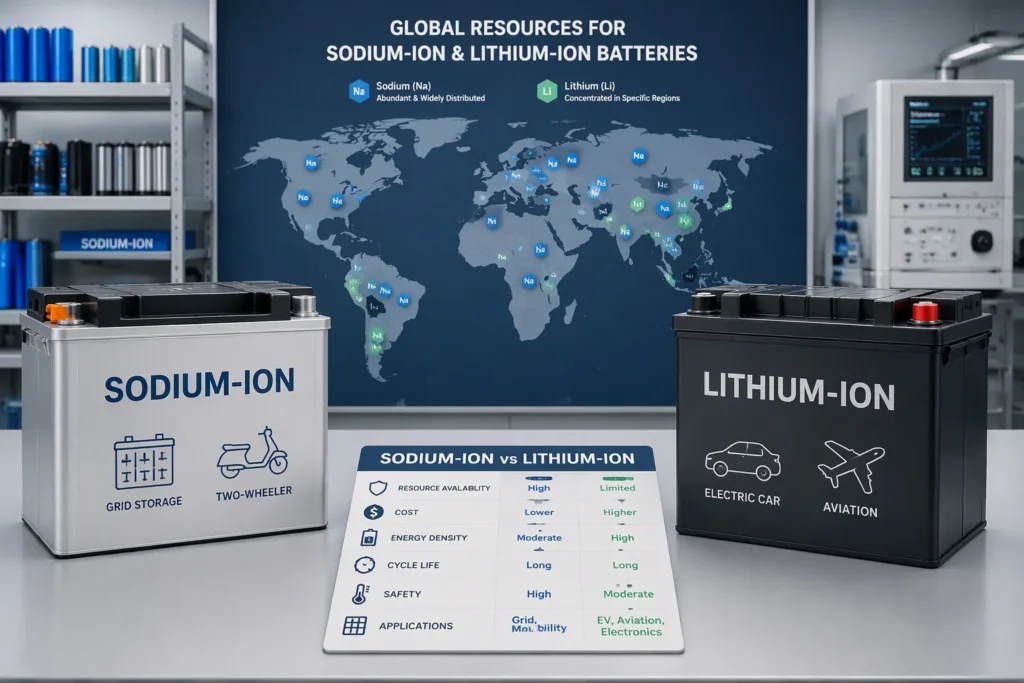
The two chemistries do different jobs. Sodium-ion batteries hold less energy than mainstream lithium-ion batteries. So a sodium-ion pack weighs more for the same stored energy. Lithium-ion is still the better fit for long-range electric cars, premium consumer devices and aviation. Sodium-ion cells suit fixed installations, backup systems, two-wheelers and short-range urban vehicles. Their wide temperature window helps in cold stores, remote sites and hot climates. Their strong thermal stability lowers fire risk in dense urban storage. High power capability supports fast charge and discharge cycles. Buyers should match the chemistry to the duty cycle, not to a single headline figure.
Cost, Compliance and Supply-Chain Diversification
Cost tells a similar story of fit rather than victory. Sodium-ion batteries use abundant precursors, so cell prices depend less on lithium, nickel and cobalt markets. Analysts expect the global sodium-ion market to grow as factory output rises and material costs fall. Lithium-ion still wins on cost per kilowatt-hour in many high-energy applications, and its mature supply chain keeps prices competitive. The global battery market is large enough for both.
Compliance shapes the choice as well. Sodium-ion cells avoid lithium transport restrictions, and this makes logistics simpler for grid projects. Both chemistries must meet the same safety and transport standards, such as UN 38.3 for shipping. Regulators treat na-ion batteries under existing frameworks, so certification paths are familiar.
Supply-chain diversification is the strongest argument for na-ion batteries. Sodium resources are spread widely, and this reduces dependence on a few producing regions. Na-ion batteries therefore add a second pillar to procurement strategies. They do not replace lithium-ion. They spread risk across two chemistries, and this protects project schedules when one material market tightens. The industry benefits from a broader technology base. Grid operators gain a cost-stable option. Vehicle makers gain a low-cost chemistry for entry models. Each chemistry keeps its own best-fit territory.
Na-Ion Batteries and Regional Leadership
China’s Dominant Position
China leads the world in making sodium-ion batteries. Chinese manufacturers moved the chemistry from pilot lines to full commercial output before their rivals did. Several plants now run sodium-ion battery lines that are only for this product. These factories supply grid operators and vehicle makers with finished products. Analysts now track sodium-ion battery shipments as a separate category for the first time, and Chinese output makes up most of that total.
This lead rests on three practical strengths. First, China has mature supply chains for hard carbon, layered oxide cathodes and electrolyte salts. Second, Chinese firms scaled cell production capacity early, which spread fixed costs across large volumes. Third, demand from grid projects at home gives factories a steady order book. This mix lets Chinese suppliers quote competitive prices and short lead times. Rivals in other regions are still working through pilot stages, so the gap in deployment remains wide.
Early Steps in the US and Europe
The United States and Europe are at an earlier stage. Research groups and start-ups in both regions run pilot lines and test cells for stationary storage. Several developers aim at grid-scale projects first, where energy density matters less. These programmes are still small next to Chinese output, yet they build local know-how and supplier networks.
Europe sees a clear role for na-ion batteries in its move to clean energy. Wind and solar farms need cheap, safe storage to shift power across the day. Sodium-ion cells suit this job because they cope with wide temperature swings and resist thermal runaway. European grid operators also value the lithium-free chemistry because it makes logistics simpler. Government-backed demonstration projects now test na-ion battery packs on real networks. The industry watches these trials closely. Success there would give European suppliers a foothold in a market that Chinese firms currently lead.
Grid Storage and Clean-Energy Integration
Balancing Wind and Solar Systems
Wind and solar farms make power when nature allows, not when people need it. A grid needs storage to move extra midday solar power into the evening peak. Sodium-ion batteries do this job well. They answer dispatch signals quickly, so they can smooth sudden drops in wind output. Their wide operating window keeps capacity ready through cold nights and hot afternoons. Their thermal stability lowers fire risk at busy urban substations. These traits make sodium-ion cells a useful buffer for networks that rely heavily on renewables.
Stationary energy storage also gains from the chemistry’s cost profile. A grid site can trade energy density for steady prices, because space is seldom the limiting factor. Sodium-ion batteries use plentiful precursors, so project budgets depend less on lithium and cobalt markets. A wind farm operator can therefore plan a storage block with more predictable lifetime costs. The na-ion route adds a second supply pillar for utilities that already run lithium-ion assets.
Barriers to Wider Adoption
Several barriers still slow uptake. Cost competitiveness remains the first. Lithium-ion keeps a lower price per kilowatt-hour in many high-energy duties, and its mature supply chain defends that lead. Manufacturing scale is the second barrier. Sodium-ion output is growing fast, yet it remains small next to lithium-ion volumes, so unit costs fall more slowly. Standards form the third barrier. Regulators already certify na-ion batteries under familiar frameworks, including UN 38.3 for transport, but grid connection rules and long-term performance benchmarks for the grid storage market are still maturing.
None of these barriers looks permanent. Each one eases as factories expand and test data builds up. Buyers should treat them as timing questions rather than verdicts. A pilot project today gives an operator real performance data for the procurement decision tomorrow. The sodium-ion battery therefore enters grid planning as a credible option with known limits, not as a speculative bet.
Future Prospects for Sodium-Ion Technology
Complementarity with Lithium-Ion
In the years ahead, sodium-ion batteries will work alongside lithium-ion cells rather than replace them. Each chemistry keeps its own best-fit territory. Lithium-ion still serves long-range vehicles and premium devices, where energy per kilogram decides the design. Sodium-ion serves fixed storage, backup power and short-range transport, where cost, safety and temperature tolerance carry more weight. A procurement team can therefore run both chemistries in one portfolio and match each duty cycle to the right cell.
This pairing makes the battery industry stronger as a whole. Sodium-ion technology adds a second supply pillar, and that spreads risk when one material market tightens. Grid operators gain a cost-stable option for stationary energy storage. Vehicle makers gain a low-cost route into entry models. The roadmap ahead therefore points to a broader technology base, with each chemistry defending its own ground.
Outlook for Costs and Applications
Cost will follow factory scale. Sodium-ion battery output is growing fast from a small base, so unit prices should fall as production lines fill and material processes mature. Analysts expect the global sodium-ion market to expand on this path, though the pace depends on how quickly manufacturers add capacity and how soon grid standards settle. Sodium-ion batteries will likely stay above lithium-ion on price per kilowatt-hour in high-energy duties for some time, and below it in cost-sensitive, space-tolerant projects.
Applications should widen in step. Early demand centres on grid storage, backup systems and two-wheelers. Later growth may reach short-range urban vehicles and cold-climate installations, where the wide operating window helps. Market share will likely stay modest next to lithium-ion, yet the na-ion battery should hold a durable place. Continued material refinement will decide how far that place grows.
Sodium-ion batteries are now made and sold on a large scale, and China sets the pace. The chemistry now has a firm place in uses that value cost, safety and temperature tolerance, especially grid storage. Sodium-ion batteries add variety to chemistries and supply chains alongside lithium-ion. They do not replace it. The roadmap points to steady material innovation and falling costs, and these gains will decide where the sodium-ion battery fits next. The na-ion route gives the industry a second pillar. Sodium-ion batteries therefore stand as a lasting complement to lithium-ion, not a rival to it.
FAQ
How do sodium-ion batteries compare with lithium-ion for grid storage?
Sodium-ion batteries give up some energy density in exchange for safety, temperature tolerance and steady costs. Grid sites rarely run out of space, so the lower energy per kilogram matters little. Lithium-ion is still the best fit for long-range vehicles. Each chemistry suits its own duty cycle.
What made 2026 a turning point for the na-ion battery?
In 2026, sodium-ion cells became easy to buy for grid storage and electric vehicles. Chinese makers moved the chemistry from pilot lines to full commercial output. Analysts now track na-ion batteries as a separate shipment category. The technology therefore entered the market as a proven product.
Which applications suit na-ion batteries best?
Fixed storage, backup power, two-wheelers and short-range urban vehicles fit the chemistry well. Its wide operating window helps in cold stores and hot climates. Strong thermal stability lowers fire risk at dense urban sites. Long-range electric cars remain a poorer match.
Do na-ion batteries need different shipping rules?
No. Regulators certify na-ion batteries under familiar frameworks, including UN 38.3 for transport. The chemistry avoids lithium transport restrictions, so logistics stay simple for grid projects. Certification paths are therefore familiar to project teams.
Will sodium-ion batteries replace lithium-ion?
No. Sodium-ion batteries add a second supply pillar alongside lithium-ion. Each chemistry keeps its own best-fit territory. Grid operators gain a cost-stable option, and vehicle makers gain a low-cost route into entry models. The na-ion route broadens the industry base rather than displacing one chemistry.