
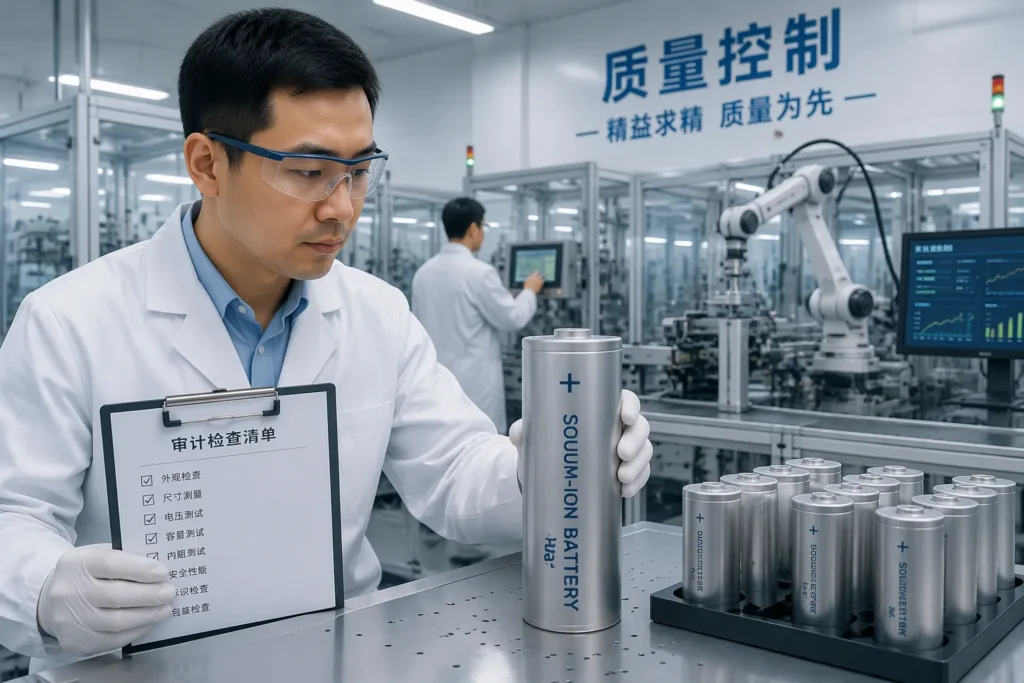
Use this supplier audit checklist to assess any sodium-ion battery manufacturer in China across six categories:
Supplier profile and capability
Technical performance and application fit
Quality management and production consistency
Regulatory compliance and certifications
Cost and commercial terms
Audit execution steps
Each item below expands into three practical parts: the verification method, the evidence you should request, and the red flags to watch for. Keep the list above as a quick reference during first contact. Turn to the detail when you move to document review and site verification.
Key Takeaways
Check the supplier’s business licence and factory address to confirm they are a real manufacturer.
Ask for test reports that prove the battery’s performance, safety and cycle life.
Request traceability records to track each battery back to its materials and production batch.
Verify safety and transport certificates like IEC 62133 and UN 38.3 for every model.
Get a detailed quotation and a written supply agreement to avoid hidden costs and shortages.
Supplier Profile and Capability in China
Corporate Identity and Factory Footprint
Begin with the legal entity. Request the business licence and match the registered company name, scope of business and registered capital against the trading name on the quotation. A mismatch between the selling entity and the manufacturing entity is common in china, so ask directly which company owns the plant and which company issues the invoice.
Next, verify cell origin. Ask for the cell specification sheet, the production line record and any third-party audit report covering the site. Cross-check the factory address on those documents against the business licence. Treat glossy brochures and unverifiable certificates as red flags. A credible supplier will send scanned originals without hesitation.
Capacity and Scale Readiness
Confirm the manufacturing bases by name and location, then ask for annual capacity in GWh or MWh together with the current utilisation rate. This separates installed capacity from capacity you can actually book. Ask how the supplier would absorb a doubling of your order volume and what lead time that would require.
Scalability claims deserve evidence. Request a capacity expansion plan, recent output statistics and a customer reference list. Reliable suppliers document qualification and scale-up milestones rather than quoting headline figures. For context, VEKEN operates bases in Ningbo, Nanchang and Dongguan and publishes its capacity position openly — the standard to expect is documentation you can check, not a number you must accept. Consistent performance at scale depends on this groundwork.
Technical Performance and Application Fit
Cell Chemistry and CTQ Parameters
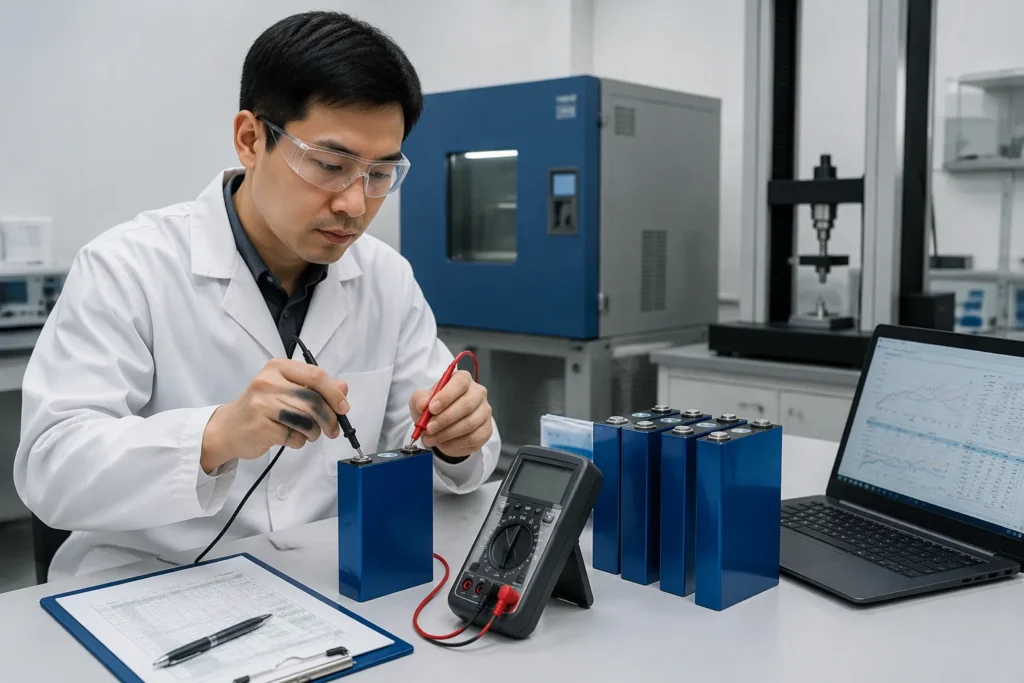
Critical-to-quality (CTQ) parameters define what the cell must deliver in your application. Ask the supplier to list each CTQ value, the measurement method and the permitted tolerance in one table. Typical entries cover nominal capacity, nominal voltage, internal resistance, self-discharge rate and operating temperature range. Critical-to-process (CTP) parameters describe how the line holds those values stable, such as coating weight, electrode thickness and formation protocol.
Parameter | What to request | Red flag |
|---|---|---|
Capacity and voltage | Nominal value, test method, tolerance band | Tolerance stated as “typical” only |
Internal resistance | Measurement method and sample size | No per-cell data |
Operating temperature | Full discharge and charge window | Figures that shift between documents |
Cycle life | Test conditions and end-of-life criterion | Cycle count with no test conditions |
Request proof of Grade-A cell status and per-cell matching reports. These reports show how the supplier groups cells by capacity and resistance before pack assembly. A supplier who cannot produce them is likely sorting cells informally.
Use published performance data as a benchmark for the evidence you should receive. VEKEN sodium battery cells operate from -40℃ to 80℃, tolerate deep discharge with over 4000 cycles on prismatic models, and pass nail penetration testing without fire or explosion. Ask every candidate to supply equivalent test reports for temperature and safety testing, signed and dated.
Customer Qualification of Battery Materials
The qualification of battery materials determines whether your pack behaves consistently across batches. Start with the cathode active material and the anode active material. Request the specification sheet for each, including the impurity profile, particle size distribution and moisture limit. The anode active material deserves particular attention in sodium-ion cells, because hard carbon grades vary widely between sources.
Ask how the supplier performs customer qualification of battery materials. A sound process includes incoming inspection, a trial batch, electrical testing and a documented approval decision. Request the approval record for the anode active material currently in use. Confirm whether the supplier validates a second source, and how a material change is notified to you.
Cell-maker qualification of a new material usually takes several weeks of testing. Ask for the actual timeline and the acceptance criteria. A supplier who cannot describe this process has probably never formalised it. Treat any change of cathode active material or anode active material without written notice as a serious red flag. The same discipline applies to your own supplier qualification of the finished cell.
Quality Management for Manufacturers
Quality Systems and Process Control
Start with the bill of materials. Request the current BOM for the cell and pack you intend to buy, then match every listed component against its approved specification. Ask how the supplier verifies incoming components at IQC. A sound answer names the inspection items, the sampling plan and the acceptance criteria for each critical part.
Battery inspection and end-of-line testing complete the picture. Ask for the EOL test list, the pass and fail limits, and the record format. Request the BMS specification, including protection thresholds and communication protocol. Document the common manufacturing mistakes at each process step, such as coating weight drift or formation errors, and ask how the line detects them. These process controls reveal whether the supplier’s quality systems work in daily production.
Traceability and Batch Consistency
Traceability turns a promise into a checkable record. Ask the supplier to walk you through one finished pack back to its cell batch, electrode lot and material receipt. A fully traceable supply chain produces this record quickly. Request the full traceability records for a recent shipment and confirm that the batch codes match the labels.
Material shelf life and storage conditions affect consistency. Ask for the stated shelf life of the anode and cathode materials, the storage temperature and humidity limits, and the re-test rule after storage. Batch-to-batch consistency depends on these controls as much as on the line itself.
Treat any gap in supply-chain traceability as a stop signal until the supplier closes it.
Strong quality systems also cover change notification and the qualification of new material sources. Ask how the supplier records each change and who approves it. This discipline supports supply-chain traceability across the full product life.
Regulatory Compliance and Qualification
Product Safety and Transport Certification
Compliance evidence separates a serious manufacturer from a trading intermediary. Ask for the product safety test reports first. Sodium-ion cells are commonly assessed against IEC 62133 for cell and battery safety, and against UN 38.3 for transport. Request the full report, not the certificate cover page. Check that the model number on the report matches the cell you intend to buy.
Transport documentation matters for every shipment. Sodium-ion cells travel under specific UN numbers, and the supplier must provide the test summary, the safety data sheet and the packing instruction reference. Confirm the report date and the testing laboratory name. An expired report or a laboratory you cannot verify is a red flag.
Export and Environmental Documentation
Export paperwork proves the supplier can ship legally and repeatedly. Request the customs registration, the export licence where applicable, and a sample commercial invoice and packing list. Ask which incoterms the supplier supports and which port it ships from. These details reveal real export experience.
Environmental documentation covers material restrictions and waste handling. Ask for RoHS and REACH declarations for the cell and pack, plus the material safety data sheet in English. Confirm how the supplier handles end-of-life cells and whether it accepts returns. A supplier that cannot produce current declarations has not maintained its qualification file.
Build a compliance folder for each candidate and date every document. Re-check the folder before each purchase order. This habit keeps your own qualification records audit-ready and protects you at customs.
Cost and Commercial Terms
Cost Structure and Quotation Transparency
Ask for a quotation broken down by line item, not a single unit price. A transparent quote separates cell cost, pack assembly, BMS, housing, testing and packaging. It also states the incoterm, the currency and the validity period. Compare quotes on the same basis, because a low headline price often hides excluded freight or test fees.
Quotation item | What to confirm |
|---|---|
Cell and pack price | Volume tier and currency |
Tooling and setup | One-off or amortised |
Testing and certification | Included or billed separately |
Payment terms | Deposit share and balance trigger |
Request the price validity window and the clause covering material price changes. Sodium-ion material costs move, so a supplier should state how often it revises prices and what notice it gives. Treat a quote with no breakdown and no validity date as a red flag.
Supply Security and VEKEN Sourcing Options
Supply security rests on more than a low price. Ask how the supplier protects consistent supply during peak demand. Request the allocation policy, the safety stock it holds and the lead time it guarantees in writing. Confirm how the supplier manages its own supply-chain for cathode and anode materials, and whether it holds qualified second sources.
VEKEN illustrates the evidence a buyer should expect. The company reports manufacturing bases in Ningbo, Nanchang and Dongguan, a stated annual capacity of 100GWh, and more than 20 years in the energy industry. It also offers custom pack options across temperature range, cell model and configuration. Verify each claim against documents during the qualification stage rather than accepting the brochure.
Ask for a written allocation agreement before you place a volume order.
Supplier Audit Checklist Execution
Pre-Audit Documentation Requests
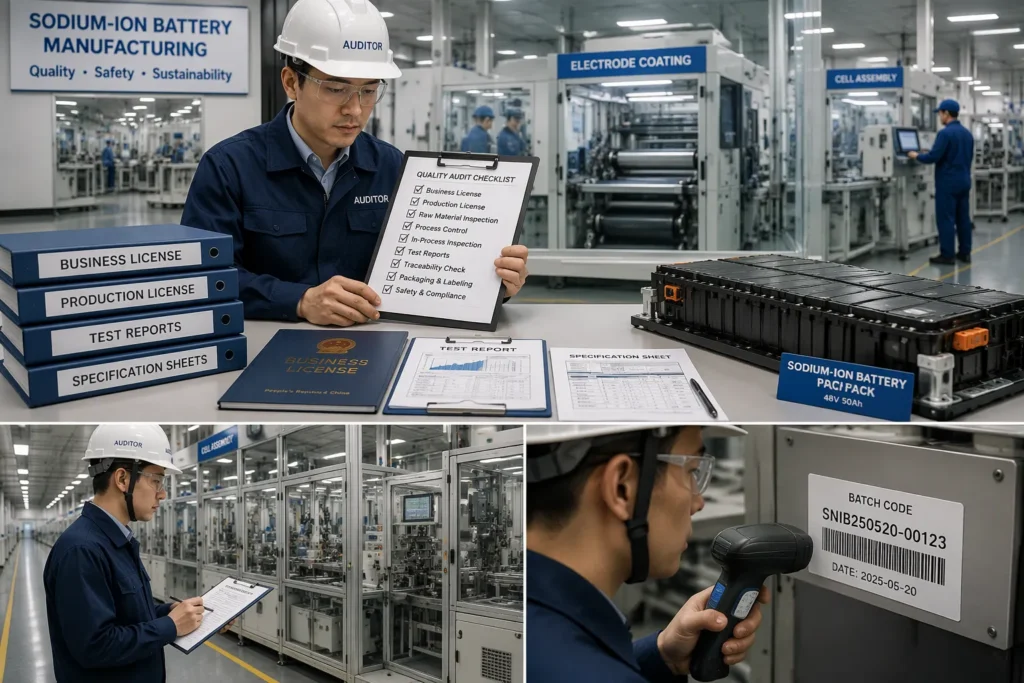
Execution begins before anyone travels. Send a written documentation request to the supplier and set a clear deadline for the response. Group the request by the five assessment categories covered earlier, so the supplier knows exactly what to prepare. A well-structured supplier audit checklist turns this step into a simple tick-box exercise.
Ask for the business licence, cell specification sheets, third-party test reports and the quality manual in the first batch. Add the BOM, the end-of-line test records and one full traceability record for a recent shipment. Request the safety and transport certificates, plus the customs registration and a sample commercial invoice. State the format you expect: scanned originals, signed and dated.
Review every document against the checklist before you book travel. Note each gap and each inconsistency in a shared log. Send the gap list back to the supplier and ask for clarification in writing. This preparation shortens the site visit and sharpens your questions. A supplier who delays or deflects the documentation request signals risk early, which saves you the cost of a wasted trip.
On-Site Verification and Red Flags
The plant and process audit confirms what the paperwork claims. Walk the line from material store to end-of-line testing. Watch the electrode coating, the cell assembly and the formation area in sequence. Ask operators to explain the control points at each station. Compare the line you see with the process flow chart you received in advance.
Verify documents on site rather than in the meeting room. Pull a finished pack from stock and trace it back to its cell batch and material receipt. Match the batch codes on the label against the traceability record. Check that the BMS specification on file matches the unit fitted to the pack. Confirm the calibration labels on test equipment are current.
Interview the quality team about change notification and second-source approval. Ask how the supplier records a material change and who signs it off. Request the approval record for the current anode material. Observe the storage area for temperature and humidity control, and confirm the shelf-life labels on incoming material.
Any gap between the documented process and the line you observe deserves a written corrective action before you approve the supplier.
Close the visit with a short debrief. Summarise the findings, agree the corrective actions and set dates for closure. Record every red flag in your log, together with the evidence you saw. Repeat this discipline for each candidate, and the qualification decision becomes a comparison of documented facts rather than impressions. Adapt the supplier audit checklist to the specific supplier and application, and review it after each audit so the process improves with use.
You now hold the full framework in six categories:
Supplier profile and capability
Technical performance and application fit
Quality management and production consistency
Regulatory compliance and certifications
Cost and commercial terms
Audit execution steps
Weight these criteria to suit your application. Performance-critical uses demand technical fit and quality consistency. Volume procurement leans on compliance and cost.
Build a repeatable process. Prepare documentation requests in advance, verify evidence on site, and log red flags systematically. Treat the supplier audit checklist as a starting framework for qualification, not a fixed script. Adapt it to each supplier and application, then review it after every audit.
FAQ
How long does a sodium-ion battery supplier audit in China usually take?
Plan for a documentation phase of roughly one to two weeks before travel, then one to two days on site. The timeline depends on how quickly the supplier returns scanned originals. A supplier who delays the document request signals risk early, so set a written deadline and hold to it.
Which certifications should a sodium battery manufacturer hold?
Ask for IEC 62133 test reports covering cell and battery safety, plus UN 38.3 transport testing for every model you intend to ship. Request the full report rather than the certificate cover page. Confirm that the model number on each report matches the cell on the quotation.
How do I verify cycle life and low-temperature claims?
Request signed, dated test reports that state the test conditions and the end-of-life criterion. Published benchmarks show what good evidence looks like: VEKEN sodium cells operate from -40℃ to 80℃ and prismatic models exceed 4000 cycles. Match every claim against a report you can check.
What sample size should I request for per-cell matching reports?
No fixed number suits every order, so ask the supplier to state its own sampling plan and defend it. The report should show how cells are grouped by capacity and internal resistance before pack assembly. A supplier who cannot produce per-cell data is likely sorting cells informally.
Can I shorten the audit for a second-source supplier?
You can, provided the second source shares the same manufacturing base and quality system. Re-verify the business licence, the cell origin documents and one full traceability record. Never skip the on-site traceability check, because a familiar brand name does not guarantee the same production line.