Why Sodium-Ion Batteries Fit Outdoor Backup Power
Outdoor power systems must work away from the grid, handle repeated charging and discharging, and remain dependable across changing temperatures. These requirements make sodium-ion batteries for RVs, camping, portable power stations, and emergency backup power an increasingly relevant application area.
The International Energy Agency (IEA) reports that current sodium-ion batteries offer a major low-temperature advantage over lithium-ion batteries, particularly LFP, while their lower energy density remains an important limitation. The latest sodium-ion cells can retain around 90% of nominal capacity at temperatures as low as -40°C, although actual system performance depends on the cell, battery management system, pack design, and operating conditions.
For B2B buyers, this means sodium-ion technology should not be viewed as a universal replacement for lithium batteries. It is better evaluated according to the specific operating environment and power requirements.
1. Sodium-Ion Battery for RV Applications
An RV combines transportation and living functions in one mobile platform. A typical off-grid setup may need stored electricity for:
- 💡 LED lighting
- 📱 Smartphones, tablets, and communication equipment
- 💻 Laptops and mobile workstations
- 📡 Wi-Fi routers and networking equipment
- 🧊 Refrigerators and small cooling systems
- 📺 Entertainment equipment
- 🔋 DC auxiliary equipment
- ☀️ Solar charging systems
This creates demand for 12V sodium-ion batteries for RVs, auxiliary batteries, and larger battery packs connected to solar charging and power conversion equipment.
Cold-weather operation is particularly relevant to RV users traveling in northern regions or using vehicles during winter. IEA data indicates that sodium-ion chemistry can maintain performance at temperatures where conventional lithium-ion systems can experience greater performance losses.
However, buyers should check the manufacturer’s actual charging and discharge temperature specifications rather than assuming every sodium-ion battery has the same cold-weather capability.
2. Sodium-Ion Batteries for Camping and Boondocking
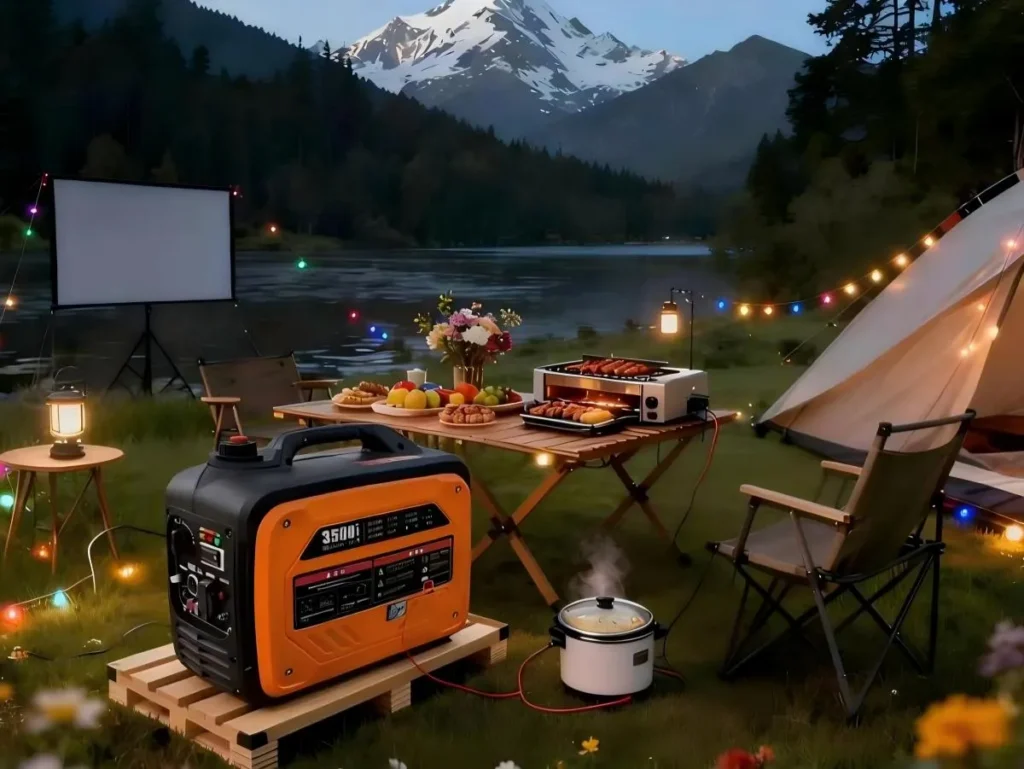
Boondocking, or camping without a conventional electrical hookup, is another practical scenario for sodium-ion battery systems.
A typical off-grid energy flow can be simplified as:
Solar panel → Charge controller → Sodium-ion battery → Inverter/DC loads → Outdoor equipment
This configuration can provide stored energy when solar generation is unavailable, such as at night or during periods of low sunlight.
For example, an RV parked at a remote campsite may use solar panels during the day to recharge the battery while the stored electricity powers communication devices, lighting, refrigeration, and other low-to-medium power loads after sunset.
Sodium-ion batteries can be attractive for these applications because weight and energy density are not always the only design priorities. Stationary or semi-stationary outdoor equipment can sometimes accommodate a larger battery pack in exchange for temperature tolerance and other chemistry-specific advantages.
3. Portable Backup Power for Outdoor Equipment
The same concept extends beyond RVs.
Potential applications for a sodium-ion portable power station include:
| Application | Typical power requirement | Why battery performance matters |
|---|---|---|
| Camping | Low to medium | Long periods away from grid power |
| RV backup | Medium | Repeated charging and daily cycling |
| Outdoor work | Low to medium | Mobile electricity at remote sites |
| Emergency backup | Medium | Availability when grid power fails |
| Remote monitoring | Low | Reliable stored energy |
| Solar backup | Medium to high | Daily charge/discharge cycles |
For B2B product developers, sodium-ion technology can therefore be considered for outdoor backup batteries, solar energy storage, portable power stations, emergency power supplies, and auxiliary vehicle batteries.
The suitability depends on required voltage, usable capacity, peak output, operating temperature, enclosure, charging method, and battery management system.
4. Sodium-Ion vs. Lithium-Ion for Outdoor Power
The key differences can be summarized simply:
Sodium-ion advantages
- Better low-temperature performance in current commercial generations
- Uses sodium rather than lithium as the carrier ion
- Suitable for applications where energy density is not the primary requirement
- Increasing commercial deployment and manufacturing investment
Sodium-ion limitations
- Lower energy density than leading lithium-ion chemistries
- Larger or heavier packs may be required for the same stored energy
- Supply chains and product ecosystems are less mature than lithium-ion
- Actual performance varies considerably between cell designs
IEA currently identifies lower energy density as one of sodium-ion technology’s main limitations. Current sodium-ion cells can reach up to about 175 Wh/kg, compared with up to about 205 Wh/kg for LFP and higher figures for some NMC cells.
Therefore, a sodium-ion battery for RV or outdoor backup power makes the most sense when its specific strengths match the application’s requirements.
5. What B2B Buyers Should Check
When sourcing sodium-ion batteries for RVs, portable power stations, or outdoor backup systems, technical specifications should be reviewed before price.
Battery specification checklist
- Nominal voltage — such as 12V, 24V, or 48V.
- Usable capacity — Wh or Ah under the stated test conditions.
- Continuous discharge power — important for appliances and inverters.
- Peak discharge capability — relevant for motor starts and short high-power loads.
- Charging temperature — especially important for winter applications.
- Discharge temperature — verify the actual tested range.
- Cycle-life test conditions — cycle count alone is not enough.
- BMS functions — over-voltage, over-current, temperature, and short-circuit protection.
- Certifications and transport documents — depending on the destination market and shipping method.
- OEM/ODM capability — important for customized voltage, capacity, enclosure, connectors, and system integration.
For large-volume procurement, buyers should also examine production capability, quality-control processes, testing facilities, lead-time management, and supply-chain structure.
6. Veken’s Sodium-Ion Battery Manufacturing Capability
Veken provides sodium-ion battery solutions alongside its battery manufacturing and R&D capabilities. Its published information states that it has in-house cell production, supports OEM and ODM projects, and provides engineering support for customized sodium-ion battery requirements. Veken also lists applications including emergency power, energy storage, motive vehicles, and other industrial uses.
Veken’s manufacturing structure is also relevant for B2B sourcing. Its published company information describes its own manufacturing facilities, R&D resources, and supply-chain capabilities.
For textile-related products, Veken also operates its own textile manufacturing facilities in Ningbo, but this capability is separate from the battery business.
For buyers evaluating a sodium-ion battery supplier, Veken’s relevant resources can be reviewed through its sodium-ion battery page and battery solutions page.
7. Where Sodium-Ion Outdoor Power Is Most Practical
The strongest near-term use cases are applications where temperature tolerance, repeated cycling, backup capability, and supply diversification matter more than achieving the smallest possible battery pack.
A practical application chain is:
RV / outdoor equipment → battery storage → solar or external charging → DC/AC loads → repeated off-grid operation
This makes sodium-ion technology worth evaluating for RV auxiliary batteries, camping power systems, portable backup power, solar storage, remote equipment, and emergency electricity systems.
At the same time, sodium-ion should not automatically replace lithium-ion in every portable application. When maximum energy density, minimum weight, or compact size is the dominant requirement, lithium-ion technologies can remain more suitable. IEA likewise identifies energy density as a current limitation for sodium-ion batteries.
Conclusion
Sodium-ion battery applications for RVs and outdoor backup power are developing around a clear technical advantage: strong low-temperature performance combined with growing battery manufacturing capacity.
For B2B applications, the right approach is to match the chemistry to the operating conditions rather than selecting a battery based on chemistry alone.
For customized battery projects, OEM/ODM requirements, and industrial applications, buyers can review Veken’s company information or contact page.