
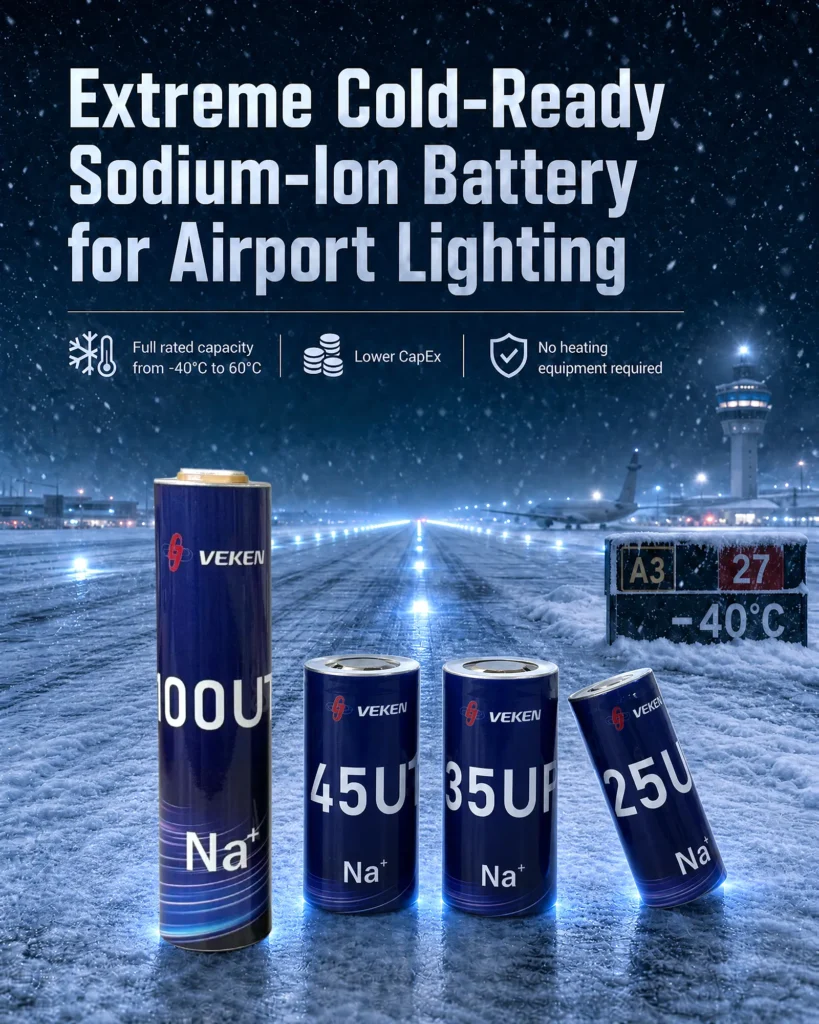
When the mains drops in a Norwegian building at −25 °C, the emergency lights must stay on for the full backup time the code requires. Lead-acid batteries fade in the cold. Sodium-ion batteries do not. Here is what changed, and what a real Nordic project teaches us about emergency lighting backup in extreme cold.
❄️ Why Cold Weather Breaks Emergency Lighting Backup
When the mains fails in a cold building, the backup battery has to deliver its full rated time at the coldest ambient the site ever sees — not at 25 °C in a lab. Lead-acid batteries are the default in many buildings, but they have three cold-weather weaknesses that show up every winter:
- 🧊 Capacity drops fast below 0 °C. The liquid electrolyte thickens, so usable capacity can fall by 30–50% at −20 °C. Lights dim or die before the test time is up.
- 🔁 Short cycle life in cold rooms. Stairwells, parking decks, and unheated plant rooms cycle batteries daily. Lead-acid typically lasts only a few hundred cycles, so it gets swapped every 1–3 years.
- 🔥 Fire-safety risk during charging. Lead-acid off-gases hydrogen, and charging in cold conditions can cause internal heat build-up — a hazard that is hard to defend in a fire-rated room above a stairwell.
For integrators and building operators in Nordic and other cold-climate sites, the everyday reality is this: the backup battery that should keep people safe is the weakest link in the cold.
🔋 How Sodium-Ion Batteries Survive −30 °C
A sodium-ion cell moves sodium ions between a hard-carbon anode and a layered cathode in a non-aqueous electrolyte. The detail matters less than two practical differences from lead-acid:
- ❄️ The electrolyte does not freeze. Sodium ions keep moving well below 0 °C, so usable capacity holds up at low temperature.
- 🛡️ No water, no thermal runaway. The chemistry is far less prone to fire or explosion in abuse tests, which is why it is a good fit for occupied buildings.
In Veken’s internal testing, sodium-ion cells discharge at −30 °C with a stable voltage curve, and they pass nail-penetration and over-charge tests without catching fire or exploding. Both points matter in a building asset.
An emergency lighting integrator in Norway retrofitted several commercial buildings, with stairwells and parking decks at −20 °C to −30 °C and strict fire-safety rules for equipment above escape routes.
Three pain points drove the battery choice:
- Lead-acid capacity dropped in the cold, so backup time fell short in winter tests.
- Short cycle life meant batteries were swapped every few years.
- Fire risk from charging lead-acid in fire-rated rooms was not acceptable.
The team chose Veken sodium-ion cells:
| Pain point | Solution | Tech support |
|---|---|---|
| Cold capacity fade | Stable discharge to −30 °C, no heater | Wide-temp electrolyte |
| Frequent replacement | Long cycle life lowers total cost | ≥8,000 cycles (internal test) |
| Fire-safety rules | No thermal runaway, no fire, no explosion | Passes nail-penetration test |
Results from the project:
- 💰 About 30% lower total cost vs lead-acid (internal project data).
- 📈 Stable operation through the first winter, with far fewer swaps.
- 🔁 8,000+ cycle life in lab testing — years of service expected.
📊 Sodium-Ion vs Lead-Acid, Side by Side
For emergency lighting backup in cold climates, the two chemistries compare as follows. Sodium-ion data is from Veken’s internal testing; lead-acid figures are typical.
| Feature | Sodium-ion | Lead-acid |
|---|---|---|
| Low-temp discharge | Stable to −30 °C | Capacity drops below 0 °C |
| Cycle life | 8,000+ (internal test) | 300–500 (typical) |
| Fire risk | Low (no thermal runaway) | Higher (hydrogen, acid) |
| Maintenance | Low | Water top-up, venting |
| Cold-climate cost | Lower over life | Lower up front only |
| Best fit | Cold sites, fire-rated rooms | Mild climates, budget |
📝 How to Specify Sodium Batteries for Emergency Lighting
Checklist for sourcing cells in a cold-climate emergency lighting project:
- Check the cold discharge curve at your worst-case ambient (e.g., −30 °C).
- Match capacity to the code with margin for cold fade — target at least 1.5× the minimum required minutes.
- Ask for cycle life at your depth-of-discharge, not a vendor headline number.
- Request safety test reports: nail penetration, over-charge, short circuit, thermal abuse.
- Match form factor (cylindrical 26700, prismatic, etc.) to your fixture and BMS.
- Plan for OEM/ODM if you need a custom pack or branding.
For a sodium battery OEM partner with its own factory, stable large-scale order capacity, and an experienced engineering team, Veken is one option. See the sodium battery page and the battery product line.
❓ Frequently Asked Questions
Can sodium-ion batteries replace lead-acid in emergency lights?
Yes, for most cold-climate retrofits and new builds. Verify the cold discharge curve and the safety test reports at your site.
What is the lowest working temperature?
Veken’s sodium-ion cells are designed to discharge stably at −30 °C in internal testing. Lead-acid loses useful capacity well before 0 °C.
How long do they last?
In internal testing, cells reach 8,000+ cycles, which translates to years of service before replacement in a real building.
Are sodium-ion batteries safe inside a building?
In Veken’s lab, cells pass nail-penetration and over-charge tests without fire or explosion, and they do not vent hydrogen like lead-acid.
📚 Sources and Further Reading
- Sodium-ion battery — Wikipedia
- Veken sodium battery range
- Veken battery product line
- About Veken
- Contact Veken
- IEA — Energy Storage
Data note: Cycle life, cold-temperature discharge, and cost figures come from Veken’s internal testing and the Norway project record. They are conservative estimates for engineering comparison, not contractual warranties. Last updated: 18 August 2026.