
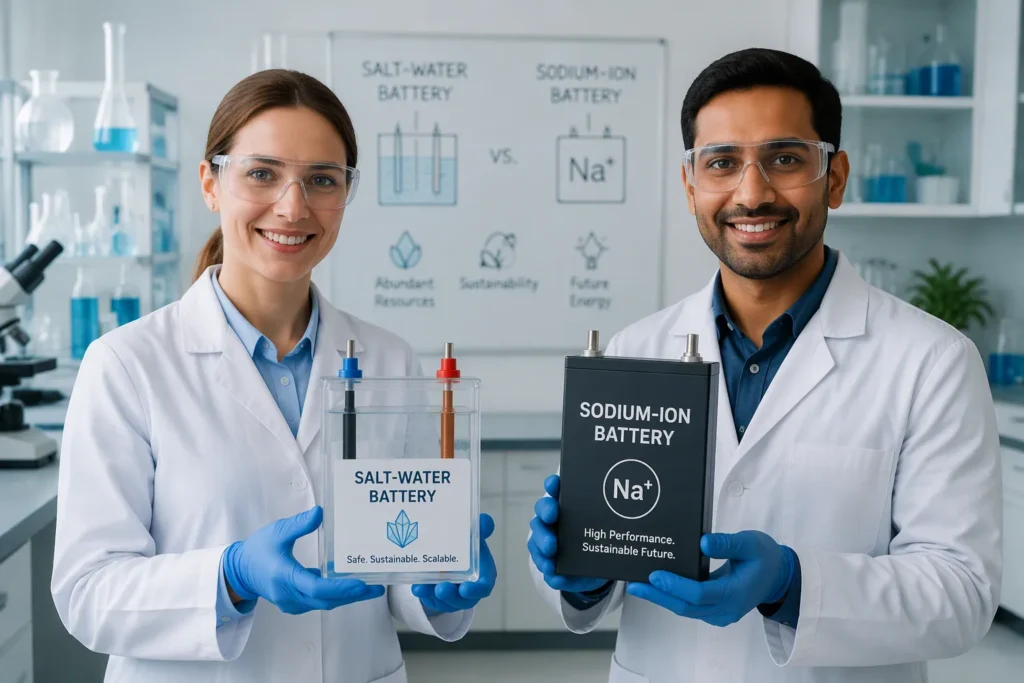
A salt-water battery and a sodium-ion battery are not the same product. The two technologies are related, but each one works in a different way. Readers often think the names mean the same thing. This habit leads to poor buying choices.
The differences cover four areas: chemistry, form factor, performance and best-use cases. Chemistry shapes how each cell stores and releases energy. Form factor decides where the battery fits. Performance covers energy density, charging speed and cycle life. Best-use cases show which option suits a given job.
This guide puts the two side by side. Clear comparisons follow, with practical detail for each point.
Key Takeaways
Salt-water batteries and sodium-ion batteries are different technologies. They have their own designs and are best used in different ways.
Salt-water batteries are good for stationary storage. Their water-based electrolyte cannot catch fire, and their storage hours can be scaled up easily.
Sodium-ion batteries store more energy and charge faster, so they work well for mobile and backup power uses.
Sodium-ion batteries cope well with deep discharge and last more than 4000 cycles. They need little upkeep because they have no moving parts.
Always check the real battery chemistry and ask for test reports before you buy, as the salt-water label can cover different designs.
What Is a Salt-Water Battery?
How It Works
A salt-water battery stores energy using a saline electrolyte. This electrolyte is a water-based mix of sodium chloride, the same salt found in seawater. This water-based chemistry sets it apart from cells that use organic solvents.
Many salt-water batteries use a flow-battery design. Liquid electrolyte moves from outside tanks through a cell stack. The stack turns chemical energy into electrical energy. Tank size sets the storage capacity, and stack size sets the power output. This split lets designers scale each part on its own.
The term carries a subtle point. Researchers sometimes call aqueous sodium-ion batteries saltwater batteries. Both use water-based electrolytes and sodium chemistry. This overlap means the label can describe more than one design. Buyers should check the actual cell chemistry and construction before they compare products.
Where It Fits Best
A salt-water battery suits stationary storage. The water-based electrolyte is non-flammable, so the technology fits sites where fire risk matters. Flow systems also scale well for long-duration duty. A utility or a commercial building can store energy for hours by making the tanks bigger.
The design has practical limits. Water-based cells carry less energy per kilogram than cells with organic electrolytes. Flow systems also need pumps, tanks and plumbing. These parts add footprint and maintenance work. The technology therefore fits fixed installations better than vehicles or portable devices.
Readers who meet the term in a product listing should confirm the design. A flow system and an aqueous sodium-ion cell both fall under the salt-water battery label. Each one serves stationary storage, yet their hardware differs. The next section covers sodium-ion cells in detail.
What Is a Sodium-Ion Battery?
How It Works
A sodium-ion battery is a cell you can recharge. Sodium ions carry the charge between the two electrodes as the battery charges and discharges. The build follows the lithium-ion pattern: an anode, a cathode, a separator and an electrolyte. Sodium ions travel through the electrolyte and move in and out of the electrode materials. This back-and-forth motion stores and releases energy.
Sodium gives a useful advantage as a raw material. The element is plentiful in the earth’s crust and in seawater. This supply helps keep material costs lower than lithium-based chemistry. Sodium-ion cells also handle deep discharge well. The chemistry suits large-scale production and a steady supply.
VEKEN’s Sodium Battery Range
VEKEN makes sodium batteries for tough jobs. The company joined the lithium battery industry in 2004 and now uses that experience for sodium chemistry. Its sodium cells work across a wide temperature range, from -40°C to 80°C. Output stays steady even in extreme cold.
Safety makes the range stand out. The cells have passed nail-penetration tests without fire or explosion. They also survive extrusion and drop tests, which helps with safe transport and storage over long distances. Prismatic cells give more than 4000 cycles, and deep-cycle performance lasts over five times longer than lead-acid batteries.
The range serves several markets. Telecom sites need reliable backup power. E-mobility uses include motorcycles and agricultural machinery. Emergency power systems and home or industrial energy storage also fit the product line. Buyers can customise the operating temperature range, cell model, capacity, voltage and pack dimensions. VEKEN offers cylindrical cells such as the 32700 and 33140, plus prismatic cells such as the 50160 and 72173.
Salt-Water Battery vs Sodium-Ion: Performance
Energy Density and Efficiency
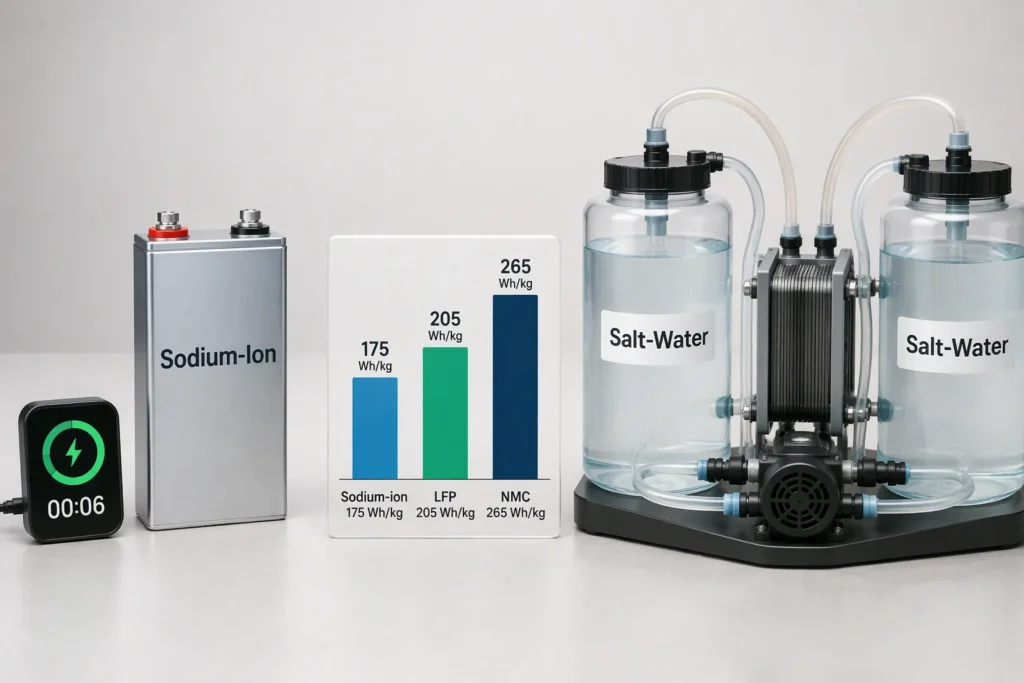
Energy density shows how much energy a battery holds for its weight and size. Sodium-ion cells now reach up to 175 Wh/kg, according to the IEA 2026 Global EV Outlook. Lithium iron phosphate (LFP) reaches 205 Wh/kg, and nickel manganese cobalt (NMC) reaches 265 Wh/kg. CATL quotes its Naxtra passenger EV cell at the same 175 Wh/kg figure.
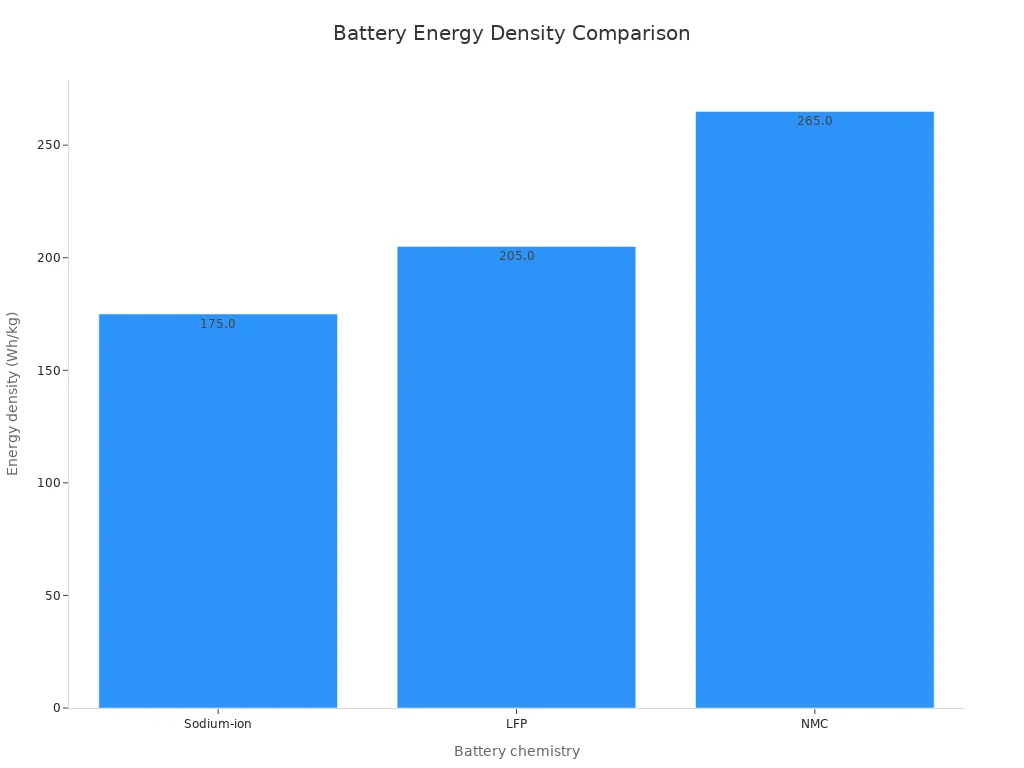
A salt-water battery sits below these figures. Its water-based electrolyte limits the voltage each cell can hold. Flow designs also add pumps, tanks and plumbing, and these parts add mass and space without storing energy. The gap is qualitative here, yet the direction is clear: a salt-water battery trades energy density for non-flammable chemistry.
Charge speed favours sodium-ion. BAIC stated in March 2026 that a sodium-ion prototype in its Aurora programme used 4C charging, with a full charge in about 11 minutes. The same prototype claimed a 450 km CLTC range and energy density above 170 Wh/kg. These remain prototype claims, not independently tested production-car results. Sodium-ion can still charge faster than lithium-ion in comparable designs, because its chemistry tolerates higher currents.
Round-trip efficiency tells a less complete story. Published comparisons rarely report it for sodium-ion.
No round-trip efficiency values for sodium-ion batteries are reported in any of the retrieved results.
Flow batteries face their own efficiency losses. Pumps consume power, and the stack adds resistance. Buyers should request measured efficiency data from suppliers rather than assume a figure.
Cycle Life and Durability
Cycle life measures how many charge and discharge rounds a battery survives before capacity fades. Sodium-ion handles deep discharge well. VEKEN’s prismatic sodium cells exceed 4000 cycles, and their deep-cycle performance lasts over five times longer than lead-acid batteries. That margin matters in telecom backup and storage sites, where cells sit at partial charge for long periods and then discharge deeply.
Salt-water flow systems also target long service life, and their stationary design avoids the vibration and weight stress of mobile use. Their pumps and seals, however, need inspection over time. Sodium-ion cells have no moving parts, so maintenance stays low.
Both technologies suit long-duration duty. Sodium-ion wins on energy density, charge speed and fit for mobile applications. A salt-water battery wins on inherent non-flammability and simple scaling of storage hours. The right pick depends on the site and the load profile.
Safety, Standards and Cost
Safety and Regulatory Compliance
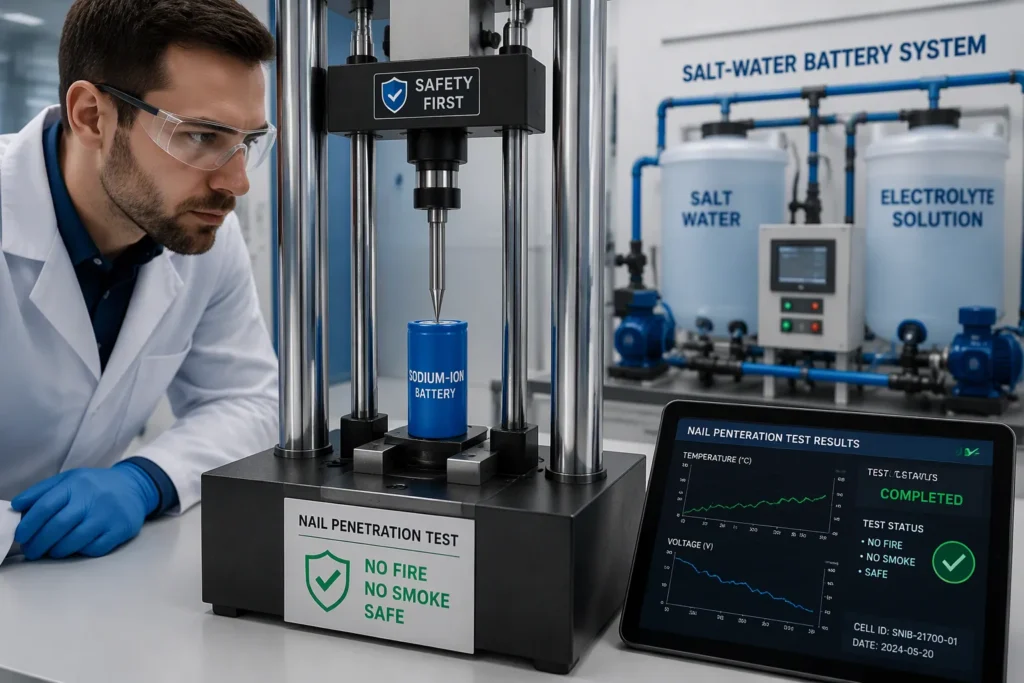
Safety tests show clear differences between the two technologies in real use. When you allow for stored energy, sodium-ion cells behave much like NMC cells if they overheat. Even so, they reach lower top temperatures and give off no jets of flame. This lowers the chance of the problem spreading from cell to cell. The result depends on the cathode chemistry, as the table below shows.
Cathode Chemistry / Cell Type | Nail Penetration Test Result |
|---|---|
Layered oxide (commercial 18650, Mn-Fe-Ni, Al or Cu current collector) | Thermal runaway caused by penetration, like NMC and LFP cells |
Layered oxide (larger format) | Top temperature above 400°C |
Prussian blue analogue | No reaction to nail penetration; less self-heating energy, no rush into thermal runaway |
NASICON | Top temperature around 100°C |
VEKEN’s sodium batteries have passed nail-penetration, extrusion and drop tests with no fire or explosion. These results back up safe transport and storage over long distances. A salt-water battery uses a water-based electrolyte, which cannot catch fire by nature. Even so, buyers should check that a supplier holds the certifications their market asks for. They should also ask for test reports instead of trusting marketing claims.
Cost and Application Fit
Sodium is found in large amounts in the earth’s crust and in seawater. This supply keeps material costs below those of lithium-based chemistry, and it helps keep prices steady over the long term. A salt-water flow system has a different cost setup. Tanks and pumps add upfront expense, and splitting power (stack) from energy (tank volume) lets buyers scale storage hours on their own. Looking after pumps and seals adds running cost over the system’s life.
Application fit comes from these traits. A salt-water battery suits stationary storage, where non-flammable chemistry and scalable duration matter most. Sodium-ion cells, including VEKEN’s range, serve telecom backup, e-mobility such as motorcycles and agricultural machinery, emergency power, and home or industrial energy storage. VEKEN offers customisation of temperature range, capacity, voltage and pack dimensions, so buyers can match the cell to the load profile.
The two products are different in chemistry, shape and best uses. A salt-water battery uses a water-based electrolyte, often in a flow design with tanks and pumps. A sodium-ion cell uses sodium ions inside a sealed pack built much like a lithium-ion cell. The salt-water label covers a related but separate category, not another word for the same thing.
These are not the same technology, so buyers should treat them as separate choices. Fixed sites that need non-flammable chemistry and storage hours that can grow suit the flow design. Telecom backup, e-mobility, emergency power and home or industrial storage suit sodium-ion packs. Match the choice to the load profile and the site.
FAQ
Is a salt-water battery the same as a sodium-ion battery?
No. A salt-water battery uses a water-based saline electrolyte, often in a flow design with tanks and pumps. A sodium-ion battery uses sodium ions inside a sealed pack built much like a lithium-ion cell. The two are related, yet they remain separate technologies.
Which one suits home energy storage?
Both can serve a home. A salt-water flow system fits fixed sites that need non-flammable chemistry and storage hours that can grow. VEKEN’s sodium-ion packs also suit home storage, and buyers can customise capacity, voltage and pack dimensions to match the household load.
How does a sodium-ion battery perform in cold weather?
VEKEN’s sodium cells work from -40°C to 80°C. Output stays steady even in extreme cold. This range suits telecom sites, agricultural machinery and emergency power in cold climates. Buyers should confirm the operating range of any specific model before purchase.
How long do these batteries last?
VEKEN’s prismatic sodium cells exceed 4000 cycles. Their deep-cycle performance lasts over five times longer than lead-acid batteries. Salt-water flow systems also target long service life, though their pumps and seals need inspection over time. Sodium-ion cells have no moving parts, so maintenance stays low.
Are sodium-ion batteries safe?
VEKEN’s sodium batteries have passed nail-penetration, extrusion and drop tests without fire or explosion. Test results vary with cathode chemistry, so buyers should request test reports rather than trust marketing claims. A salt-water battery cannot catch fire by nature, because its electrolyte is water-based.