
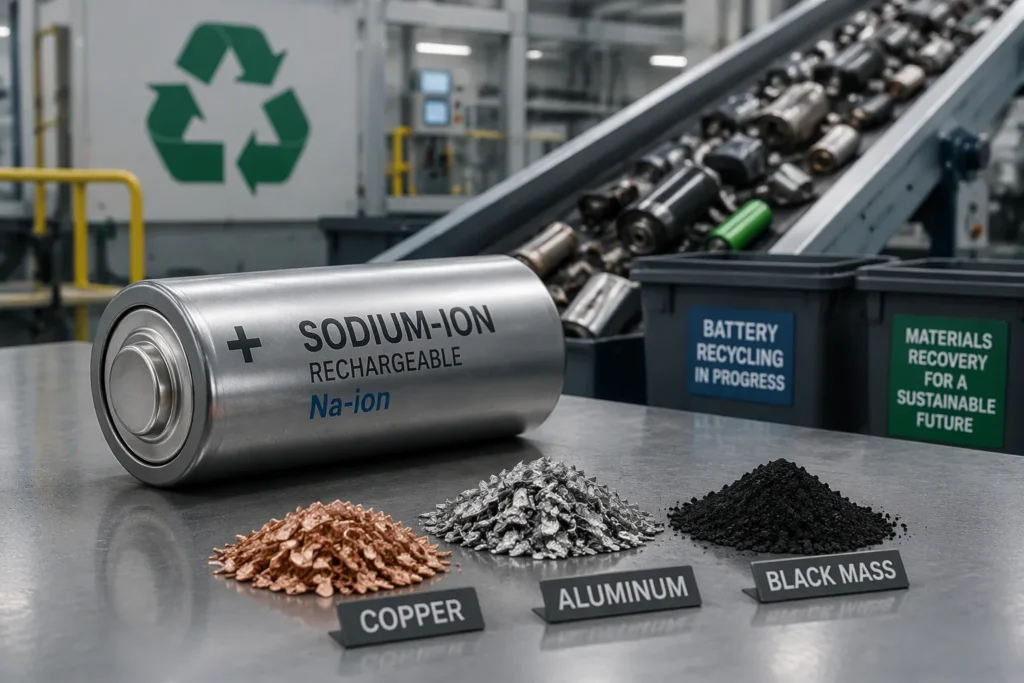
Sodium-ion batteries are not yet fully recyclable in practice. Most of their material mass can be recovered with existing processes, but some components still escape clean recovery. That gap matters for anyone judging recycling claims.
“Fully recyclable” would mean every part of a spent cell returns to useful material through established routes, with no residual waste and no loss of quality. In reality, recovery rates vary by component and by process.
Material recovery and true circularity are different standards. A battery can give back most of its weight and still fall short of full recycling.
Key Takeaways
Sodium-ion batteries are not fully recyclable today because some parts still lack clean recovery routes.
Most of a spent cell’s mass, including casing, foils, and cathode metals, can be recovered with existing processes.
The electrolyte and separator are the hardest components to recycle and remain the main gaps.
Recovery rates vary by plant and process, so headline percentages usually describe mass, not full circularity.
Current regulations enable compliant recycling but do not demand full recycling of every component.
What “Fully Recyclable” Means
Material Recovery Versus Circularity
In plain British English, “fully recyclable” describes a product whose every part can return to useful material through established, large-scale routes. No component goes to landfill, no residue needs special disposal, and the recovered materials perform as well as virgin ones. That is a high bar. Most products, including batteries, fall short of it today.
Material recovery is the narrower idea. It means pulling valuable substances out of a spent battery, such as metals from the cathode or copper from the current collector foils. Circularity goes further. It asks whether those recovered materials flow back into new cells in a closed loop, rather than into lower-grade uses. A process can recover most of a battery’s mass and still fail the circularity test. Readers judging recycling claims should therefore ask two separate questions: how much comes back, and what happens to it next.
Mass Recovery Versus Full Recycling
Mass recovery measures weight. A recycling line might return the great majority of a cell’s bulk — steel casing, aluminium, copper and cathode metals — as saleable output. That figure sounds impressive, and it is genuinely useful. It tells operators how much material avoids landfill.
Full recycling measures something else: whether each component, including the electrolyte and separator, finds a clean recovery route. These lighter fractions often prove harder to handle. Electrolyte salts can degrade during processing, and separator plastics may burn or contaminate other streams. A battery can therefore score well on mass recovery while leaving its electrolyte and separator effectively unrecovered. The distinction matters because marketing claims often quote the first number and imply the second. Neither standard is superior in every context; they simply answer different questions about what a recycling process actually achieves.
How Recyclable Are Sodium-Ion Batteries?
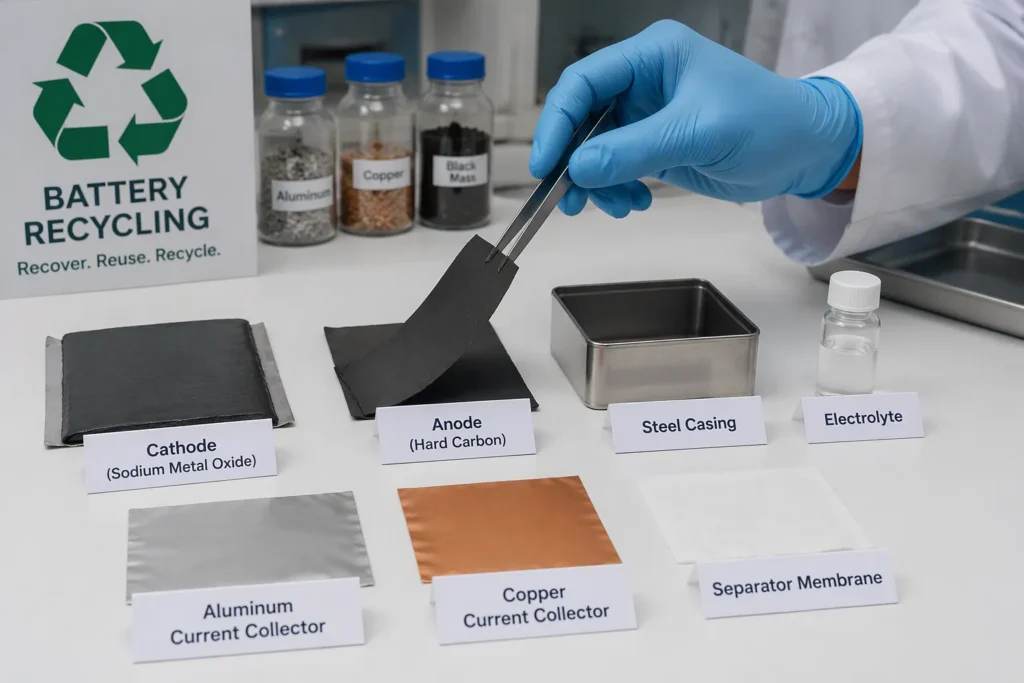
Cathode, Anode and Casing
The cathode holds the most valuable metals in a sodium-ion cell. Recovery routes for cathode materials are well established in principle. ✅ Industrial processes can extract these metals with reasonable efficiency. One complication arises with failed cathode materials. These materials can prove difficult to dissolve in traditional inorganic acids. That resistance complicates extraction and may require alternative leaching agents or pre-treatment steps. Researchers continue to refine these methods.
The anode presents fewer difficulties. Hard carbon, the common anode material in sodium-ion batteries, offers a straightforward recovery path. ✅ Operators can separate and process it without specialised equipment. The casing, typically steel or aluminium, is the simplest component to recover. ✅ Standard mechanical sorting captures it cleanly, and established metal recycling streams accept it directly.
Current collector foils deserve attention. Traditional non-aqueous sodium-ion designs use aluminium and copper foils. A fully recyclable design has been demonstrated that reconsiders these foils. This design approach shows that full recyclability is technically achievable when engineers plan for it from the start. The demonstration matters because it proves the concept, even if commercial adoption lags behind.
Electrolyte and Separator
The electrolyte remains the hardest component to recover cleanly. ⚠️ Electrolyte salts can degrade during processing, and their recovery demands specialised handling. Standard mechanical routes do not capture them effectively. Hydrometallurgical steps may recover some electrolyte components, but the process is neither simple nor universal. The separator poses similar challenges. ⚠️ Separator plastics often burn or contaminate other material streams during processing. Neither component currently finds a clean, large-scale recovery route.
These two components explain why sodium-ion batteries are not yet fully recyclable. The bulk materials — cathode metals, anode carbon, casing and foils — all have viable recovery paths. The electrolyte and separator do not. That gap defines the current state of recycling technology for this chemistry.
Recycling Processes and Recovery Rates
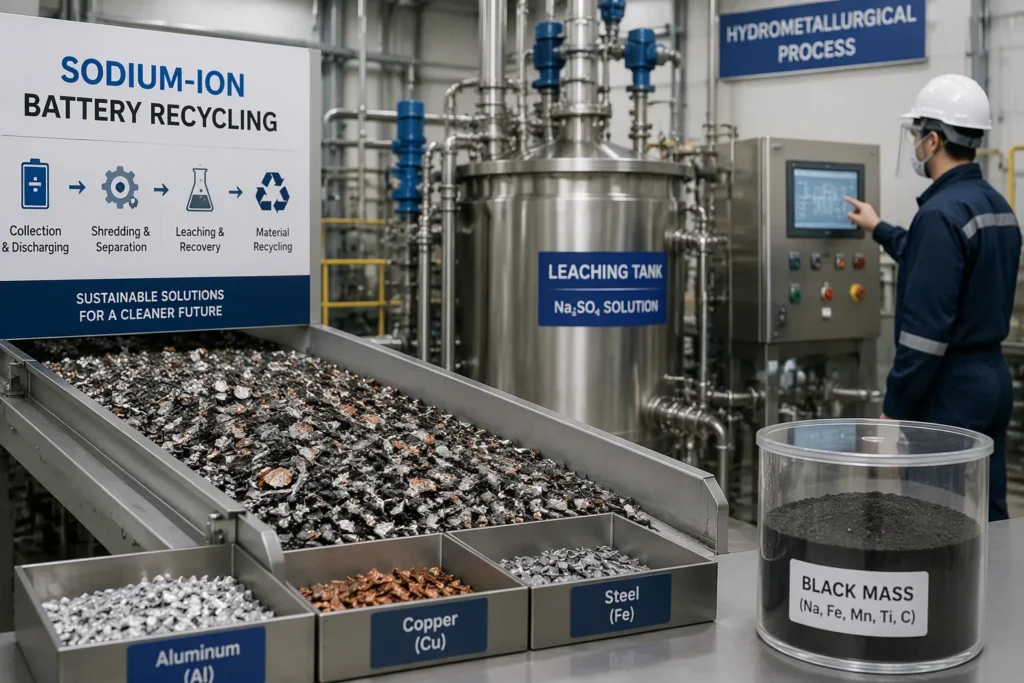
Mechanical and Hydrometallurgical Routes
Recycling lines generally combine two families of process. Mechanical routes come first. Operators shred, crush and screen spent cells, then separate output by density, magnetism and size. This stage is often called pre-treatment. It produces mixed “black mass” — a fine powder holding cathode and anode materials — plus separated steel, aluminium and copper. Mechanical sorting is fast and needs no complex chemistry. It cannot, however, separate individual metals within the black mass.
Hydrometallurgical routes handle that second job. The term simply means “using liquids to dissolve and extract metals”. Operators leach the black mass in acid or another solvent, then recover metals from the solution by precipitation, solvent extraction or ion exchange. These steps can reach high purity. They also demand careful control of temperature, acidity and reagent strength. Pyrometallurgical routes — smelting at high temperature — offer an alternative for some fractions, though they consume more energy.
The two approaches work best together. Mechanical pre-treatment concentrates the valuable material. Hydrometallurgical refining then extracts it at battery grade. A well-designed line links both stages and routes each output to the process that suits it.
What Gets Recovered Today
Recovery figures vary widely by plant, feedstock and process design. No single number describes the industry. Broadly, the bulk fractions perform well. Steel casings, aluminium and copper foils, and cathode metals all have mature recovery paths, and operators typically capture the great majority of this mass. Hard carbon anode material also separates cleanly.
The lighter fractions lag behind. Electrolyte salts and separator plastics remain the weak points, as the previous section explained. A plant may recover most of a cell’s weight while losing much of its electrolyte. Readers should therefore treat headline recovery percentages with care. The figure usually describes mass, not every component.
Compliant recycling and disposal services for sodium-based batteries are available today. These services support manufacturers, energy storage operators and transport fleets. They handle collection, safe transport and documented processing. That infrastructure matters as volumes grow. It also gives buyers a legitimate end-of-life route while full-recycling technology matures.
Sodium-Ion Batteries Versus Lithium-Ion
Technical and Economic Comparison
Both chemistries share the same recycling playbook: shred the cell, separate the casing and foils, then leach the black mass. The differences sit in what comes out and what it is worth.
Factor | Sodium-ion | Lithium-ion |
|---|---|---|
Rare or high-value metals | Few | Several, including cobalt and nickel in many designs |
Cathode leaching | Can resist traditional inorganic acids | Mature routes exist |
Thermal stability | Generally more stable | Varies by chemistry |
Recycled material value | Lower | Higher |
Sodium-ion cells contain fewer rare materials. That lowers material cost, yet it also weakens the economic case for recycling. A plant earns less from recovered sodium compounds than from recovered cobalt or nickel. Reuse options can shrink too. If cell prices fall sharply, buyers may prefer new cells over refurbished packs. Recycling then depends on regulation and collection volumes rather than scrap value alone.
Safety shapes handling and disposal. Sodium-ion batteries are generally more stable than lithium-ion cells, with lower thermal runaway and fire risks. Transporters and recyclers therefore face a gentler task when storing, moving and dismantling spent packs.
Where VEKEN’s Sodium Battery Fits
VEKEN‘s Sodium Battery illustrates where this chemistry earns its place. The range covers cylindrical and prismatic cells, with stable output down to -40℃ and cycle life exceeding 4000 cycles in the prismatic line. Nail penetration tests produce no fire or explosion, which supports safe long-distance transport and storage.
These traits suit stationary energy storage, telecom backup, e-mobility and emergency power. In each case, long service life and predictable end-of-life handling matter more than energy density. Sodium-ion batteries will not replace lithium-ion everywhere. They offer a practical alternative where safety, temperature tolerance and cost stability carry the most weight.
Regulatory Requirements and the Near-Term Outlook
What Regulations Require
Current rules govern battery waste by category, not by chemistry. The Waste Batteries and Accumulators Regulations (WBAR, 2009 as amended) sort waste batteries into automotive, industrial and portable groups. They place controls on treatment, recycling and export. Operators must register as an ABTO to treat or recycle waste automotive or industrial batteries. Exporters must register as an ABE.
These rules do not demand full recycling of sodium-ion batteries. The guidance treats sodium-ion cells like lithium-ion cells where the risks match. That covers toxic metals in the cathode and flammable electrolytes such as NaPF6 in organic solvents. The framework therefore enables compliant recycling. It does not require every component to return to useful material.
EU Battery Regulation 2023/1542 sets recovered-content thresholds and digital battery passports from 2027.
China runs extended producer responsibility and a traceability platform.
The United States uses IRA, 45X and DOE programmes plus critical minerals policy.
India and Southeast Asia are building emerging EPR frameworks.
South Korea, Japan and Australia add further rules, alongside transport and hazardous-goods law and PFAS/binder regulation.
What Comes Next
Near-term process work focuses on Prussian Blue Analogue cathodes and hard carbon anode recovery. Researchers model material composition, recovery economics and end-of-life timing for each chemistry. That work should sharpen recovery rates for the fractions that lag today.
Tighter rules will push the market further. Digital battery passports and recovered-content thresholds give recyclers a reason to document what comes back. Sodium-ion batteries still lack a dedicated recycling standard. Operators should expect gradual change, not a sudden leap to full circularity.
Sodium-ion batteries are not fully recyclable today. Most of their material mass — casing, foils, cathode metals and hard carbon anode — returns through established mechanical and hydrometallurgical routes. The electrolyte and separator remain the main gaps, and no large-scale process captures them cleanly yet.
The outlook is gradual. Recovery methods for Prussian Blue Analogue cathodes and hard carbon continue to mature, and tighter rules on recovered content and digital battery passports give recyclers a reason to document results. Readers should treat headline recovery percentages as mass figures, not proof of full circularity. Sodium-ion recycling sits between promise and practice: strong on bulk recovery, still short on the lighter fractions.
FAQ
Are sodium-ion batteries fully recyclable today?
No. Recycling lines recover most of a spent cell’s mass, including the steel casing, aluminium and copper foils, cathode metals and hard carbon anode. The electrolyte and separator still lack a clean, large-scale recovery route. Full recyclability therefore remains a design goal rather than an industry standard.
What recovery rate do sodium-ion battery recycling processes achieve?
Recovery rates vary by plant, feedstock and process design, so no single figure describes the industry. Bulk fractions such as casings, foils and cathode metals perform well through mechanical and hydrometallurgical routes. Electrolyte salts and separator plastics lag behind. Readers should treat headline percentages as mass figures, not proof that every component returns.
How does sodium-ion battery recycling compare with lithium-ion recycling?
Both chemistries share the same playbook: shred the cell, separate the foils, then leach the black mass. Sodium-ion cells contain fewer rare metals, so recovered material carries lower value. That weakens the economic case for recycling and can limit reuse options when new cell prices fall sharply.
How should businesses dispose of sodium-ion batteries safely?
Compliant recycling and disposal services for sodium-based batteries are available to manufacturers, energy storage operators and transport fleets. These services handle collection, safe transport and documented processing. Sodium-ion cells are generally more stable than lithium-ion cells, with lower thermal runaway and fire risks, which simplifies storage and dismantling.
Does regulation require full recycling of sodium-ion batteries?
No. Rules such as the Waste Batteries and Accumulators Regulations 2009 govern battery waste by category and control treatment, recycling and export. The EU Battery Regulation 2023/1542 sets recovered-content thresholds and digital battery passports from 2027. These rules enable compliant recycling; they do not demand that every component returns to useful material.