

The sourcing decision starts with the right questions, not the brochure. Brand owners weighing private label and oem solutions for sodium-ion packs should open with five groups of questions:
Performance: energy, power, cycle life, temperature range and safety.
Fit: pack dimensions, BMS integration and charging profile.
Compliance: certifications, transport rules and labelling.
Cost: unit price, MOQ, tooling and warranty.
Supplier reliability: quality systems, cell traceability and lead times.
The same question set applies to both routes. Ask manufacturers the same things about emerging sodium-ion platforms, and the answers show where each option fits best. Good answers also reveal how much of the production and manufacturing burden the supplier carries. Written replies and sample packs beat any glossy deck.
Key Takeaways
Ask manufacturers five key questions about performance, fit, compliance, cost, and supplier reliability.
Understand the difference between OEM, ODM, and private label routes to choose the best fit for your brand.
Request written answers and sample packs to verify claims and ensure quality.
Check certifications, traceability, and storage procedures to ensure safety and compliance.
Compare total costs, including warranty and freight, to make a fair decision.
Private Label and OEM Solutions for Sodium-Ion Packs: First Questions
OEM, ODM and Private Label Explained
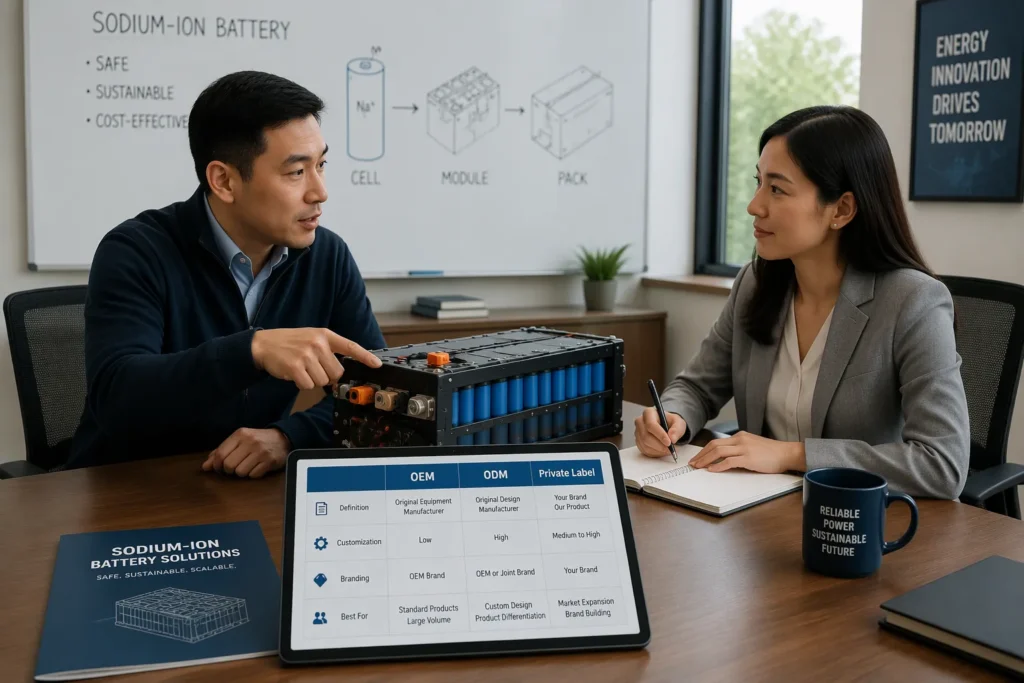
Three routes sit under the sourcing umbrella, and they differ in who owns the design. That single fact drives cost, branding control and speed to market more than any datasheet figure.
Route | Who designs the pack | Branding | Typical fit |
|---|---|---|---|
OEM | The buyer specifies, the factory builds to that design | Buyer’s brand | Teams with in-house engineering |
ODM | The factory owns an existing platform | Buyer’s brand on a standard design | Fast entry, limited customisation |
Private label | Factory platform, buyer’s identity on top | Buyer’s brand, packaging and documentation | Catalogue products, low engineering load |
An OEM arrangement gives the buyer design ownership. The factory supplies manufacturing capacity and process discipline. An ODM platform shortens development, yet the buyer inherits the factory’s choices on chemistry and layout. Private label goes one step further: the pack leaves the line with the buyer’s branding, packaging and paperwork, and the buyer carries no design burden at all.
Five Questions That Frame the Comparison
Ask these five before any commercial talk, and the answers will sort the routes quickly.
Who owns the design, and who holds the drawings?
Which cells go in, and through which channels do they arrive?
What has been validated, and against which test regime?
What is the MOQ and the lead time?
What documentation ships with the pack?
Question one settles design ownership and future revision rights. Question two matters because cell provenance shapes safety, cycle life and traceability. Question three separates a tested platform from a paper promise. Question four exposes the real commitment behind the price. Question five covers declarations, test reports and labels.
These five questions apply equally to private label and oem solutions for sodium-ion packs. A private label buyer still needs to know the cell source. An OEM buyer still needs the validation record. The answers simply land in different places. Private label and oem solutions for sodium-ion packs diverge on design control, not on the fundamentals of safety or storage performance.
Sodium-ion chemistry rewards this discipline. The technology selection and chemistry behind a pack decide its storage behaviour, its cold-weather output and its abuse tolerance. A supplier who answers all five questions in writing shows real command of sodium-ion battery manufacturing. One who dodges question two or three is telling the buyer something useful too.
Brand owners comparing private label and oem solutions for sodium-ion packs should score every reply against the same five criteria. That habit turns a brochure into a decision.
Technical Performance Questions
Energy, Power and Cycle Life
Performance talk gets vague fast. Pin the supplier down on three numbers and the picture sharpens.
Parameter | What to ask | Why it matters |
|---|---|---|
Energy | Usable watt-hours at pack level, not cell level | Sizing for runtime |
Power | Continuous and peak discharge ratings | Motor and inverter loads |
Cycle life | End-of-life criterion and test conditions | Replacement cost planning |
Ask whether the figures describe a single cell or the finished pack. The gap between the two is real. Assembly losses, busbar resistance and thermal design all trim performance. A supplier who quotes cell data for a pack question is skipping a step.
Cycle life deserves special attention. Sodium-ion cells tolerate deep discharge well, yet the count depends on depth, rate and temperature. Ask for the test regime behind the claim. A figure without conditions is a slogan, not a specification.
Temperature Range and Safety
Sodium-ion chemistry handles cold better than many lithium alternatives. That advantage only holds if the pack design supports it. Ask for discharge and charge limits separately, plus the storage window for idle units. A wide discharge range with a narrow charge range catches buyers out.
Then move to battery safety. Request abuse test results: overcharge, short circuit, crush and thermal propagation. Ask how the BMS responds and where the cutoff sits. Good manufacturing practice shows up here. Production lines that test every pack, not just samples, give buyers far more confidence.
Safety also ties to cathode and anode materials. Hard carbon anodes behave differently from layered oxide cathodes under stress. A supplier should explain those differences in plain terms. That answer reveals whether the team understands its own chemistry or just resells it.
Application Fit Questions
Pack Fit and BMS Integration
A great cell in a badly fitting pack is a wasted purchase. Ask for the envelope drawing first: length, width, height, mass and mounting points. Then check the connector type and cable routing against the target product. A few millimetres of mismatch can force a redesign of the enclosure, and that cost lands on the buyer.
Battery management systems deserve equal scrutiny. Which protocol does the BMS speak — CAN, RS485 or something else? Does it report state of charge, state of health and individual cell voltages? Ask how the battery management system handles cell balancing and where it sets cutoff thresholds. A pack that talks to the host device cleanly saves weeks of integration work. One that doesn’t turns a simple assembly job into a debugging project.
Good battery system design also covers service access. Can a technician swap a module without scrapping the whole unit? That question shapes long-term storage deployments, where units sit idle for months and then need attention.
Charging Profile and Duty Cycle
Charging behaviour decides real-world usability. Request the recommended charge voltage, current limits and taper behaviour. Ask whether the pack tolerates opportunity charging during breaks, or whether it needs a full cycle. Sodium-ion chemistry is forgiving on this front, yet the BMS settings still govern what the pack will accept.
Duty cycle matters just as much. Describe the actual load pattern — peak draws, rest periods, daily hours — and ask the supplier to map it against cycle life claims. A pack rated for shallow cycling may behave differently under deep, frequent discharge. Production teams who understand the application give sharper answers here.
Finally, ask how the pack behaves in storage. Long idle periods, partial charge and temperature swings all affect the first charge after months on a shelf. A supplier with solid manufacturing discipline will have a written storage procedure ready. That document tells a buyer more about safety culture than any sales call.
Regulatory Compliance Questions
Certifications, Transport and Labelling
Compliance questions feel dull until a shipment stops at a border. Ask early, and ask in writing. A sodium-ion pack travels under transport rules that differ from lithium, so the supplier must know the current regime, not last year’s.
Item | What to request | Why it matters |
|---|---|---|
Transport testing | Clears air and sea freight | |
Product safety | IEC 62133 report or equivalent | Backs battery safety claims |
Market marking | CE, UKCA or destination-specific marks | Enables lawful sale |
Labelling | Language, symbols, capacity marking | Avoids customs delays |
Ask who holds the test reports and whether they cover the exact pack variant on offer. A certificate for a sister model proves little. Labelling deserves a sample too. Buyers should see the actual printed label before production starts.
Documentation and Compliance Planning
Paperwork is where good manufacturing shows. Request the declaration of conformity, the material data sheet and the test summaries as a single document set. Ask how the supplier stores those records and for how long. Traceable records support safety investigations years later.
Planning beats reacting. Map the destination markets first, then work backwards to the tests each one needs. Ask the supplier how they handle a revision — a new cell or a changed BMS can trigger fresh testing. Build that cost into the budget from day one.
Storage conditions belong in this conversation as well. Ask how the factory stores cells before assembly, and how it stores finished packs awaiting shipment. Poor storage control undermines every certificate on file. The same applies to storage at the buyer’s warehouse: request written guidance on temperature, humidity and state of charge. Compliance is a chain, and weak storage practice breaks it.
Finally, ask for a named contact who owns compliance. A supplier with clear production and manufacturing discipline answers these questions without hesitation.
Cost Questions for Sodium-Ion Packs
Unit Price, MOQ and Tooling
Price talk gets awkward fast. Ask what sits inside the quoted figure. Does it cover the pack alone, or the charger, cables and packaging too? A low number often hides extras.
Then ask about minimum order quantities. A validated platform usually carries a lower MOQ, because the factory already runs that design. A full custom build needs new tooling, fresh fixtures and extra production time. That tooling cost lands on the buyer, and it rarely shrinks with volume. Buyers weighing sodium-ion battery manufacturing plant setup costs should remember that supplier scale shapes their unit price too. A plant with mature sodium-ion battery manufacturing plant cost structures passes savings along. A new line does not.
Here’s the trade-off in plain terms. Validated platforms win on speed and price. Custom builds win on fit. Neither is wrong — it depends on the product.
Warranty and Total Cost of Ownership
Warranty terms deserve a close read. How long does cover last, and what voids it? Ask who pays freight on a replacement unit. That single clause can dwarf the unit cost difference between two quotes.
Total cost of ownership goes wider. Add freight, duties, storage and replacement rates over the service life. Storage matters more than buyers expect: poor storage conditions at any point in the chain can trigger failures that warranty won’t cover. Ask the supplier for written storage guidance and factor warehousing storage cost into your model.
Replacement assumptions need honesty. Ask for field failure data from comparable deployments. A supplier with solid manufacturing records will share trends. One who won’t is a risk.
Finally, compare quotes on the same basis. Same volume, same warranty, same freight terms. That’s the only fair cost comparison.
Sodium-Ion Battery Manufacturing Capability
Quality Systems and Cell Traceability
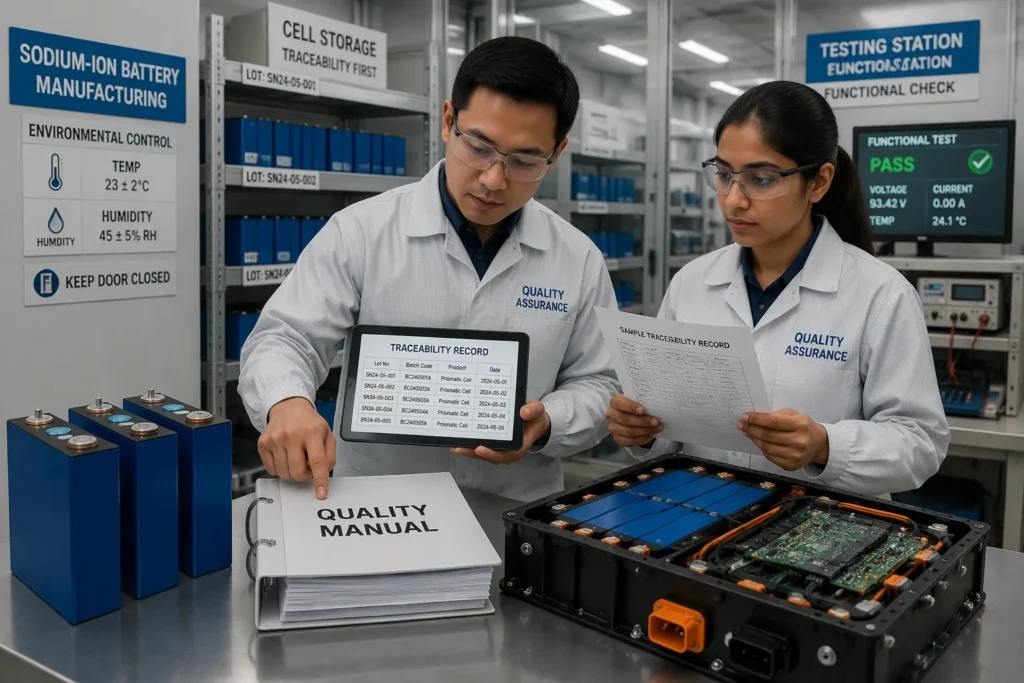
A factory tour tells you less than a document pack. Ask for the quality manual first. Which management system does the plant run, and who audits it? Then ask about the testing regime. Does every unit get a functional check, or only a sample from each lot? Full-unit testing costs more, yet it catches faults before they reach a warehouse.
Cell sourcing is the next pressure point. Ask which cell makers supply the line and whether those cells arrive through authorised channels. Grey-market cells undercut the price and wreck traceability. A serious partner keeps purchase records for every batch.
Lot-level traceability separates real sodium-ion battery manufacturing from box-shifting. Can the supplier tie a finished pack back to its cell lot, its bms board batch and its cathode and anode materials? If a fault appears in the field, that chain shortens the investigation. Ask to see a sample traceability record. The format matters less than the habit.
Watch how the plant handles storage too. Cells waiting for assembly need controlled temperature and humidity. Finished packs need the same care before dispatch. Ask for the written procedure and check it against what you see on the floor.
Supply Continuity and Lead Times
Lead time claims deserve a sceptical ear. Ask how the supplier builds the estimate: cell procurement, battery pack assembly, testing and freight. A single number hides the weak link. Push for the breakdown.
Supply continuity matters just as much for energy storage solutions buyers. Ask what happens when a cell model changes. Does the supplier hold buffer stock, or qualify a second source? A revision to the chemistry or the bms can trigger fresh validation, so build that into the plan.
Component-level models give buyers flexibility. Compare the options before committing.
Model | What ships | Best fit |
|---|---|---|
Full pack | Finished, tested unit | Fast market entry |
SKD | Semi-knocked-down kit | Local assembly, lower freight |
CKD | Complete-knocked-down kit | Regional production, tariff planning |
Each model shifts cost and control between the parties. CKD and SKD suit brands building a local sodium-ion battery manufacturing business, while full packs keep life simple. Ask how future revisions reach each format.
Finally, ask about contract manufacturing terms. Who owns the tooling? What notice period applies? A supplier with clear answers here shows the production discipline that keeps a supply chain steady.
Here’s the checklist to take into the next supplier call:
Design ownership and revision rights.
Cell source and authorised channels.
Validation records and test conditions.
MOQ, lead time and tooling costs.
Certifications, labels and paperwork.
Warranty terms and freight liability.
Quality systems, traceability and manufacturing discipline.
Storage procedures at the factory and in transit.
Score private label and oem solutions for sodium-ion packs against the same list. Then match the route to the product: a catalogue item suits private label, a bespoke enclosure suits OEM. Ask manufacturers for written answers and a sample pack before committing. Check how each one handles production and storage first. That habit separates real sodium-ion manufacturing partners from brochure builders.
FAQ
Which route suits a brand with no engineering team?
Private label fits best here. The factory owns the design, and the buyer applies branding, packaging and documentation. An ODM platform sits close behind it. Both routes cut the engineering load, yet the buyer still needs written answers on cell source and validation before signing.
How does a buyer verify cell traceability?
Ask for a sample traceability record. A serious partner ties each finished pack back to its cell lot, BMS board batch and electrode materials. That chain shortens any field investigation. Buyers should also confirm the cells arrive through authorised channels, since grey-market supply wrecks the record.
What drives lead time in sodium-ion battery manufacturing?
Cell procurement usually sets the pace, followed by assembly, testing and freight. Ask for the breakdown rather than one number. A supplier with mature sodium-ion battery manufacturing holds buffer stock and qualifies a second source. That habit keeps supply steady when a cell model changes.
How should a buyer plan for pack storage?
Request the written procedure for both the factory and the warehouse. Cells and finished packs need controlled temperature, humidity and state of charge. Poor storage undermines every certificate on file. Buyers should factor warehousing storage cost into the model and check the floor against the document.
What changes when a design revision lands?
A new cell or a changed BMS can trigger fresh validation and new labels. Ask how revisions reach each format — full pack, SKD or CKD. Clear notice periods and tooling ownership keep production predictable. Buyers should budget for retesting rather than treat it as a surprise.