

Wholesale sodium-ion cells supplied in container or cabinet volumes typically carry a MOQ of 8% to 15%, with lead times of 30 to 60 days. OEM orders for custom sodium-ion packs or BMS configurations usually require 300 to 1,000 units. 🔋
Cell format, manufacturer production capacity, and whether the order is standard or customised set these figures. A repeat order on a frozen design sits at the lower end; a new design pushes both volume and time upward.
Lead time and customisation follow the same logic. This article examines each factor and shows how the three interact for procurement planning.
Key Takeaways
Wholesale sodium-ion cells have a MOQ of 8% to 15% for container orders or 300 to 1,000 units for custom packs.
Cell format, plant capacity, and design status determine the final MOQ and lead time.
Lead time runs 30 to 60 days for standard orders and shortens to 4-8 weeks for repeat orders on a frozen design.
Customisation options include cell format, capacity, chemistry, connectors, labelling, and certification support.
Freeze your design early to lower MOQ, shorten lead time, and secure better pricing.
Minimum Order Quantity (MOQ) for Sodium-Ion Cells
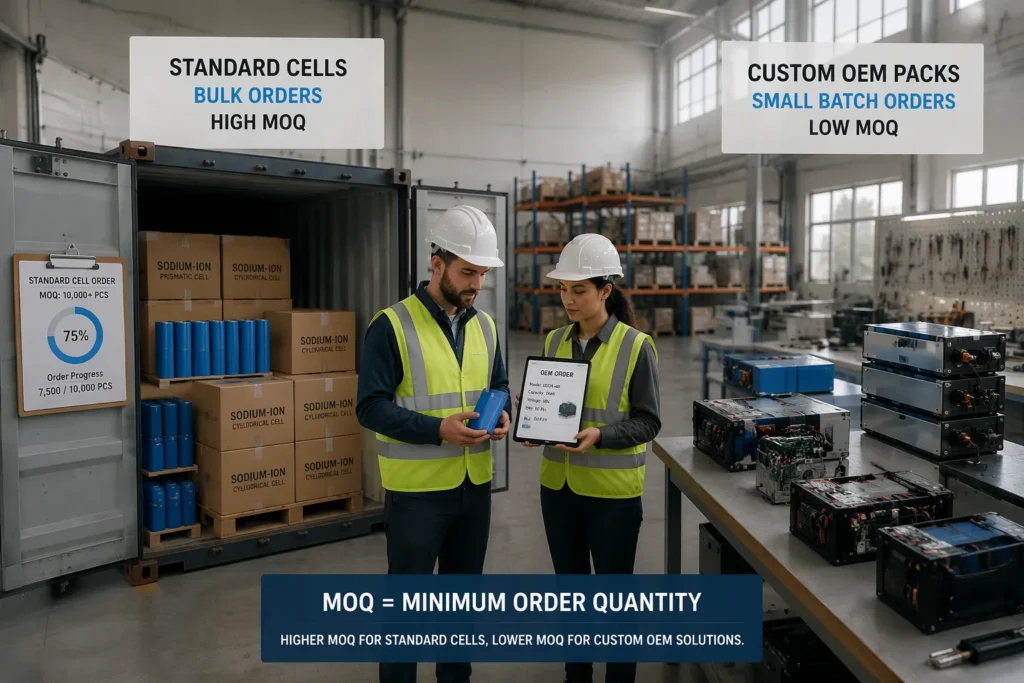
Typical MOQ Ranges
Order volume depends on how the buyer intends to use the cells. Two broad categories cover most wholesale purchases, and each carries its own MOQ profile.
Order type | Typical MOQ | Typical lead time |
|---|---|---|
Container or cabinet volume (standard cells) | 8% to 15% of a container or cabinet | 30 to 60 days |
OEM custom packs or BMS configurations | 300 to 1,000 units | Project-dependent |
Container and cabinet orders suit buyers who need standard cells for energy storage builds or integration into existing systems. The 8% to 15% range reflects the practical loading of a shipment. A buyer who fills only a fraction of a container still pays for handling, documentation and freight, so suppliers set a floor that keeps the shipment economic.
OEM orders follow a different logic. A custom sodium-ion pack or a tailored BMS configuration requires tooling, sample builds and validation before mass production begins. Suppliers therefore ask for 300 to 1,000 units to recover that set-up effort. The exact figure within the range depends on the complexity of the pack design and the number of custom components.
What Sets MOQ
Four factors drive the final figure. Buyers who understand them can plan volume and budget with far greater confidence.
Cell format ranks first. Standard cylindrical or prismatic formats come off existing lines, so suppliers can accept smaller volumes. Unusual formats require line changes and raise the minimum.
Manufacturer production capacity matters next. A plant running at high utilisation has little room for small runs. A supplier with spare capacity can often accommodate a lower MOQ for sodium-ion cell wholesale orders.
Standard versus customised orders form the third factor. A catalogue cell shipped as-is sits at the low end of the range. A custom pack with a bespoke BMS, connector layout or enclosure pushes the MOQ upward, because every change adds engineering time and inventory risk.
New versus repeat design closes the list. A repeat order on a frozen, validated design removes most set-up work, so suppliers frequently accept smaller top-up volumes. A first-time design carries sampling, testing and approval costs that the MOQ must absorb.
These factors interact rather than act alone. A standard cell in a common format, ordered from a supplier with spare capacity, may ship at the bottom of the 8% to 15% band. A custom pack with a new BMS design will sit at the top of the 300 to 1,000 unit range, or above it. Buyers should confirm the MOQ in writing at quotation stage and ask which factors drive the number. That question often reveals room for negotiation on volume, scheduling or payment terms.
Lead Time Stages and Ranges
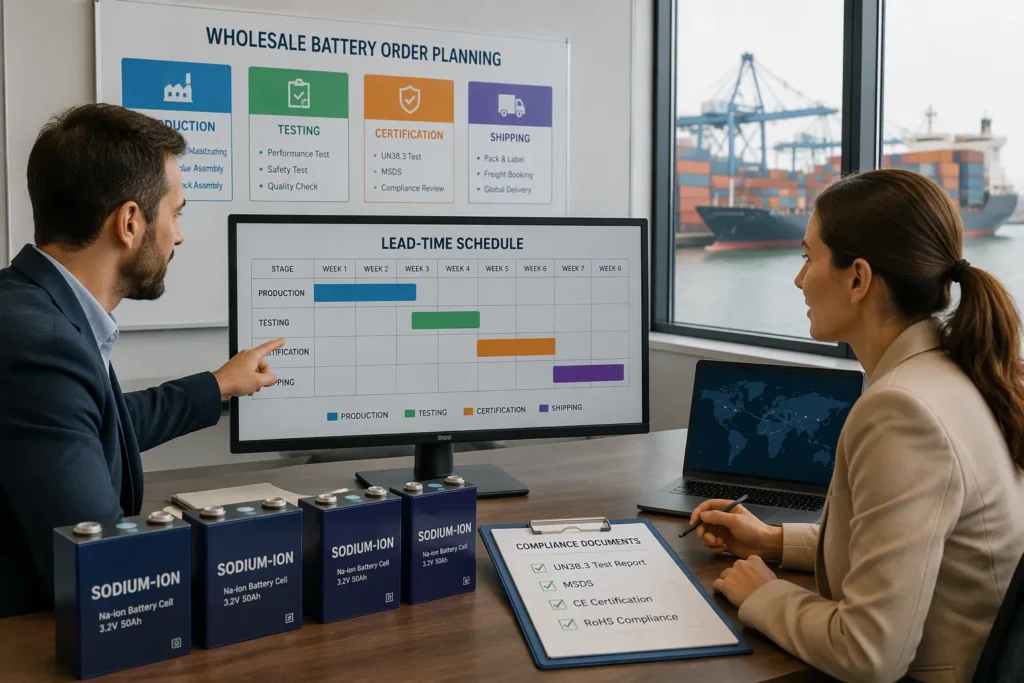
Production, Testing, Certification, and Shipping
Sodium-ion battery lead time depends on order type. Container or cabinet volume orders typically run 30 to 60 days. Repeat orders on a frozen, validated design run four to eight weeks, depending on configuration and cell type. The schedule breaks into four stages.
Production. The factory schedules cell fabrication, formation and ageing. Standard formats move quickly because the line already runs them.
Testing. Cells undergo capacity, voltage and safety checks. Sampling and batch verification add time for first-time designs.
Certification. Documentation and compliance testing cover transport and market requirements. New designs need fresh validation here.
Shipping. Freight booking, dangerous goods paperwork and port handling close the schedule. Sea freight for container volumes dominates this stage.
Each stage carries its own buffer. A delay in testing pushes certification back, and certification gates shipping. Buyers should therefore track the stages separately rather than treat lead time as one block.
What Shortens or Lengthens Lead Time
Design status is the strongest lever. OEM projects involving new designs take longer to validate and certify. Every new pack layout, connector or enclosure needs samples, test cycles and approval before mass production. ODM projects move faster because the core platform is already established. The supplier adapts a proven design, so validation covers only the changed elements.
BMS customisation deserves separate attention. A tailored battery management system can involve long lead times and high costs. Firmware development, hardware revision and safety verification all sit on the critical path. Buyers who need a custom BMS should budget extra weeks and confirm the schedule in writing.
Cell type and configuration also shift the timeline. A common format in steady production shortens the production stage. An unusual format or a low-volume run lengthens it, because the line needs changeover time.
Order history matters too. A repeat order on a frozen design removes most engineering work, so the four-to-eight-week window becomes realistic. A first order with open specifications rarely meets that window.
Supplier capacity completes the picture. A plant with spare capacity can pull a sodium-ion cell order forward. A plant running near full utilisation pushes it back, whatever the contract states.
Practical guidance follows from these points. Freeze the design before requesting a firm delivery date. Separate engineering time from production time in the quotation. Ask the supplier which stage carries the most risk for the specific configuration. These questions turn a headline lead time into a plan the buyer can schedule against.
Customisation Options
Sodium-ion battery manufacturers offer both OEM and ODM customisation, which gives wholesale buyers flexible routes to a finished product. OEM suits buyers who bring their own design and need a manufacturing partner. ODM suits buyers who prefer to adapt an established platform and save engineering time. Premium sodium-ion configurations and deeper customisation options remain available for larger battery builds, where the engineering cost spreads across a bigger volume.
Cell Format, Size, Capacity, and Voltage
Format, size, capacity and voltage form the physical and electrical layer of customisation. Each choice fits a different application and carries a different cost profile.
Option | Best fit | Cost profile |
|---|---|---|
Standard cylindrical or prismatic format | Energy storage cabinets, retrofit projects | Lowest; tooling already exists |
Custom size or format | Enclosures with fixed dimensions | Higher; new tooling and sampling |
Matching a target pack voltage or runtime | Moderate; validation per variant | |
Premium configuration | Larger battery builds | Highest; justified by volume |
Buyers should match the option to the application first and the budget second. A standard format serves most storage builds well. A custom format earns its cost when the enclosure cannot change.
Chemistry Tuning, Connectors, Labelling, Packaging, and Certification Support
Chemistry tuning adjusts the electrode formulation for a target balance of energy, power and cycle life. Connectors and busbar layouts follow the pack architecture. Labelling and packaging cover market language, shipping marks and dangerous goods documentation. Certification support helps buyers meet transport and market requirements, such as IEC 62619 for industrial battery safety and UL 1973 for stationary storage.
These options vary widely in cost. Labelling and packaging sit at the low end. Chemistry tuning and certification support sit higher, because both involve test cycles. Buyers should evaluate suppliers carefully and look for manufacturers that adhere to strict quality standards. A supplier who documents test methods and traceability gives the buyer a defensible basis for approval.
How MOQ, Lead Time, and Customisation Interact
Balancing MOQ, Lead Time, and Customisation
The three factors move together. A buyer who changes one shifts the other two. The table below shows the direction of each effect.
Factor | 🔧 Effect on lead time | ⏳ Effect on MOQ |
|---|---|---|
Deeper customisation | Longer; new samples and validation | Higher; set-up cost spreads over more units |
Larger order volume | Longer production stage | Lower unit cost, same floor |
Frozen, validated design | Shorter; four to eight weeks on repeat orders | Lower; top-up volumes accepted |
A custom pack with a bespoke BMS sits at the slow, expensive corner. A standard cell on a repeat order sits at the fast, flexible corner. Buyers should compare options only on technical performance, application fit, regulatory compliance and cost. A lower MOQ means little if the cell fails the application. A short lead time means little if certification is incomplete.
Planning a Procurement Decision
A practical framework helps buyers evaluate battery material suppliers and navigate volume and timing.
Define the application load, voltage and cycle target before contacting suppliers.
Request the quality specification in writing, including test methods and traceability.
Ask which factors set the quoted MOQ, and whether a repeat order lowers it.
Separate engineering time from production time in the delivery schedule.
Confirm certification scope for transport and the target market.
Compare total landed cost, not unit price alone.
Buyers who freeze the design early shorten every later stage. A validated design removes sampling from the critical path, so repeat orders move faster and accept smaller volumes. First-time designs carry the opposite profile.
Suppliers who document their test methods give buyers a defensible approval basis. Buyers should check every claim against technical performance, application fit, regulatory compliance and cost. That discipline turns a quotation into a decision.
Wholesale sodium-ion cells carry a MOQ of 8% to 15% for container or cabinet volumes, or 300 to 1,000 units for OEM packs. Cell format, plant capacity and design status set the figure. Lead time runs through production, testing, certification and shipping, and a frozen design shortens every stage. Customisation spans format, capacity, chemistry, connectors, labelling and certification support, each with its own cost profile.
Buyers should weigh these three factors together. A low volume means little if certification is incomplete. Every claim deserves a check against technical performance, application fit, regulatory compliance and cost.
Buyers ready to move forward should request a quote with their required volume, timeline and customisation needs. The supplier can then confirm MOQ, lead time and pricing.
FAQ
What is the typical MOQ for sodium-ion cell wholesale orders?
Container or cabinet volume orders usually carry a MOQ of 8% to 15% of a container or cabinet. OEM orders for custom sodium-ion battery packs or BMS configurations typically require 300 to 1,000 units. Cell format, plant capacity and design status set the final figure.
How long does a sodium-ion battery order take to deliver?
Container or cabinet volume orders run 30 to 60 days. Repeat orders on a frozen, validated design take four to eight weeks, depending on configuration and cell type. New OEM designs take longer, because sampling, testing and certification sit on the critical path.
Can a buyer order custom sodium-ion battery packs below the standard MOQ?
A repeat order on a validated design often lowers the floor, because set-up work is already complete. A first-time custom pack rarely qualifies. Buyers should ask the supplier which factors set the quoted MOQ and whether a top-up volume is possible.
Which customisation options affect sodium-ion battery lead time most?
BMS customisation carries the longest lead time and the highest cost, because firmware development and safety verification sit on the critical path. Chemistry tuning and certification support also add test cycles. Labelling and packaging change little.
Does a larger order volume shorten sodium-ion battery lead time?
No. A larger volume lengthens the production stage, though it lowers unit cost. Lead time shortens through a frozen, validated design and a supplier with spare capacity. Buyers should separate engineering time from production time in the delivery schedule.