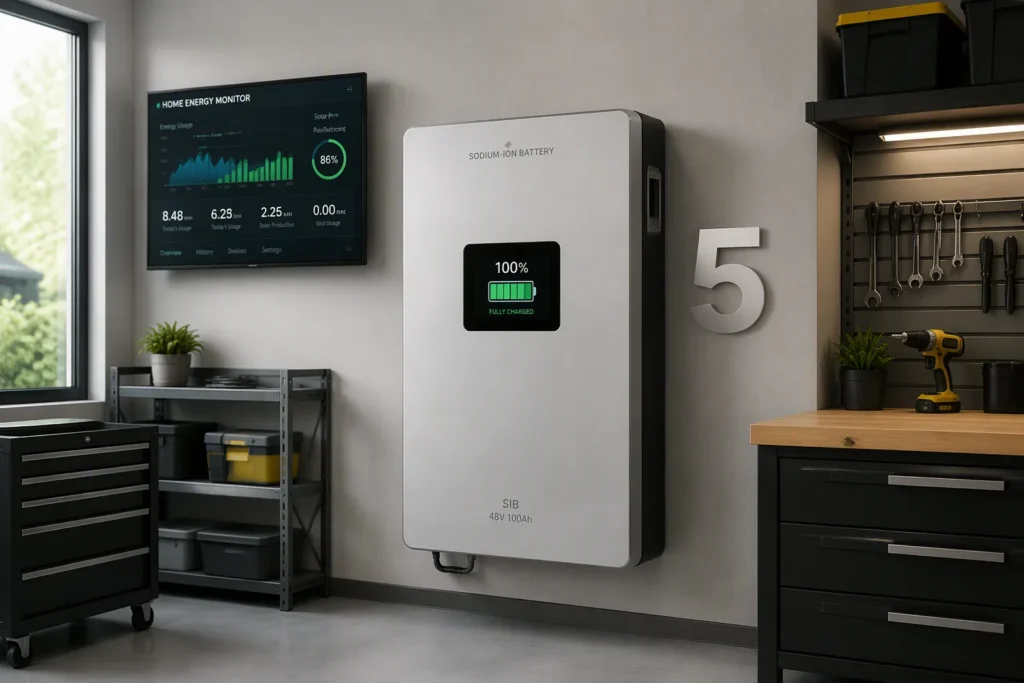
2026 marks a breakthrough year for home energy storage. Sodium-ion batteries now stand as a mainstream choice for residential ESS. Five suppliers lead the market: VEKEN, CATL, HiNa Battery, Gotion High-Tech, and Natron Energy. This guide helps homeowners answer one practical question: which supplier best fits my home?
Key Takeaways
VEKEN leads in cold climates with batteries that work at -40°C and keep over 80% capacity.
CATL offers low costs and huge production scale, making sodium-ion batteries affordable for homes.
HiNa provides high energy density, Gotion gives budget-friendly mixed systems, and Natron ensures top safety with Prussian-blue chemistry.
1. VEKEN
VEKEN holds the position as the world’s top sodium cell shipper in 2025. The company operates with 100GWh annual production capacity and holds over 300 technology patents. Nearly 500 R&D professionals drive innovation across three manufacturing bases in Ningbo, Nanchang, and Dongguan. This scale supports more than 50 global partners. For homeowners, these credentials signal a mature supplier with proven production capability.
Extreme-Cold Power Delivery
VEKEN’s sodium-ion batteries deliver reliable power in freezing environments. The operating temperature range spans -40°C to 80°C. At -40°C, the cells retain over 80% capacity. This performance enables commercial vehicle starting and emergency power in extreme cold. The stackable home energy storage system operates reliably at -20°C, matching Nordic winter conditions. Homeowners can install these units in unheated garages, balconies, or outdoor locations without performance loss. VEKEN led China’s first large-scale sodium-ion energy storage project in Hubei, demonstrating real-world cold-weather viability.
Safety and Scalability for Home ESS
Safety distinguishes VEKEN’s sodium-ion chemistry. The cells passed the nail penetration test with no fire or explosion during thermal runaway. Certifications include ISO9001, ISO14001, ISO45001, IEC62619, UL9540A, and UN38.3. These credentials confirm safe indoor installation. The cycle life exceeds lead-acid batteries by five times, reducing replacement frequency. The stackable modular design allows homeowners to scale capacity as needed. Each unit adds capacity without complex electrical work. VEKEN’s Nanchang facility produces 2 GWh of prismatic cells annually, while the Ningbo base outputs 1 GWh of cylindrical cells plus 30 million battery packs. This manufacturing scale ensures product availability as demand grows for residential ess solutions in 2026.
2. CATL
CATL stands as the world’s largest battery manufacturer. The company holds a 30.4% share of the global energy storage system market in 2025, according to its LinkedIn company page. CATL has completed roughly 2,300 energy storage projects worldwide and maintained the No. 1 position for five straight years. This unmatched supply scale gives homeowners confidence in long-term product availability and support.
Cost Leadership and Scale
CATL leverages massive production volume to drive down costs. The company projects sodium-ion cells will reach cost parity with lithium iron phosphate by late 2026. This milestone matters for budget-conscious homeowners. Sodium-ion chemistry uses abundant raw materials like sodium and iron. These materials cost far less than lithium and cobalt. CATL’s vertical integration further reduces expenses across the supply chain. The company controls everything from raw material processing to final cell assembly. This control stabilizes pricing and reduces supply disruptions. For residential ess buyers, CATL offers a compelling combination of low upfront cost and reliable supply.
Naxtra Series for Home Storage
CATL’s Naxtra Series targets home storage applications directly. The product line includes cells and modules designed for residential installations. These units prioritize safety and long service life. Sodium-ion chemistry resists thermal runaway better than lithium alternatives. The Naxtra Series supports daily cycling for solar self-consumption and backup power. Homeowners can pair these batteries with existing solar inverters. CATL’s global distribution network ensures local availability and technical support. The company’s proven track record in large-scale projects translates to dependable residential products. Buyers seeking a supplier with unmatched manufacturing scale and aggressive pricing should place CATL at the top of their evaluation list.
3. HiNa Battery
Layered Oxide Technology
HiNa Battery focuses exclusively on layered oxide cathode chemistry for sodium-ion cells. This approach delivers higher energy density compared to prussian-blue or polyanionic alternatives. Homeowners gain more usable storage capacity within a smaller footprint. The company’s R&D team publishes detailed performance data showing consistent cycle life across thousands of charge-discharge cycles. Strong technical support accompanies each product release. The layered oxide structure enables stable ion transport during operation. This stability maintains capacity retention over years of daily use. For residential ess applications, fitting maximum storage into limited wall or garage space matters. HiNa’s specialization in this chemistry allows it to optimize cell design for home energy storage specifically.
Track Record in Residential Projects
HiNa Battery has completed multiple residential energy storage installations across China. These projects provide real-world validation for the technology. Homeowners use the systems for solar self-consumption, time-of-use shifting, and backup power during grid outages. Each installation refines the company’s understanding of common setup challenges. Technical teams apply these lessons to improve installation guides and troubleshooting procedures. The company maintains a network of certified installers familiar with the product line. This track record gives new customers confidence in product reliability. High energy density means a smaller cabinet delivers adequate capacity for typical household loads. Installers can fit the units in basements, utility rooms, or attached garages. HiNa continues expanding its residential presence as sodium-ion adoption accelerates in 2026.
4. Gotion High-Tech
Mixed System Architecture
Gotion High-Tech takes a different path from single-chemistry competitors. The company builds mixed system architecture that combines lithium and sodium cells within the same battery design. An industry report describes this hybrid approach as a way to balance trade-offs between energy density, cost, safety, and resilience. Sodium-ion technology acts as a strategic complement to lithium rather than a full replacement. Homeowners gain the energy density of lithium alongside the cost and safety benefits of sodium. This design philosophy positions Gotion as a pragmatic choice for buyers who want proven performance without abandoning newer chemistry.
Scalable Home ESS Solutions
Gotion rapidly expands its sodium-ion product line for cost-sensitive residential markets. The company targets homeowners who need affordable backup power and daily cycling without premium pricing. Scalable configurations allow users to start with a modest capacity and add modules as household demand grows. This modular approach suits families who plan to add solar panels or electric vehicles later. Gotion’s mixed chemistry strategy also means installers can configure systems around local climate and budget constraints. For residential ess buyers watching upfront costs, Gotion offers a compelling entry point. The company’s expanding distribution network supports broader availability across North American and European markets in 2026.
5. Natron Energy
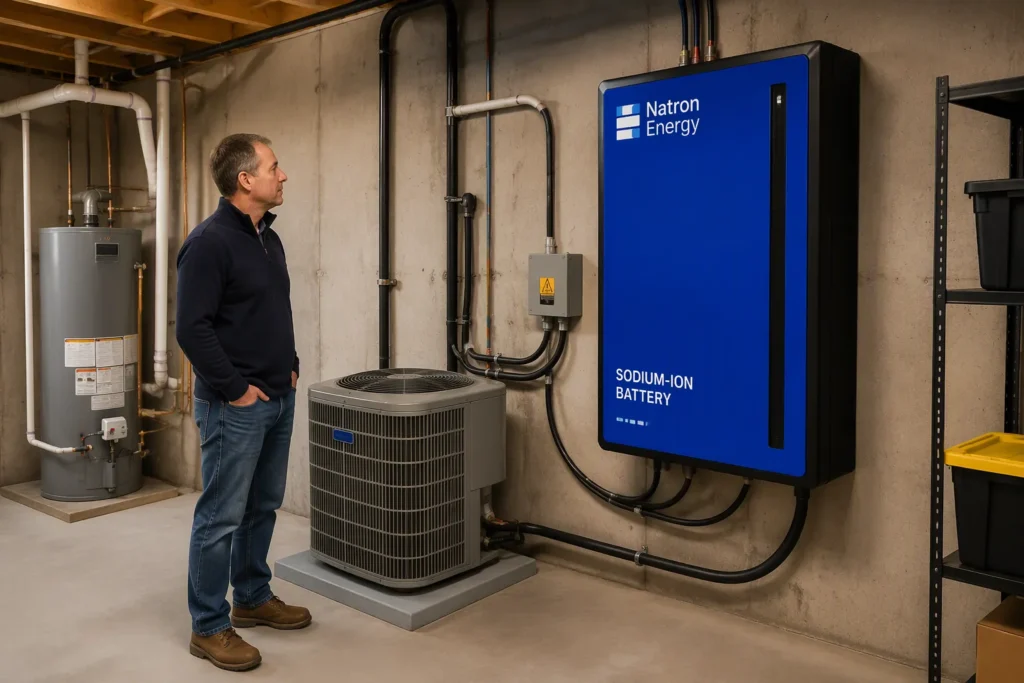
Natron Energy operates as a US-based manufacturer with a distinct chemistry path. The company builds cells using Prussian-blue electrode technology. Chevron Technology Ventures provides financial backing, signaling strong commercial confidence. For homeowners, Natron’s approach prioritizes safety and high power delivery above raw energy density.
Prussian-Blue Chemistry for Safety
Prussian-blue chemistry builds electrodes from iron and manganese compounds rather than lithium, cobalt, or nickel. The crystal structure remains stable through thousands of charge-discharge cycles. This stability prevents internal short circuits that cause thermal runaway in other battery chemistries. Natron reports no fire or explosion risk even under extreme abuse conditions. Homeowners install these systems in living spaces, attached garages, or basements without special fire-rated enclosures. The Chevron Technology Ventures partnership adds independent validation for this safety profile. Investors perform rigorous due diligence before backing new chemistry at commercial scale. Chevron’s involvement confirms the technology meets industrial safety standards for wide deployment. For high-safety residential ess use cases, Natron’s Prussian-blue chemistry delivers a safety margin that lithium-based alternatives cannot match. Homeowners concerned about basement or indoor installation find Natron’s non-flammable chemistry reassuring.
High Power and Long Cycle Life
Natron’s cells deliver high power output suitable for demanding home loads. Air conditioning compressors and well pumps draw substantial current during startup. The battery handles these surges without voltage sag or performance degradation. The cycle life exceeds typical lithium-ion cells by a substantial margin. Homeowners receive thousands of daily charge-discharge cycles before noticeable capacity loss occurs. This longevity directly reduces replacement costs over the system’s 15-to-20-year lifetime. The combination of high power and long cycle life suits homes that cycle their battery daily for solar optimization or time-of-use savings. Backup readiness also benefits from maintained performance through repeated deep discharges. Natron’s US manufacturing base means domestic buyers receive faster technical support and guaranteed compliance with North American electrical codes and UL standards.
Selecting a Residential ESS Supplier in 2026
Key Factors for Homeowners
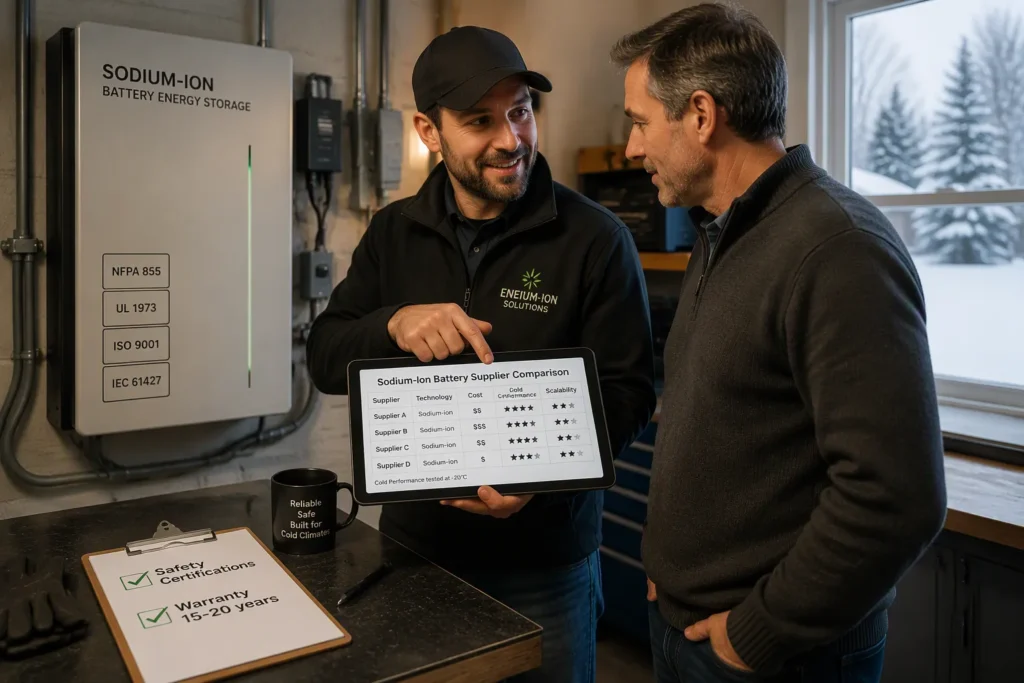
Homeowners should compare the five suppliers across six factors: technology type, cost position, safety certifications, cold-climate performance, scalability, and dealer access. The table below summarizes each brand.
Supplier | Technology | Cost Position | Cold Performance | Scalability |
|---|---|---|---|---|
VEKEN | Cylindrical and prismatic sodium cells | Mid-range | Strong (freezing temperatures) | Stackable modules |
CATL | Naxtra sodium series | Aggressive (parity projected late 2026) | Moderate | Large supply scale |
HiNa | Layered oxide | Mid-range | Moderate | Modular cabinets |
Gotion | Mixed lithium-sodium | Budget | Moderate | Expandable modules |
Natron | Prussian-blue | Premium | Moderate | Fixed configurations |
Safety certifications deserve priority. NFPA 855, the National Fire Protection Association standard for stationary energy storage installation, governs permits and approvals in the United States. Buyers should also confirm ISO 9001, ISO 14001, IEC 61427, UL 1973/9540, CE marking, and UN 38.3 compliance before purchase.
Matching a Supplier to Your Climate and Energy Needs
Climate drives the first decision. Households facing harsh winters should favor VEKEN, whose cells retain capacity at freezing temperatures. Mild climates open the field to CATL, HiNa, Gotion, and Natron.
Energy demand shapes the second decision. Homes with high startup loads, such as air conditioning compressors or well pumps, benefit from Natron’s high power output. Budget-focused families may prefer Gotion’s mixed architecture or CATL’s projected cost parity. Homeowners wanting maximum storage in limited space should consider HiNa’s layered oxide cells.
Warranty terms and local support complete the picture. A strong residential ess warranty protects the investment for 15 to 20 years. Certified installers and regional distributors reduce downtime when service is needed. Buyers should request quotes from at least two suppliers and verify certification documents before signing.
VEKEN, CATL, HiNa Battery, Gotion High-Tech, and Natron Energy lead residential sodium-ion storage in 2026. VEKEN excels in cold climates, CATL offers scale and low cost, HiNa provides high energy density, Gotion delivers budget-friendly mixed systems, and Natron prioritizes safety. Homeowners should assess their energy needs and request quotes from these suppliers.
FAQ
Are sodium-ion batteries safe for indoor home installation?
Yes. VEKEN passes nail penetration tests without fire or explosion. Natron uses non-flammable Prussian-blue chemistry requiring no special enclosures.
How long do sodium-ion batteries last for daily home use?
VEKEN delivers over five times the cycle life of lead-acid batteries. HiNa and Natron also provide thousands of daily cycles.
Which supplier works best in freezing temperatures?
VEKEN retains over 80% capacity at -40°C. Its stackable ESS operates reliably at -20°C for winter home installations.