
How Sodium-Ion Batteries Work: Principles, Materials & Real-World Applications
🔋 Keywords: how sodium-ion batteries work, sodium-ion battery principle, sodium battery working principle, sodium battery chemistry, sodium-ion battery structure, sodium vs lithium battery, sodium-ion battery applications, sodium battery manufacturer, OEM sodium battery supplier
As global demand for affordable and safer energy storage continues to grow, sodium-ion batteries (SIBs) have become one of the most discussed alternatives to lithium-ion batteries.
Unlike lithium, sodium is one of the most abundant elements on Earth. This makes sodium-ion technology attractive for applications where cost, supply-chain stability, and safety are more important than achieving the highest possible energy density.
This guide explains how sodium-ion batteries work, what materials they use, how they compare with lithium batteries, and where they are already being deployed.
What Is a Sodium-Ion Battery? 🔬
A sodium-ion battery is a rechargeable battery that stores and releases electrical energy through the movement of sodium ions (Na⁺) between two electrodes.
Its operating principle is remarkably similar to a lithium-ion battery:
- Positive electrode (Cathode)
- Negative electrode (Anode)
- Electrolyte
- Separator
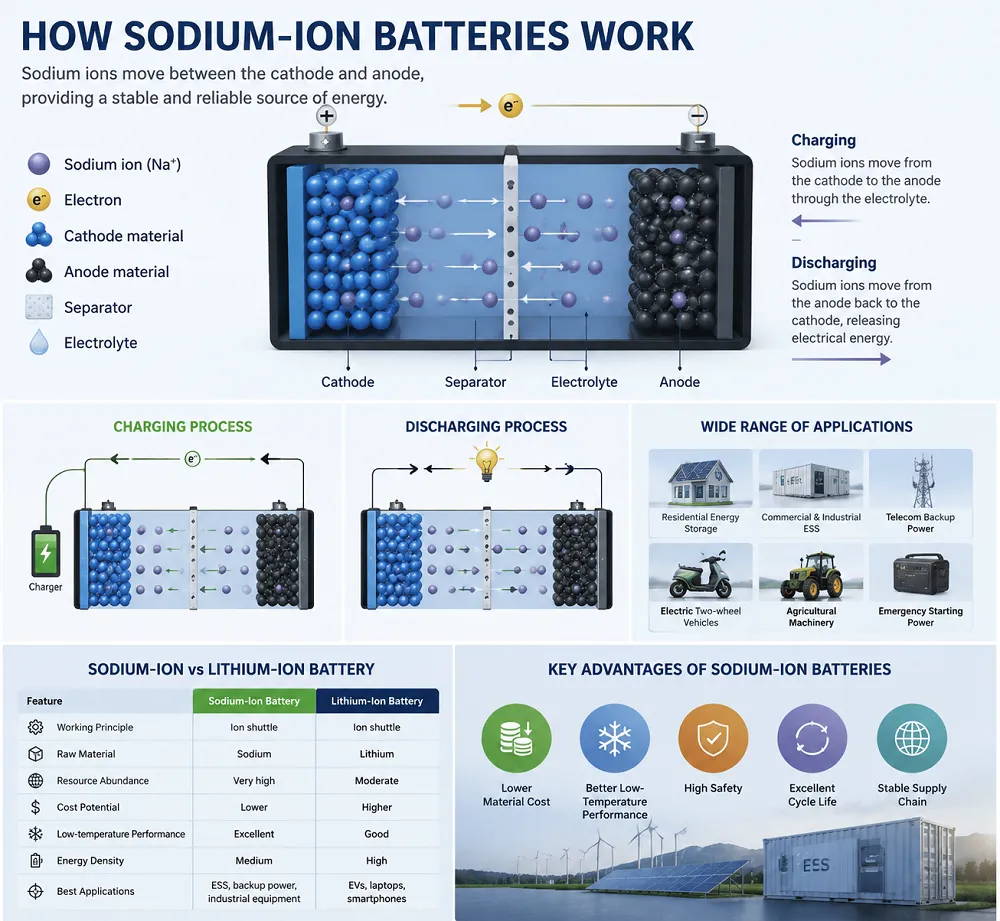
During charging and discharging, sodium ions shuttle back and forth between the cathode and anode while electrons travel through the external circuit, supplying power to connected devices. This electrochemical mechanism has been extensively studied and forms the basis of modern sodium-ion battery technology.
The Basic Structure of a Sodium-Ion Battery 🧩
Understanding each component makes the working principle much easier.
| Component | Function |
|---|---|
| Cathode | Stores and releases sodium ions |
| Anode | Receives sodium ions during charging |
| Electrolyte | Allows sodium ions to move between electrodes |
| Separator | Prevents short circuits while allowing ion transport |
| Current Collectors | Transfer electrons through the circuit |
Most commercial sodium-ion batteries currently use combinations such as:
- Layered oxide cathodes
- Prussian Blue analog cathodes
- NASICON-type cathodes
- Hard carbon anodes
Researchers continue improving these materials to increase energy density, charging speed, and cycle life.
How Does a Sodium-Ion Battery Work? ⚡
Step 1: Charging
When an external charger supplies electricity:
➡️ Sodium ions leave the cathode.
➡️ They travel through the electrolyte.
➡️ They are stored inside the hard carbon anode.
Meanwhile, electrons travel through the charging circuit to balance the charge.
Simple process
Cathode → Sodium ions → Electrolyte → Anode
Electrons travel through the external circuit.
Step 2: Discharging
When the battery powers equipment:
➡️ Sodium ions move back to the cathode.
➡️ Electrons flow through the external circuit.
➡️ Electrical energy powers the connected device.
This continuous movement of ions creates rechargeable energy storage.
Discharge process
Anode → Sodium ions → Electrolyte → Cathode
Electrons → External load → Electrical power
Why Can Sodium Replace Lithium? 🌍
Both lithium and sodium belong to the alkali metal family.
Their chemical properties are similar:
- Both easily lose one electron.
- Both transport positively charged ions.
- Both support reversible electrochemical reactions.
The biggest difference is resource availability.
| Property | Sodium | Lithium |
| Natural abundance | Very high | Relatively limited |
| Geographic distribution | Widely distributed | Concentrated in several regions |
| Raw material cost | Lower | Higher |
| Supply risk | Lower | Higher |
Because sodium resources are abundant worldwide, many energy experts believe sodium-ion batteries can reduce dependence on critical mineral supply chains, especially for stationary energy storage.
Key Advantages of Sodium-Ion Batteries ✅
1. Lower Material Cost
Sodium is abundant and inexpensive compared with lithium, making long-term production more economical.
2. Better Low-Temperature Performance ❄️
Many sodium-ion batteries maintain stable performance under cold conditions where some lithium batteries experience noticeable capacity loss.
This makes them attractive for:
- Outdoor equipment
- Cold-climate energy storage
- Commercial vehicles
- Backup power systems
3. High Safety 🔥
Sodium-ion batteries generally demonstrate good thermal stability.
Many commercial products have passed penetration and transportation safety testing, reducing fire risks during storage and logistics.
4. Excellent Cycle Life 🔄
Modern sodium-ion batteries can support thousands of charge-discharge cycles depending on chemistry and application.
5. Stable Supply Chain 🌎
Sodium resources are globally available, helping manufacturers diversify raw material sourcing.
Current Limitations of Sodium-Ion Batteries
Despite rapid progress, sodium-ion batteries still face several technical challenges.
Lower Energy Density
Lithium-ion batteries generally store more energy per kilogram.
This makes lithium preferable for:
- Premium electric vehicles
- Smartphones
- Lightweight consumer electronics
Larger Ion Size
Sodium ions are physically larger than lithium ions.
This affects:
- Electrode design
- Material expansion
- Energy density optimization
Researchers continue developing new cathode and anode materials to improve performance.
Sodium-Ion Battery vs Lithium-Ion Battery
| Feature | Sodium-Ion | Lithium-Ion |
| Working principle | Ion shuttle | Ion shuttle |
| Raw materials | Sodium | Lithium |
| Resource abundance | Very high | Moderate |
| Cost potential | Lower | Higher |
| Low-temperature performance | Excellent | Good |
| Energy density | Medium | High |
| Safety | High | High (depends on chemistry) |
| Best applications | ESS, backup power, industrial equipment | EVs, laptops, smartphones |
Where Are Sodium-Ion Batteries Used? 🏭
Commercial adoption is accelerating in several industries.
Typical applications include:
- Residential energy storage
- Commercial energy storage systems
- Telecom backup power
- Industrial ESS
- Motorcycle starting batteries
- Agricultural machinery
- Commercial vehicle auxiliary batteries
- Electric two-wheel vehicles
- Emergency starting power supplies
Manufacturers are also developing sodium-ion solutions for microgrids and renewable energy integration, where cost, safety, and long cycle life are priorities.
Choosing a Reliable Sodium Battery Manufacturing Partner
For OEM buyers, battery performance depends not only on chemistry but also on manufacturing capability.
When evaluating suppliers, consider:
- In-house cell manufacturing
- Engineering support
- Quality certifications
- Production capacity
- OEM/ODM experience
- Battery testing capability
- Export experience
Veken is a professional battery manufacturer with dedicated sodium-ion battery production capabilities. According to publicly available company information, it provides:
- In-house sodium battery manufacturing
- OEM & ODM services
- Multiple production bases
- Engineering support
- International certifications including ISO9001, UN38.3 and MSDS
- Battery solutions for energy storage, starting power and industrial applications
- Experience serving customers in more than 30 countries
Learn more:
- Home: https://vekenindustry.com/
- About Veken: https://vekenindustry.com/about/
- Sodium Battery Solutions: https://vekenindustry.com/sodium-battery/
- Battery Products: https://vekenindustry.com/battery/
- Contact: https://vekenindustry.com/contact-us/
Frequently Asked Questions (FAQ)
Are sodium-ion batteries rechargeable?
Yes. Like lithium-ion batteries, sodium-ion batteries are rechargeable through reversible electrochemical reactions.
Do sodium batteries use lithium?
No. Sodium-ion batteries primarily rely on sodium ions for energy storage, although some material systems may include other metals within electrode compounds.
Are sodium-ion batteries safer?
Many sodium-ion chemistries exhibit excellent thermal stability and have demonstrated strong safety performance in standardized testing, making them well suited for stationary energy storage and industrial applications.
Will sodium-ion batteries replace lithium-ion batteries?
Not completely. These technologies are expected to complement each other. Lithium-ion batteries remain advantageous where maximum energy density is required, while sodium-ion batteries are increasingly suitable for cost-sensitive, safety-focused, and large-scale energy storage applications.