
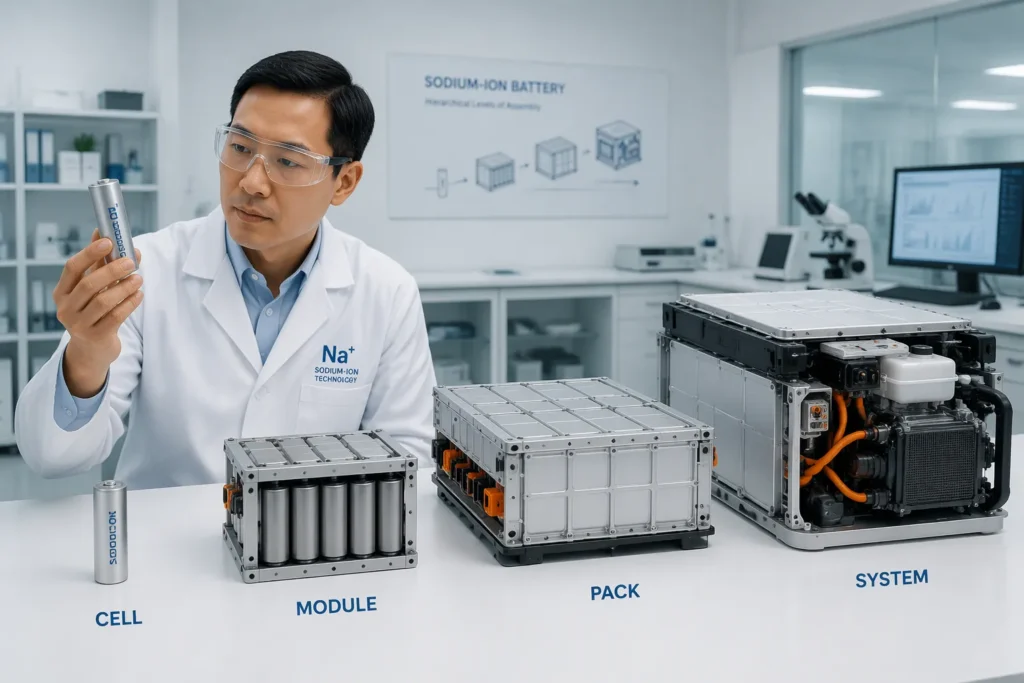
Pricing is structured for sodium-ion batteries across four levels: cell, module, pack and system. Each level adds its own cost components and margins. A cell price therefore differs sharply from an installed system price.
This breakdown examines the cost drivers at each tier. It traces how prices scale from cell to system. It also compares the structure with other battery technologies. Readers gain a clear view of where sodium-ion costs arise and how to read a quotation with confidence.
Key Takeaways
Sodium-ion battery prices differ across four levels: cell, module, pack, and system.
Each level adds extra costs and profits, so a cell price is much lower than a system price.
Always compare prices at the same level to avoid mistakes.
Ask suppliers to state the level, currency, and what is included in each quote.
Sodium-ion batteries compete best on total installed cost, not just cell price.
How Pricing Is Structured for Sodium-Ion Batteries
The Four-Level Cost Chain
Pricing is structured for sodium-ion batteries as a chain of four tiers. The chain runs from the battery cell, through module assembly, to the pack, and finally to the installed system. Each tier performs different work. Each tier therefore carries its own cost components and its own margin.
A battery cell contains electrodes, electrolyte, separator and casing. Module assembly adds interconnects, sensing and housing. The pack adds thermal management, safety engineering and enclosure design. The system adds inverters, controls, installation and commissioning. Sodium-ion battery manufacturing spreads these tasks across separate facilities and separate suppliers. Margins stack at every handover.
Why Level Labelling Matters
Buyers must label four prices separately. These are cell manufacturing cost, cell selling price, pack price and installed-system tender price. Mixing these figures distorts any comparison of sodium-ion economics. A low cell figure can hide integration overheads. A high system figure can hide an efficient pack design.
The cell level covers materials and cell production only. It excludes module, pack and system integration. A cell price is therefore not directly comparable with an installed system price. Analysts who compare the two make an error of scope.
Sodium-ion batteries compete on total delivered cost, not on cell price alone. Clear labelling lets a buyer trace where cost arises. It also lets a buyer compare sodium-ion cells with lithium alternatives on equal terms. Every quotation should state its level, its currency and its basis.
Cell Costs for Sodium-Ion Batteries
Material and Manufacturing Components
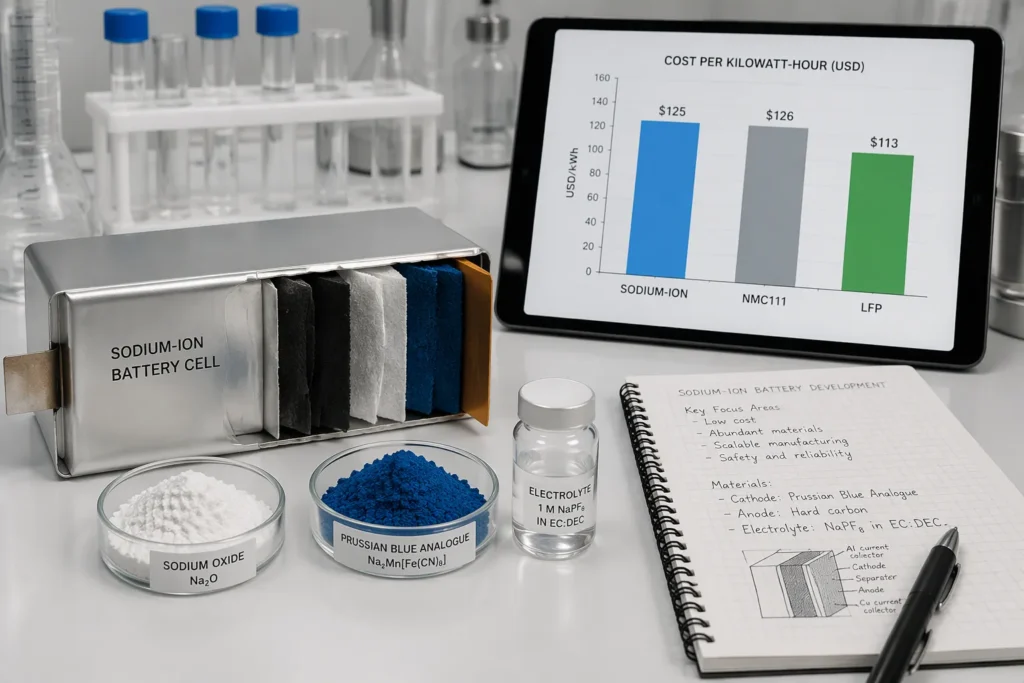
A sodium-ion cell draws its cost from four main areas. These are electrode active materials, electrolyte and separator, casing and current collectors, and the manufacturing process itself. Cell material cost centres on sodium compounds rather than lithium compounds. Sodium oxide and Prussian blue analogue (PBA) chemistries dominate early commercial designs.
A 2023 bottom-up analysis priced sodium oxide and sodium PBA cells at around $125/kWh. The same study put NMC111 at $126/kWh and LFP at $113/kWh, all in 2019 US dollars. These figures sit close together. The cell level therefore offers no dramatic advantage on paper at that point in time.
Manufacturing adds conversion steps, drying energy, formation cycling and yield losses. Sodium-ion battery manufacturing can reuse much of the equipment and process knowledge built for lithium lines. This overlap supports sodium-ion battery manufacturing scale-up without a wholly new factory template.
A 2025 study reports a range of $54–$62/kWh at cell level. This figure is indicative only. It reflects optimistic assumptions on scale and material pricing. Readers should treat it as a forward-looking benchmark, not a current market price.
Input-Cost Stability Versus Lithium
Input-cost stability separates sodium-ion from lithium chemistry. Sodium carbonate trades at about $300 per ton. Lithium carbonate has ranged from $13,000 to over $80,000 per ton in recent years. This gap lowers input-cost uncertainty for sodium-ion batteries.
Stable material cost helps sodium-ion battery manufacturing plan long production runs. Buyers gain more predictable pricing across contract terms. Sodium-ion cells also avoid cobalt and nickel, which removes another volatile line from the bill of materials.
The advantage is not absolute. Sodium-ion cells carry lower energy density in many designs. A lower cost per kilowatt-hour at the battery cell does not automatically translate into a cheaper installed pack. Sodium-ion battery manufacturing must still prove yield and consistency at volume.
Analysts should compare sodium-ion cells with lithium alternatives on a like-for-like basis. The cell material cost gap is real. The total system economics depend on factors beyond the cell.
For further reading, the IEA’s battery cost tracking and peer-reviewed bottom-up cost studies provide transparent methodology.
Module and Pack: Manufacturing and Pack Integration
From Cells to Modules
Module and pack assembly begins with the battery cell. A module groups several sodium-ion cells into one mechanical unit. The module level adds four cost elements: interconnects that carry current between cells, sensing wiring that reports voltage and temperature, a housing that holds the unit, and the labour to assemble it. Each element adds cost beyond the bare cell price.
Sodium-ion cells tolerate low-temperature operation well, which can simplify sensing requirements in some designs. Sodium-ion battery manufacturing still needs careful weld quality and torque control at this stage. A weak interconnect raises resistance and wastes energy. Module and pack assembly therefore rewards automation and repeatable process control.
What the Pack Adds
Pack integration adds roughly $40–$80/kWh on top of cell costs. The exact figure depends on thermal management needs. Air-cooled packs sit near the lower end. Liquid-cooled packs with tight temperature control sit near the upper end. The pack also carries the enclosure, the battery management system and the safety devices.
Sodium-ion batteries need less thermal protection in cold climates than some lithium options. This trait can trim pack cost in certain stationary applications. Lithium iron phosphate remains a strong fit for high-cycle stationary storage. Sodium-ion batteries suit cost-sensitive projects with wide temperature swings. Each technology has a natural home, and neither wins everywhere.
Sodium-ion battery manufacturing at the pack stage mirrors lithium practice closely. Shared enclosure designs and shared connectors reduce tooling cost. Buyers should request a pack price that states its cooling method and its included electronics. This detail keeps the cost comparison honest.
Pack-Level Pricing Drivers
Thermal and Safety Overheads
Thermal management is a major driver of pack cost. A sodium-ion pack needs cooling or heating hardware to hold cells within a safe window. Air cooling suits mild climates and low-power duty. Liquid cooling adds pumps, coolant lines and a heat exchanger. Each part raises the pack price.
Safety engineering adds further overhead. The pack needs fuses, contactors, a battery management system and venting. Enclosure design adds sealing, structural strength and fire resistance. These items protect the battery pack in real service. They also lift the pack above the bare cell price.
Sodium-ion batteries have nearly matched LFP costs at roughly $70–$100/kWh. LFP sits at $70–$80/kWh. CATL expects full cost parity by the end of 2026. Sodium-ion battery manufacturing at this stage still carries early-scale overheads. Volume growth will spread those overheads across more units.
Volume and Design Effects
Production volume shapes the pack price strongly. Low-volume runs spread tooling and setup cost over few units. High-volume lines amortise the same cost across many packs. Sodium-ion battery manufacturing benefits from shared enclosure designs and standard connectors. These choices cut tooling cost for cost-effective battery packs.
Design choices also matter. A simple pack with fewer parts costs less to build and test. A complex pack with tight thermal control costs more. Buyers should treat pack price as distinct from cell selling price and from installed system cost. The pack sits between the two. It carries integration work that cells do not.
Sodium-ion cells tolerate cold well, which can trim thermal hardware in some projects. That trait supports cost-effective battery packs for wide-temperature sites. Buyers should request a pack quote that names its cooling method and included electronics. This step keeps the cost comparison fair across battery packs.
System-Level Costs for Sodium-Ion Batteries
Beyond the Pack: Balance of Plant
System-level pricing adds balance-of-plant items on top of the battery pack. These items include inverters, controls, cabling, protection gear, installation and commissioning. Each item carries its own supplier margin. The system tier therefore holds the widest spread of cost components in the whole chain.
A 2025 benchmark places sodium-ion batteries at around €120/kWh capacity at system level. Projections suggest a fall to roughly €28.5–51.9/kWh capacity by 2050. These figures cover the full installed system, not the pack alone. Sodium-ion battery manufacturing scale and falling inverter prices both support that trajectory.
Installation and commissioning vary widely by site. A containerised unit on prepared ground needs less civil work than a retrofit into an existing plant room. Buyers should request a system quote that separates hardware, labour and grid-connection fees.
Comparing System Pricing Across Technologies
System-level structure looks similar across chemistries. Every option pairs cells with inverters, controls and installation labour. The differences sit in the ratio between pack and balance-of-plant spend. Sodium-ion batteries suit sites where wide temperature tolerance trims thermal hardware. Lithium iron phosphate fits high-cycle duty with a mature supply base. Flow systems fit long-duration duty with a different capital cost profile.
Public benchmarks help buyers test a quotation. The IEA tracks storage cost trends, and NREL publishes balance-of-plant data for stationary systems. Lazard’s levelised storage analysis offers a further cross-check. A buyer can compare a sodium-ion quote against these sources at the same level.
Sodium-ion battery manufacturing maturity will shape future system prices. Early projects carry higher integration overheads. Volume growth spreads those overheads across more systems. Sodium-ion batteries therefore compete best where total delivered cost matters more than cell-level headline figures.
How Costs Accumulate from Cell to System
Margin Stacking and Scaling
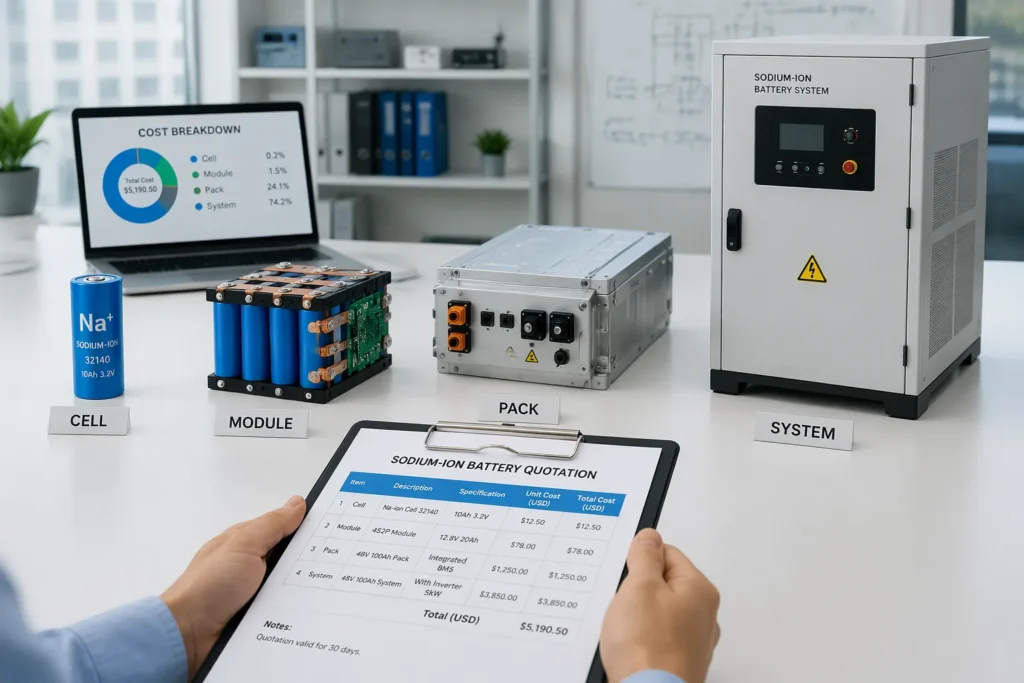
Each tier in the chain adds its own margin. The battery cell maker earns a margin on materials and conversion. The module builder earns a margin on assembly. The pack integrator earns a margin on enclosure, thermal hardware and electronics. The system integrator earns a margin on inverters, controls and commissioning. Margins therefore stack at every handover.
Scaling works in the opposite direction. Volume at the cell level spreads material and conversion cost across more units. Volume at the module level spreads tooling and setup cost. Volume at the pack level spreads enclosure and testing cost. Sodium-ion battery manufacturing gains most from scale at the cell and pack stages, where fixed cost is heaviest.
A worked example shows the effect. A cell priced at the low end of the 2025 range of $54–$62/kWh carries no pack hardware. Add the $40–$80/kWh pack adder and the figure roughly doubles. Add balance of plant and the system figure rises again. The cell level therefore understates the delivered cost by a wide margin.
Reading a Quotation Level by Level
A buyer should read every sodium-ion quotation in four steps. First, confirm the stated level: cell, module, pack or system. Second, confirm the currency and the base year, since older studies quote 2019 US dollars. Third, confirm what the price includes, such as cooling method, electronics or installation. Fourth, request like-for-like labelling from every bidder.
This discipline matters because pricing is structured for sodium-ion batteries across tiers that are not interchangeable. A supplier who quotes a cell figure invites an unfair comparison with a rival’s installed system price. A buyer who accepts that comparison misreads the cost.
The module level deserves particular attention. Modules carry interconnects and sensing that cells do not. A quotation that omits module cost hides real spend.
A cell-level comparison alone does not settle the storage economics of sodium-ion batteries. The trade-off of lifetime, power and cost plays out at the pack and system tiers. Sodium-ion cells may look close to lithium iron phosphate at the cell level. The battery pack comparison at $70–$100/kWh against $70–$80/kWh tells a different story. From a commercial and cost perspective, buyers should judge sodium-ion batteries on the installed system figure. That figure reflects every margin, every module and every pack in the chain. Sodium-ion systems compete on that basis, and so do the alternatives. Sodium-ion cells, modules, packs and systems each tell part of the story. Only the full chain settles the case.
Cost components and margins accumulate across four levels. Cell costs stay material-dominated. Module and pack stages add hardware and assembly. System costs carry the heaviest integration load. Pricing is structured for sodium-ion batteries in this same chain, and each tier adds its own margin.
Decision-makers should scrutinise the level that matches the comparison at hand. A cell figure suits material benchmarking. A battery pack figure suits hardware review. Sodium-ion batteries compete on installed cost, so buyers should request like-for-like labelling from every bidder. Sodium-ion fits cost-sensitive sites with wide temperature swings. Sodium-ion cells, packs and the full system each serve distinct roles, and sodium-ion pricing reflects that structure.
FAQ
Which price level should a buyer compare first?
The buyer should fix the level before comparing any figure. A cell price covers materials and cell production only. An installed system price covers every tier above it. Sodium-ion quotations become meaningful only when both sides state the same level, currency and base year.
Why does a cell figure understate the delivered cost?
The cell tier excludes module assembly, pack hardware and balance of plant. Pack integration alone adds roughly $40–$80/kWh on top of cell costs. A cell benchmark near $54–$62/kWh therefore sits far below the installed figure. Sodium-ion cells carry none of that integration work.
How close is sodium-ion to lithium iron phosphate on price?
Pack-level figures sit close together. Sodium-ion batteries have nearly matched LFP at roughly $70–$100/kWh against $70–$80/kWh. CATL expects full cost parity by the end of 2026. Sodium-ion battery manufacturing scale will shape how quickly that gap closes.
What drives the gap between pack price and system price?
Balance-of-plant items drive the gap. Inverters, controls, cabling, installation and commissioning all sit above the pack. A 2025 benchmark places sodium-ion at around €120/kWh capacity at system level. Site conditions move that figure considerably.
Where does sodium-ion fit best on cost?
Sodium-ion suits cost-sensitive sites with wide temperature swings. Stable sodium carbonate pricing near $300 per ton lowers input-cost uncertainty. Lithium iron phosphate remains strong for high-cycle duty. Each option fits a different duty, and the installed cost settles the choice.