
Choosing a sodium battery supplier or a lithium battery supplier depends on what you need for your project. People care about things like how well batteries work, how much they cost, if they are safe, and how they affect the environment. Some people use batteries for electric vehicles. Others use them for grid storage or at home. Sodium batteries have a small market share, but it is growing. Think about what you need, then use the guide to help you choose the best one.
- How well batteries work, price, safety, and the environment all matter when picking the best battery.
- Sodium batteries are very safe, last a long time, and are better for the environment.
Key Takeaways
- Think about what your project needs before picking sodium or lithium batteries. Things like how well they work, how much they cost, how safe they are, and how they affect the environment are important.
- Sodium-ion batteries are safer and better for the environment. They can handle heat well and make less bad gas.
- Lithium-ion batteries can hold more energy. They work best in small gadgets and electric cars. People use them a lot because they have high energy density.
- Sodium-ion batteries cost less to make. They last longer in things like grid storage and factories. They are a smart pick for big energy projects.
- Always look at supplier certifications and how much they can make. This helps you pick a good supplier who fits your needs.
Sodium-Ion vs Lithium-Ion Battery Comparison
Key Differences Overview
People want to know how sodium-ion and lithium-ion batteries are different. Both types store energy with ions, but the ions are not the same. Sodium-ion batteries use sodium ions. Lithium-ion batteries use lithium ions. These ions have different sizes and weights. This changes how the batteries work.
Sodium-ion batteries have bigger ions. These ions move slower inside the battery. Lithium-ion batteries have smaller ions. They move faster when charging and discharging.
Here is a simple look at the main differences:
- Lithium-ion batteries use small, light Li+ ions. These ions move fast when charging and discharging.
- Sodium-ion batteries use big, heavy Na+ ions. They can charge fast but may lose power faster.
| Feature | Sodium-Ion Batteries | Lithium-Ion Batteries |
|---|---|---|
| Molar Mass | 23 g mol−1 | 6.9 g mol−1 |
| Ionic Radius | 1.02 Å | 0.76 Å |
| Cathode Materials | Oxides, polyanions, Prussian blue analogs | Various lithium-based compounds |
| Charge Carrier Size | Larger (116 picometers) | Smaller (90 picometers) |
| Electrolytes | Sodium salts in organic solvents | Lithium salts in organic solvents |
| Production Processes | Similar to lithium-ion | Similar to sodium-ion |
Sodium-ion batteries use different cathode materials like oxides and Prussian blue analogs. Lithium-ion batteries use lithium-based compounds. Both batteries are made in similar ways, but the materials are not the same.
Performance and Cost Factors
Battery performance is important to everyone. People want batteries that last long, charge fast, and do not cost too much. Sodium-ion and lithium-ion batteries have different strengths for performance, cycle life, and cost.
| Battery Type | Energy Density (Wh/kg) | Cycle Life | Best Applications |
|---|---|---|---|
| Lithium High-Energy | 250-295 | 500-1,000 | Portable devices, EVs |
| Lithium Power | 200-240 | 600-1,000 | Power tools, performance apps |
| Sodium Energy | 100-120 | 3,000-10,000 | Grid storage, backup power |
| Sodium Power | 90-100 | 3,000+ | Heavy equipment, industrial |
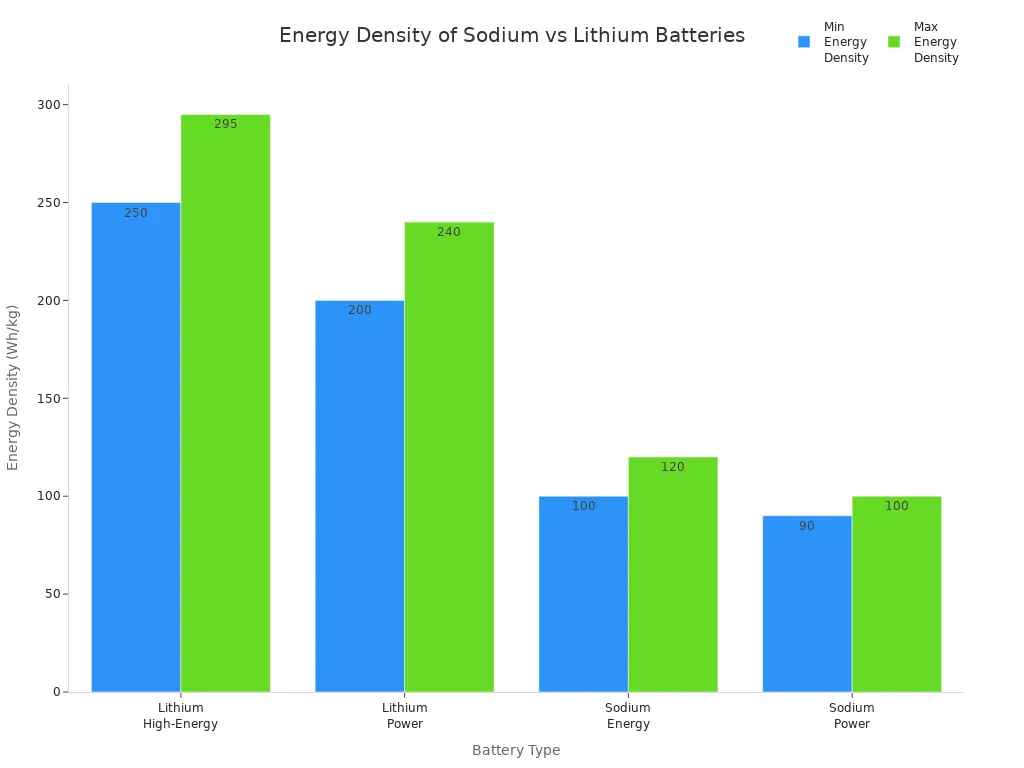
Sodium-ion batteries store less energy for their size and weight. Lithium-ion batteries can store more energy, up to 300 Wh/kg. This makes them better for electric vehicles and small devices. Sodium-ion batteries usually store 90 to 150 Wh/kg. They are best for grid storage and backup power.
Cycle life is also important. Sodium-ion batteries can last up to 10,000 cycles. Some lithium-ion batteries can last that long, but most last 5,000 to 8,000 cycles.
Cost matters too. Sodium-ion batteries are cheaper to make. They cost $54 to $62 per kilowatt-hour. Lithium-ion batteries cost more because they use expensive materials. These include lithium, cobalt, and nickel. Cheaper sodium-ion batteries are good for big energy storage projects.
Tip: If you need batteries for grid storage or heavy machines, sodium-ion batteries are a better deal and last longer. For small devices and electric cars, lithium-ion batteries work better.
Safety and Environmental Impact
Safety is very important for battery users. Sodium-ion and lithium-ion batteries have different safety levels. Sodium-ion batteries can handle more heat before problems happen. This means they are less likely to catch fire. Lithium-ion batteries can get hot fast and may catch fire or explode if damaged.
| Safety Aspect | Lithium-Ion Battery | Sodium-Ion Battery |
|---|---|---|
| Thermal runaway temperature | Lower | Higher (292 °C) |
| Thermal runaway speed | Faster | Slower |
| Gas production | More harmful gases | Fewer harmful gases |
Sodium-ion batteries make fewer harmful gases if they fail. They usually smoke instead of burning. This makes them safer to move and store. VEKEN sodium batteries passed tough safety tests, like nail penetration, without fire or explosion.
The environment is also important. Sodium-ion batteries are better for the earth. They use materials that are easy to find and process. Lithium-ion batteries need mining for lithium, cobalt, and nickel. Mining can hurt the land and water. Getting lithium uses a lot of water and can pollute the soil. Sodium-ion batteries avoid these problems and help the planet.
- Sodium-ion batteries are better for the environment when made.
- Lithium-ion batteries can pollute soil and water from mining.
- Sodium-ion batteries do not use heavy metals like lead or cobalt.
Note: Picking sodium-ion batteries helps the planet and makes recycling easier. They are safer to use and better for the environment.
People want to know the good and bad things about sodium and lithium batteries. Sodium-ion batteries are safer, cost less, and last longer, but store less energy. Lithium-ion batteries work better for small devices and electric cars, but cost more and can hurt the environment.
Application Suitability
EV Applications
Electric cars need batteries that last a long time. They also need to hold a lot of energy. People want cars that drive far on one charge. They want cars that work well for many years. Most cars use lithium-ion batteries. These batteries store more energy and weigh less. This helps cars go farther and charge faster.
| Feature | Sodium-Ion Battery | Lithium-Ion Battery |
|---|---|---|
| Energy Density | 100-150 Wh/kg | 150-250 Wh/kg |
| Cost | Lower | Higher |
| Temperature Stability | Excellent | Sensitive to heat/cold |
| Cycle Life | Comparable | Good |
| Commercial Use | Emerging | Mature |
Sodium-ion batteries work well in cold places. They keep most of their power at -20°C. Lithium-ion batteries lose more power in the cold. This makes sodium-ion batteries good for cold weather cars. But lithium-ion batteries still store more energy. They are used in most electric cars.
🚗 Tip: Lithium-ion battery suppliers are best for most electric cars. In cold places, sodium battery suppliers like VEKEN are a good choice.
Grid Storage and Renewable Energy
Grid storage needs batteries that last long and cost less. These batteries store energy from solar panels and wind turbines. They give out energy when people need it. Sodium-ion batteries are great for these jobs.
- Sodium is cheap and easy to find, so sodium-ion batteries cost less.
- They are safer because they handle heat better.
- Sodium-ion batteries help the environment more.
- They have enough energy and last long for storage.
- Factories can use old lithium-ion lines to make sodium-ion batteries.
Sodium battery suppliers like VEKEN are leaders in grid storage. Their batteries work well for big energy systems and backup power.
🌞 Note: As lithium gets more expensive, sodium-ion batteries save money. VEKEN sodium battery supplier gives good storage for solar and wind projects.
Consumer Electronics
Phones, laptops, and tablets need small and light batteries. These batteries must be strong and last long. Lithium-ion batteries are used most in these devices. They have high energy and last a long time.
| Limitation | Sodium-Ion Batteries | Lithium-Ion Batteries |
|---|---|---|
| Energy Density | About 30% lower than lithium-ion | Higher energy density |
| Cycle Life | Shorter cycle life | Longer cycle life |
| Development Stage | Still in developmental phase | Mature and widely adopted |
Sodium-ion batteries do not store as much energy. They do not last as long in phones and laptops. The technology is still new. Most suppliers use lithium-ion batteries for these devices.
📱 For phones and laptops, lithium-ion battery suppliers are the best. Sodium battery suppliers may be better in the future as they improve.
Industrial and Home Energy Storage
Factories and homes need batteries that last long and work in all weather. These batteries should cost less. People use them to store energy for farms, factories, and houses. Sodium-ion batteries do well in these places.
| Feature | Sodium-Ion Batteries | Lithium-Ion Batteries |
|---|---|---|
| Charge/Discharge Cycles | 2,000 to 4,000 cycles | 1,000 to 5,000 cycles |
| Temperature Tolerance | Excels in cold temperatures | Capacity loss in cold |
| Self-Discharge Rate | Slow self-discharge | Varies by chemistry |
| Cost and Material Abundance | More abundant and cheaper | Less abundant and more costly |
| Environmental Impact | Lower impact | Higher impact |
| Suitability for Applications | Grid-scale, microgrids | General use, portable devices |
Sodium-ion batteries cost less than lithium-ion batteries. Sodium is cheap and easy to find. They use aluminum, which lowers costs. VEKEN sodium battery supplier makes batteries for homes and factories. Their batteries work well in cold weather and lose power slowly. This makes them good for long-term storage.
🏠 Sodium-ion batteries are great for home and factory storage. VEKEN gives safe and reliable batteries for these uses.
Opportunities for Each Application
- Electric cars: Lithium-ion battery suppliers are best, but sodium battery suppliers are good for cold places.
- Grid storage and renewable energy: Sodium battery suppliers like VEKEN give safe and cheap storage.
- Consumer electronics: Lithium-ion battery suppliers are best because their batteries last longer and store more energy.
- Industrial and home energy storage: Sodium battery suppliers give reliable, cheap, and green storage.
🔎 Pick the battery type that fits your needs. VEKEN sodium battery supplier is great for grid, factory, and home storage.
Learn more about VEKEN sodium battery solutions for energy storage systems
Supplier Landscape
Leading Sodium Battery Suppliers
The sodium battery market is growing quickly. Many sodium battery manufacturers want to make better batteries. They also want to make more batteries. Some companies make safe and cheap batteries for cars and power grids. Other companies make batteries for strong tools or big energy needs. Here are some top sodium battery manufacturers and what they do:
| Company Name | Country | Market Focus |
|---|---|---|
| Faradion | UK | Safe, low-cost sodium-ion chemistry for transportation and grid storage applications. |
| Contemporary Amperex Technology Co., Ltd. | China | High energy density cells and hybrid lithium-sodium battery systems leveraging production capabilities. |
| TIAMAT Energy | France | Fast-charging sodium-ion batteries for high-power applications like power tools and urban mobility. |
| HiNa Battery Technology Co., Ltd. | China | Commercial-scale deployment with a focus on stationary energy storage systems. |
| Jiangsu Zoolnasm Energy Technology Co., Ltd. | China | Cost-effective, large-scale production for utility-scale applications and industrial energy needs. |
These sodium battery manufacturers could grow a lot in the future. Their market share is getting bigger. More companies want safer and cheaper energy.
Leading Lithium-Ion Battery Suppliers
Lithium battery manufacturers are leaders in the world battery market. CATL makes batteries that store lots of energy and last a long time. BYD uses Blade Battery technology for better safety and space. CALB makes high-voltage batteries with strong energy. Gotion High-Tech makes Lithium Iron Phosphate batteries for safety and saving money. EVE Energy makes many types of batteries, including big round cells. These lithium battery manufacturers have a large market share. They can make many batteries. Their new ideas help the battery market grow.
VEKEN Sodium Battery Supplier Strengths
VEKEN is a sodium battery supplier with lots of experience. They use advanced technology. The company spends money on research and development. They have a National-Level Academician Research Center to make better sodium-ion batteries. VEKEN uses smart machines and robots to make batteries safe and good. Here are some things that make VEKEN special:
- Advanced technology helps batteries charge and discharge better.
- Flexible designs work for many uses.
- Many safety features keep batteries safe.
- Batteries work well in very hot or cold places.
- They fit with many brands and systems.
- Sodium-based materials are good for the environment.
VEKEN sodium battery supplier makes strong and long-lasting batteries. Their ways of making batteries and their experience help them meet customer needs. Many companies trust VEKEN for safe, reliable, and green energy.
Decision Guide
Checklist for Choosing
It can be hard to pick the right sodium battery supplier or lithium-ion battery supplier. A checklist can help you find the best one for your needs. Here are some important things to check:
| Certification | Why It Matters |
|---|---|
| ISO 9001 | Shows the company makes good products every time |
| ISO 14001 | Means the company cares about the environment |
| UN38.3 | Lets batteries travel safely around the world |
| MSDS | Helps keep shipping and handling safe |
| CE / RoHS | Needed to sell in Europe |
| CB Certification | Proves the battery meets IEC rules |
You should also look at other things:
- How many cells the company can make each day or month
- How much of the work is done by machines
- How many lines they have for coating and putting batteries together
- If they can put battery packs together
- If they give a clear list of all parts (BOM)
- If they show all testing, packing, and shipping costs
📝 Tip: Always ask for proof of certifications and a full list of costs before you choose.
Flowchart for Supplier Selection
A flowchart can help you pick a supplier. Follow these steps:
- Decide what you need the battery for, like a car, home, or factory.
- Write down what matters most, like how well it works, price, safety, or the environment.
- See if the supplier has good experience and knows a lot.
- Check if they have good technology and help customers.
- Make sure they have the right safety papers and certifications.
- Look at all costs, not just the first price.
- Pick the supplier that fits your needs best.
🔍 Need more help? You can look at websites like Battery Directory or ask experts for help.
Common Mistakes
Many people make mistakes when picking a battery supplier. Here are some mistakes to watch out for:
| Mistake Type | Description |
|---|---|
| Underestimating Total Costs | Only looking at the first price and not thinking about setup or fixing costs |
| Ignoring Performance Trade-offs | Not thinking about how fast the battery charges or its voltage |
| Overlooking Support Infrastructure | Forgetting about training workers or getting the right tools |
To stop these mistakes:
- Check if the supplier has a good history and helps customers.
- Ask how the battery works in real life.
- Make sure they have safety features and the right papers.
⚡ Smart buyers look at everything, not just the price.
Picking the right battery supplier depends on what you need most. Case studies show sodium-ion batteries cost less and are better for the planet. Lithium-ion batteries are getting more expensive. Use the decision guide and tables to find what fits your needs. Think about how the battery works, price, safety, the environment, and if the supplier is trusted.
Experts say you should check both the technology and how much experience the supplier has before you choose.
Next steps for businesses:
- Figure out what you need the battery for.
- Look up suppliers and see if they have the right certifications.
- Check if their batteries are good, reliable, and if they help customers.
- Ask suppliers about prices and ways to work together.
You can read more articles and expert tips to help you pick a supplier.
FAQ
What are the main differences between sodium-ion and lithium-ion batteries?
Sodium-ion batteries use sodium ions. Lithium-ion batteries use lithium ions. Sodium-ion batteries cost less money. They work well in cold weather. Lithium-ion batteries store more energy. They power small things like phones.
Which battery type is safer for home energy storage?
Sodium-ion batteries are safer for homes. They handle heat better. They do not catch fire easily. Many people pick sodium battery suppliers for home and factory storage.
Can sodium-ion batteries replace lithium-ion batteries in electric vehicles?
Sodium-ion batteries work well in cold places. Lithium-ion batteries are used in most electric cars. They store more energy and weigh less.
How do I choose the best battery supplier for my project?
Look at certifications and how many batteries they make. Check if they help customers. Compare sodium battery suppliers and lithium battery suppliers. Pick the one that fits your needs.
Are sodium-ion batteries better for the environment?
Yes, sodium-ion batteries use easy-to-find materials. They are simple to recycle. They do not have heavy metals like cobalt or lead. This makes them better for the planet.